How Creativity Works
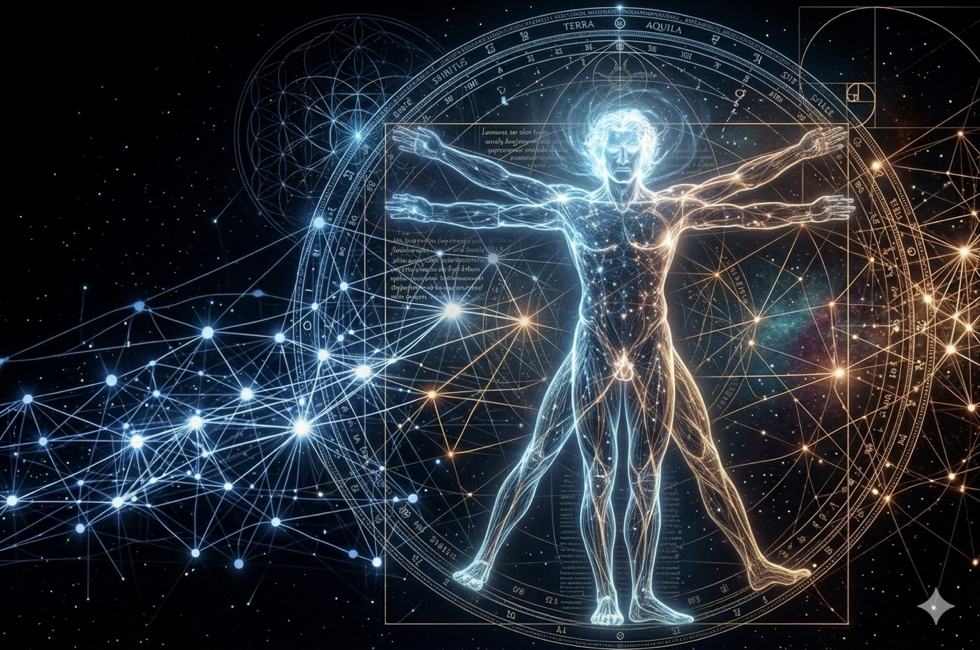
Every node lit. Every network firing. This is not what genius looks like from the outside. This is what it looks like from within.
RACER brand and Pfanner Advantage co-founder Bill Sparks is a Creative Operator — the person who makes creative endeavors actually happen, from concept through completion. His column, Cold Read, is a deep dive into the neuroscience of breakthrough thinking and why some people produce it consistently while others don't.
We've all been there: staring at a blank screen, a white canvas, or a stalled business strategy, waiting for the "muse" to gift us with a stroke of brilliance. We treat creativity like a fickle Greek deity that occasionally deigns to hurl us a lightning bolt of inspiration. If the bolt hits, we're geniuses; if it doesn't, we shrug and blame unseen supernatural forces.
But modern neuroscience has demolished these excuses.
As it turns out, creativity isn't a mystical "bolt from the blue." It is a highly coordinated neurological process—a mental heavy-lifting session in which multiple brain networks operate in a strange, paradoxical harmony. If you've ever wondered why your best ideas arrive in the shower, or why some people seem to breathe innovation while others struggle to generate a single original thought, the answer lies in the wiring of the human brain.
The Three-Headed Monster: Your Creative Networks
For decades, we were told that creativity was a "right-brain" activity. The theory was seductively simple: the left brain was the cold, calculating accountant, and the right brain was the wild-eyed artist. It's a compelling story. It is also completely unsupported by science.
Research—particularly the work of neuroscientist Roger Beaty—shows that creativity is a whole-brain sport. Instead of "sides," the relevant architecture is Large-Scale Brain Networks. Think of these as the Board of Directors for your consciousness.
1. The Default Mode Network (The Dreamer)
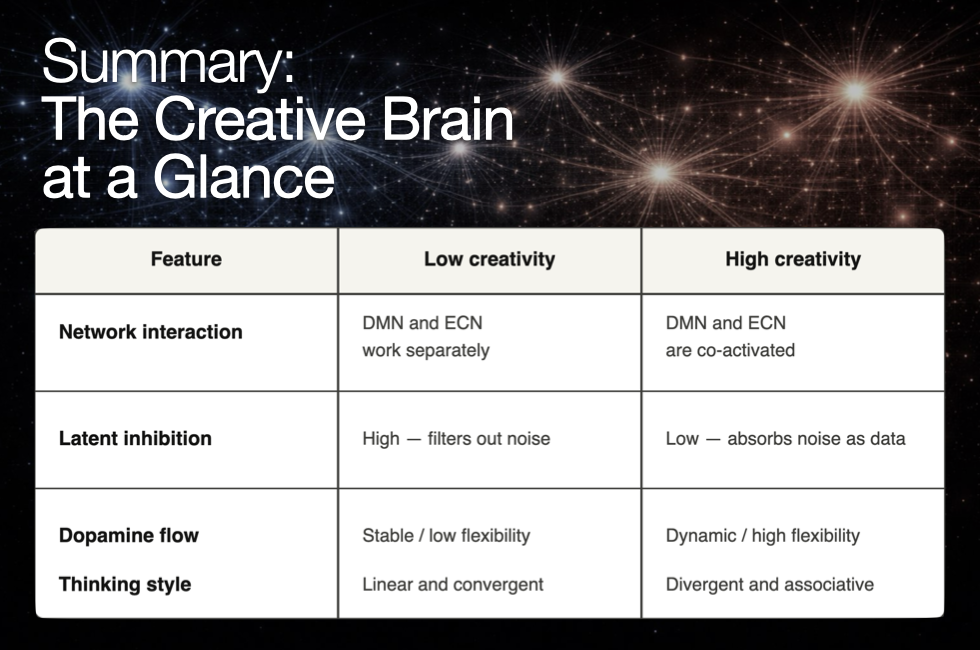
This is the network that activates when you aren't doing much of anything. When you're daydreaming, reminiscing about a trip to the coast, or imagining a future career move, your Default Mode Network (DMN) is at the wheel. It is the engine of imagination. Its job is divergent thinking—generating a chaotic, unfiltered stream of possibilities with no regard for logic, practicality, or social convention.
2. The Executive Control Network (The Editor)
If the DMN is the messy artist, the Executive Control Network (ECN) is the curator wielding a sharp red pen. This network handles focus, working memory, and evaluation. It is responsible for convergent thinking. Its job is to survey the DMN's wild output and say, "That's physically impossible," or, "That's actually brilliant—let's refine it."
3. The Salience Network (The Switchboard)
This is the unsung hero of creativity. The Salience Network acts as a traffic controller, constantly scanning both external stimuli and internal thoughts. It decides what is salient—what matters—and toggles the brain between the DMN and the ECN at precisely the right moments.
The secret sauce: In most brains, the Dreamer and the Editor simply don't talk to each other. When one is active, the other shuts off. However, research shows that in highly creative individuals, these two networks exhibit significantly higher functional connectivity. They are co-activated. A creative brain can dream and edit simultaneously—and that changes everything.
The Chemistry of "The Spark"
Creativity isn't just about wiring; it's about the chemicals coursing through that wiring. Specifically: dopamine.
We commonly think of dopamine as the "pleasure chemical," but a more accurate label is the motivation and salience chemical. When it comes to creativity, dopamine follows a U-shaped relationship:
The Flexibility Phase: High levels of dopamine in the nigrostriatal pathway are associated with cognitive flexibility—the ability to "break set." This is what lets you stop looking at a problem the way everyone else does and find a completely new angle.
The Persistence Phase: Moderate levels of dopamine in the mesocortical pathway help you stay focused long enough to actually finish the project.
Too much dopamine and you become a fountain of wild, disorganized thoughts—lots of sparks, no fire. Too little and you're rigid, stuck in a groove worn smooth by habit. The sweet spot—the Goldilocks Zone—is where original ideas are actually born.
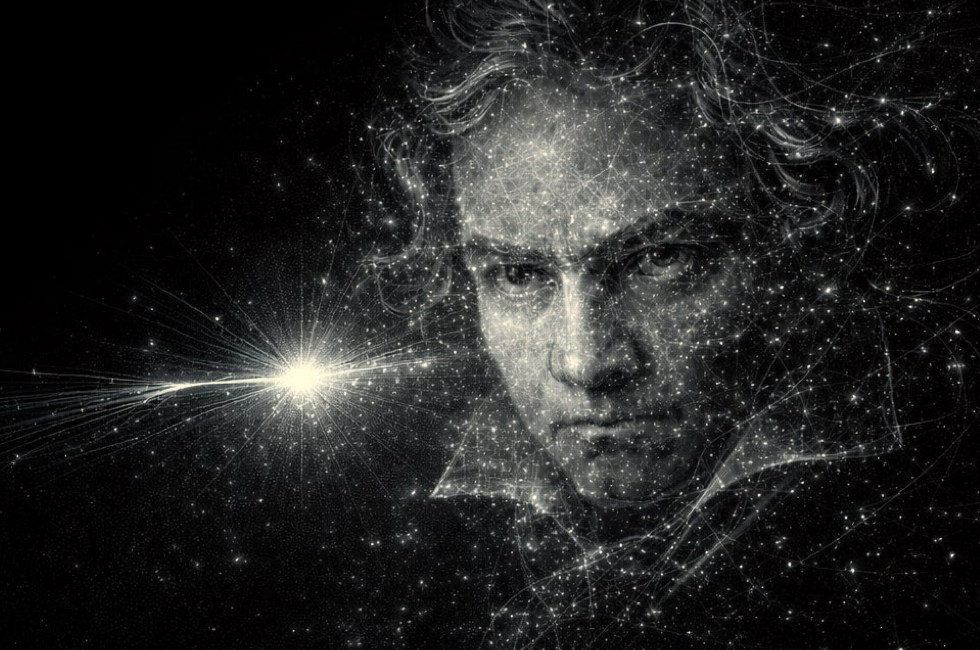
Beethoven’s Ninth Symphony was composed in total silence. Go back and read that sentence.
The "Brain Blink" and the Aha! Moment
Have you ever noticed that breakthrough insights almost never arrive while you're staring directly at the problem? They strike while you're walking the dog, washing dishes, or standing under a hot shower. There is a precise physiological reason for this: the Brain Blink.
Neuroscientists John Kounios and Mark Beeman discovered that just milliseconds before a sudden insight, the brain exhibits a spike in Alpha waves in the right visual cortex. This spike literally "blinks" the brain, temporarily shutting down incoming visual information.
Why? Because the brain needs to look inward to find a remote association. It has to go quiet before it can go deep.
Immediately after this Alpha blink, there is a sudden burst of high-frequency Gamma waves. This is the physical signature of the Aha! moment—the neural handshake between two previously unrelated ideas. You aren't just thinking of something new; your brain is physically forging a new connection. Innovation has a heartbeat.
Why Are Some People Just "More" Creative?
If we all share these networks and neurochemicals, why is there such a vast gulf between a weekend hobbyist and a visionary like Steve Jobs or Jeff Bezos? It comes down to three structural advantages—and all of them can be cultivated.
1. Low Latent Inhibition
Most people have a biological filter called Latent Inhibition: the brain's mechanism for dismissing "useless" information, like the hum of the air conditioner or the pattern on a stranger's shirt. Highly creative people often have low latent inhibition. Their filters are leaky. They absorb vastly more raw data from their environment than the average person. While this can be cognitively overwhelming, it also builds a massive library of raw material for the brain to draw from when constructing novel connections.
2. The Personality of Openness
Psychologically, the strongest single predictor of creativity is Openness to Experience. This isn't simply a willingness to try exotic food. It's a specific cognitive structure defined by curiosity, aesthetic sensitivity, and an active inner life. People high in Openness don't just tolerate unconventional ideas—their brains are physically more receptive to them.
3. The T-Shaped Intellect
Creativity thrives on associative architecture—the ability to pull threads from distant domains and weave them together. This is the core of the Medici Effect: the insight that true innovation happens at the intersection of different fields.
The Vertical Bar: Deep expertise in one discipline. You can't be a creative physicist if you don't understand physics.
The Horizontal Bar: Broad, curious exposure to many other fields—music, history, cooking, anthropology, AI.
The most creative people are T-shaped. They have the depth to execute and the breadth to import metaphors from worlds nobody else thought to visit.
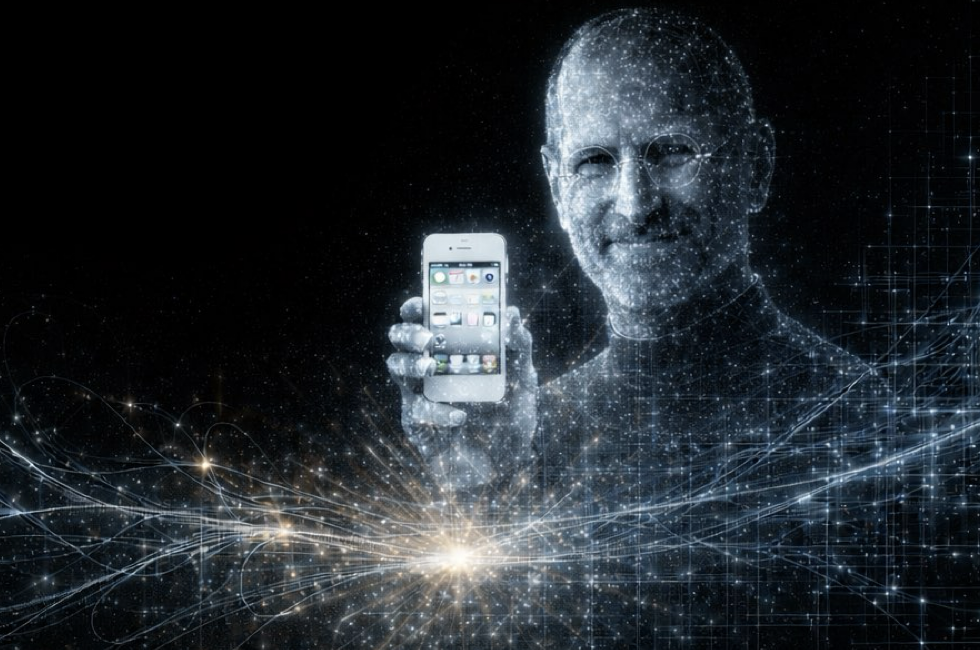
Steve Jobs took a calligraphy class he would never use. Ten years later, it became the Macintosh. Breadth isn't distraction. It's inventory.
Training Your Brain to Be More Creative
Training the DMN and ECN to co-activate is essentially a practice in controlled spontaneity. Research shows that while these networks naturally compete, specific activities can strengthen the functional connectivity between them. Here are four evidence-based exercises to get started:
1. The Alternate Uses Task (AUT)
The gold standard for training divergent thinking. It forces the DMN to generate novel ideas while the ECN evaluates their originality.
The Exercise: Pick a mundane object—a paperclip, a brick, a coffee mug. Set a timer for two minutes and list as many non-obvious uses for it as you can.
The Goal: Don't chase quantity. Chase originality and elaboration.
Why It Works: It trains the brain to bypass "first-order" (obvious) responses and dig deeper into associative memory.
2. Open-Monitoring Meditation
Research draws an important distinction between Focused Attention meditation (concentrating on the breath) and Open-Monitoring meditation for creativity.
The Exercise: Sit quietly. Instead of anchoring attention to one thing, simply observe every thought, sound, or sensation that enters awareness—without judging it or dwelling on it.
The Goal: Sustain a state of receptive, non-reactive awareness.
Why It Works: A 2012 study by Colzato et al. found that Open-Monitoring meditation specifically promotes divergent thinking by lowering the ECN's filters, allowing the DMN to surface more remote and unexpected associations.
3. Strategic Incubation (The "Boredom" Break)
The brain frequently solves its hardest problems offline—during periods when you are not actively thinking about them.
The Exercise: After working intensely on a creative problem, deliberately switch to a low-demand task: washing dishes, taking a walk without headphones, or showering.
The Goal: Avoid high-demand distractions like social media. These consume the ECN entirely, leaving no bandwidth for the DMN to wander.
Why It Works: Low-demand tasks keep the ECN just occupied enough to prevent rumination, while freeing the DMN to engage in unconscious processing—the same mechanism behind every Aha! moment.
4. Conceptual Blending (The Medici Effect)
This exercise trains the brain's associative architecture, teaching the Salience Network to detect connections between seemingly incompatible domains.
The Exercise: Take two completely unrelated concepts and force them to merge into a new product, service, or story. Example: "What would a subscription-based gardening service look like if it operated like a high-end gym?"
The Goal: Identify the underlying logic of one field and transplant it into another.
Why It Works: It forces the ECN to provide a logical framework (the how) for the DMN's imaginative leaps (the what)—precisely the co-activation pattern that defines creative cognition.
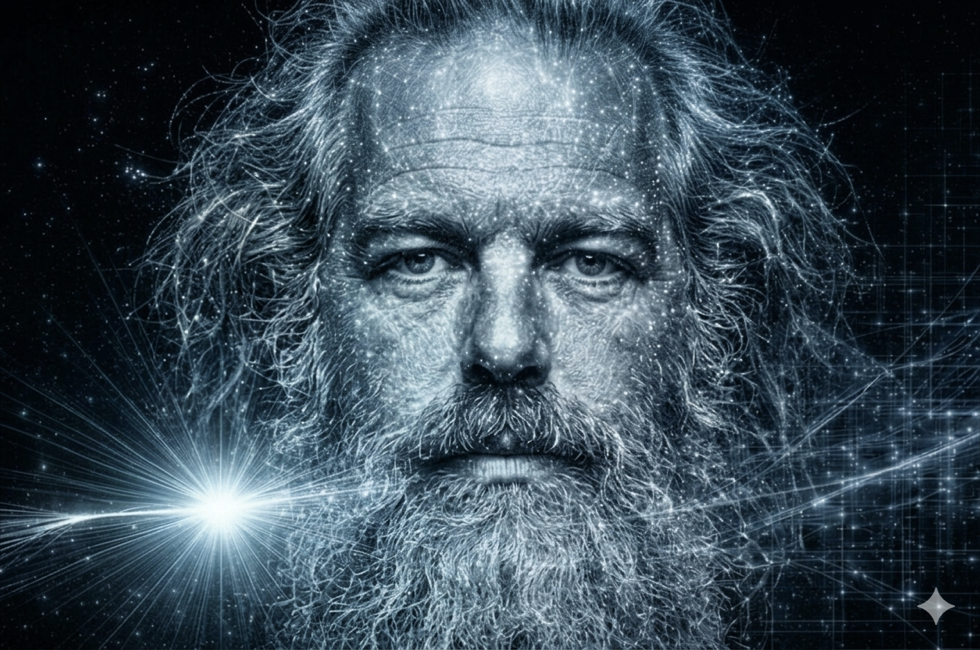
Rick Rubin — record producer, creative philosopher, and one of the most consequential ears in the history of recorded music — said it plainly: creativity is not rare. It is not elite. It is our birthright. The science agrees.
The Takeaway: It's a Muscle, Not a Miracle
The most liberating insight from the neuroscience of creativity is this: the process is malleable. Genetics may provide a 20–30% head start in terms of dopamine receptor density or the leakiness of your latent inhibition filters—but the remaining 70% is built through environment, habit, and deliberate practice.
Creativity is the result of a brain trained to stop dismissing the "irrelevant" and start hunting for the hidden connections. It means leaning into the daydream—the DMN—without losing your grip on the red pen of the ECN.
So, the next time you're stuck, stop staring at the screen. Go for a walk. Let your brain blink. The Gamma waves are queued up and ready.
You just need to get out of your own way.