
The Museum and the Paddock
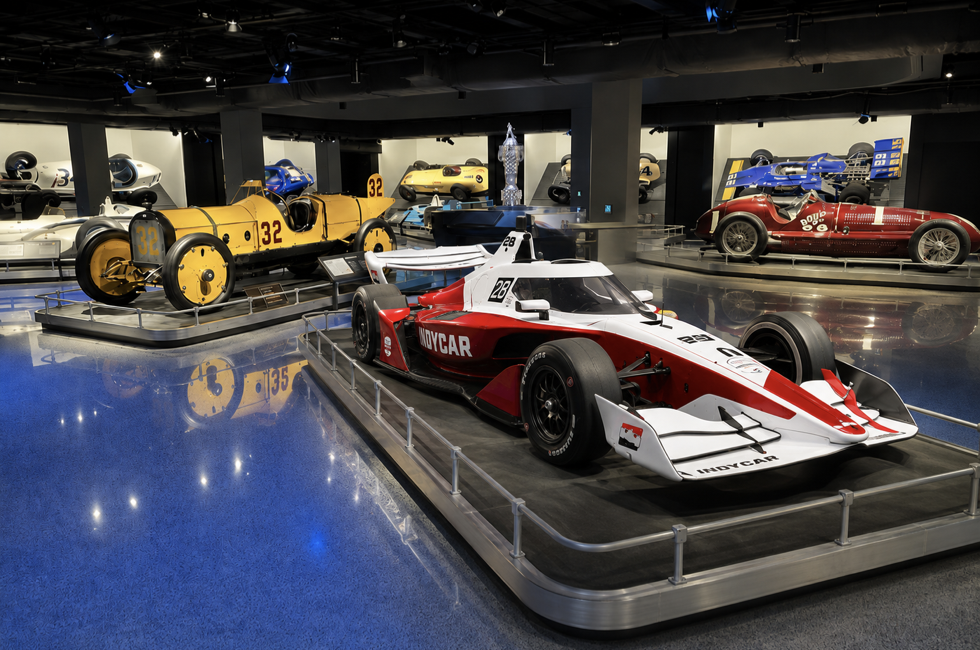
The IMS Museum celebrates IndyCar’s ongoing race to what’s next. Someday, the Dallara IR-28 will take its place among the machines that define their eras.
First in a series Paul Pfanner has spent a working life close to Indy cars, including the work Pfanner Communications did helping the Indianapolis Motor Speedway envision its Centennial Era. Here he sets the reimagined IMS Museum against today's paddock, and asks the question about the car that comes after the Dallara IR-28.
The Museum
The Indianapolis Motor Speedway Museum has been reimagined and reenergized. I've only had a couple of short visits, but I saw enough to be inspired, and I wish I'd had a whole afternoon, because the place deserves it. It's the heart of my inspiration. It reminds me why I've spent my life in this sport.
In "The 500: Immortality at Indy," the Fox Sports documentary that aired before the 110th running of The Greatest Spectacle in Racing, James Hinchcliffe walks through the new IMS Museum after hours and calls the place a cathedral of ambition. He's right, and a cathedral like that is full of cars, not wax figures of drivers. A hundred years of machines that carried real ideas about how to go fast. The Museum, and the impressive new restoration shop now being built, prove the cars are worthy of our reverence and our devotion, like the heroes who drove them to glory, because they carry the same courage and boundless human ambition. They remind us that the future we're living in now was built one lap at a time at the Brickyard.
To the rest of the world it's more than that. The Museum is the promise of motorsport to drive progress and to create meaning, and I can't think of a better case for what racing can be when it tries to change the world for the better.
You see it in the cars. The 1963 Lotus 29 is in there, restored and running, and it's run at Goodwood. It's one I fell for as a kid, the car that put the engine behind the driver and made the front-engine roadsters look old in a hurry. Near it sits the 1911 Marmon Wasp, from back when nobody had settled what a car even was. And the 1980 Chaparral 2K, which brought ground effect to the Speedway. That was no guess by then. The Lotus 78 had shown a ground-effect car could win in Formula One, and the 79 settled it, taking the world championship with Mario Andretti at the wheel, a former Indianapolis 500 winner. Once the Chaparral ran it at Indy, it became how everyone built an Indy car.
You don't need any of it explained. The cars tell you themselves. You can see what the builders were after, and that somebody believed in it enough to pay for it.
The paddock
Walk into an IndyCar paddock today and the cars are prepared to a standard those old car builders and crews never had the tools for. The liveries are sharp and the teams have real character. The work in one setup alone is mind-boggling. Up close it's hundreds of decisions with real consequences.
But they all start from the same answer. What tells one from another is mostly the wrap and the sponsor and the driver in the seat. The engineering underneath is serious. Different engines from Chevrolet and Honda, a working hybrid system, new thinking in the IR-28. You just can't see it, and none of it gives a car a face of its own. That leaves the drivers and teams and broadcasters to carry the whole public story. They carry a lot. I'm not sure they should have to carry all of it.
Why the place was built
Indianapolis got built when the automobile was still an argument nobody had won. The Speedway gave inventors a place to test what they believed, in public, under pressure, where speed made the verdict easy to read. An idea worked or it didn't, or it showed enough to come back next May in a new shape.
Plenty of the ideas were bad, some were dangerous, most cost too much, and none of it moved in a straight line. What mattered is that the car was part of the contest. The 500 showed people what a car might become, then made the ideas prove it out in front of everybody.
What the sport gets right
Modern IndyCar does a lot well, and I don't want a word of this read as if it doesn't. The drivers are superb, and the schedule asks more of them than almost any series on earth, quick on street circuits and road courses and short ovals and at Indianapolis, all in one year. The 500 is still one of the hardest days in the sport, with a character nothing else can copy. The racing is far safer than what we grew up on, the aeroscreen changed the look and saved lives, and the audience is growing after some lean years.
The common car is a big reason it steadied. It gave everyone dependable supply and known costs and a chassis worth running for years instead of scrapping every winter, and it kept the equipment worth something. That was a correction the sport needed. Racing used to burn through cars and money at a rate that couldn't hold, and I lived through years when you'd buy a new car and it was old before the truck had miles on it. The CART cars were extraordinary, and the fights between constructors gave us some of the best machinery there's ever been. The spending got crazy in the end, though, and that's the part that doesn't carry into the 2030s.
The right car for right now
IndyCar took its own road and it worked. The DW12 held the sport together through a hard stretch and ran far longer than anyone guessed the day Dan Wheldon was testing it. The IR-28 takes over in 2028, lighter and safer, aeroscreen built in, a bigger cockpit, a body shaped to let the cars run close. Dallara builds fine racing cars, and I expect this to be one because they are constantly learning.
Let it do the job it was built for. Nobody knows if the IR-28's lifespan runs five years or ten, and that depends on the car, on the teams and manufacturers, on what our crazy fast-changing world does in the meantime. But one day it reaches the point the DW12 is at now, and IndyCar will have to choose whether the next car repeats this business model or starts a new one. I think the IR-28 may be exactly the car the sport needs for this stage of its comeback. Do the job, and that next choice gets made with time in hand instead of in a crisis.
The decision that's coming
When it comes, it's a business decision before it's a technical one. The rules follow whatever the sport decides it's selling, who it wants building the car, and where the car is supposed to make its money.
An Indy car used to carry a lot of identity at once. The driver, sure, but also the team, the constructor, the engine company, and a whole point of view about how to go faster. You could line up a Lotus, a Lola, an Eagle, a Penske, a Chaparral, a March, and a Reynard and see people who flat disagreed about the solution. A wealthy individual, a manufacturer or a sponsor helped build the thing because it represented a point of view.
There's room between an open checkbook and everything staying the same. IndyCar could keep one shared safety cell and keep tight control of the pieces that bolt to it, guarantee that any team can still buy a car, and set real windows for development so the money can't run away, while capping the spending that buys a fan nothing. Inside those fences, a few defined pieces of the car could carry visible engineering, the kind of work you can see from the grandstand, live on Fox or in the audience energy of social media. Nobody with any sense wants a new Indy car chassis every spring, or a field split between the teams that can build a car and the ones that can't. The job is to pick where a difference is worth something meaningful and draw the lines that keep it there.
What the next car says
One day an IR-28 sits in that Museum, a winner or a championship car or the one tied to a driver people still talk about. It'll have earned the spot on what it did on the track. My question is the car sitting next to it. What does that one say about what the sport did next?
The IMS Museum shows what the place can do with the history the Indianapolis Motor Speedway has inspired. IndyCar has time now, which it hasn't always had, to decide what it wants to give the Museum after the IR-28. Indy used to be where the future showed up first. I'd like to see it be that again, and the way to make that happen is to debate about it out in the open, the way the sport once settled everything else, on the track and at speed, where victory travels at the speed of thought.
Other essays on the next Indy Car after the IR-28
The Fastest Thing off the Shelf
The New Indy Car is No Accident
Paul Pfanner on the launch of the 2028 IR-28 Indy car
Pfanner Advantage works with clients to turn change into advantage at the intersection of mobility, motorsport, media, technology, and marketing. Learn more or start a conversation: contact us today.
Paul Pfanner’s recent Shift Happens Insights:
The Advantage Journal arrives every week. What matters in sport, mobility, media, and technology — curated and contextualized by Bill Sparks, Bill Long, and Paul Pfanner. No hedging. No filler. Subscribe — It’s Free

