
Invent the Future
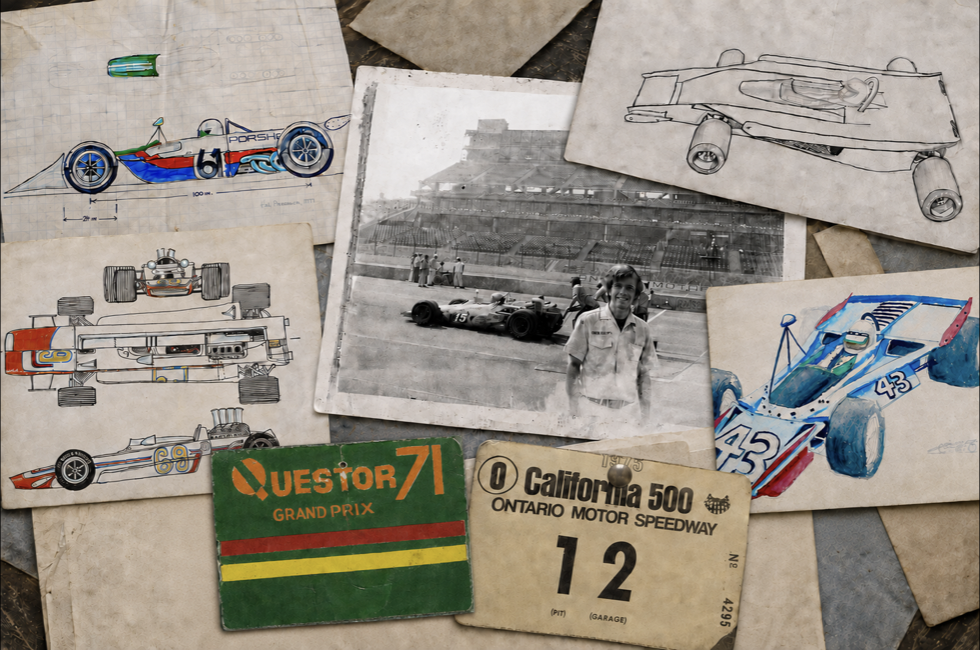
These drawings, homemade credentials and my 1971 photograph at Ontario all began with a dream and the determination to make it real. The cars themselves were ideas about what racing could become.
First in a series: A look at what a kid who'd forge credentials to get trackside at Ontario Motor Speedway had on his mind. For Paul Pfanner, the dreaming hooked him for life and never let go. Racing was built to reach the future faster and better, and not built to stand still.
The IndyCar IR-28 car sent me back to where I started
They revealed the new IndyCar, the IR-28, for the 2028 season, and instead of thinking about 2028 my head went straight to when I found the Indianapolis 500 as a kid. Back then the 500 was an argument about the future, carried out at speed. Should the engine sit in front of the driver or behind him. Did a turbine even belong on an race track. Every May somebody turned up with a new idea and a driver willing to find out if it worked. Those drivers were the test pilots. The danger was real in a physical, reputational, and financial sense and I couldn't look away.
I truly admired Dan Gurney for his driving. But what got me hooked on him was the way his mind worked. He wanted to solve big challenges in ways nobody had tried, and he built the cars to prove it. That was racing to me. A place where a good idea got to go fast in public and either made it or it didn't.
I still see that spirit in IMSA sports car racing and the WEC, and in Formula 1, and even a little in Formula E. Where I've stopped seeing it is IndyCar.
I was drawing cars that didn't exist
I was the cartoonist for the Whittier High School newspaper and was always drawing something. When an idea showed up in my head it had to come out fast, so I'd sketch it or throw down a quick watercolor painting before it got away. Most of those ideas were race cars: shapes I'd never seen, because I wanted to see them.
Sketching only went so far. I wanted to stand next to the real machines. So I forged myself some credentials and got through the garage area gate at the brand new Ontario Motor Speedway for the Questor Grand Prix and the California 500, and for the first time I saw those cars up close and checked out how they were built and how one differed from the next. It was thrilling, and it changed how I drew.
Here's what pushed me to write this essay. I took those teenage drawings where I was dreaming up what an Indy car could be, and ran them through Gemini and ChatGPT to render them as modern, photorealistic cars. A pencil sketch out of a school notebook, sitting there now like it just rolled out of the shop. The originals are below, each one paired with what the tools made of it, and a note from me on what I was chasing when I drew it and what the render turned up.
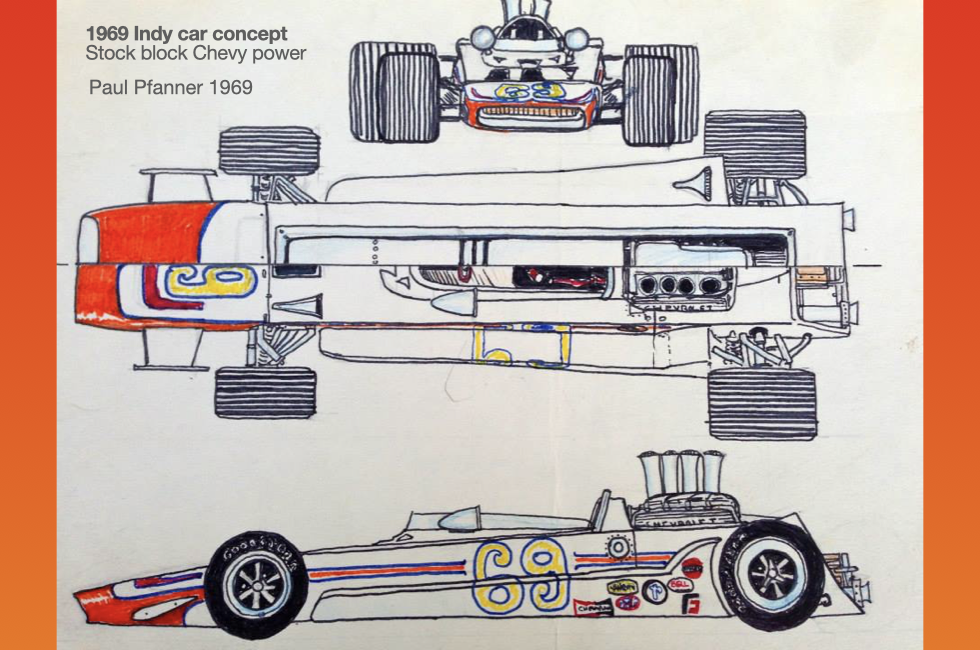
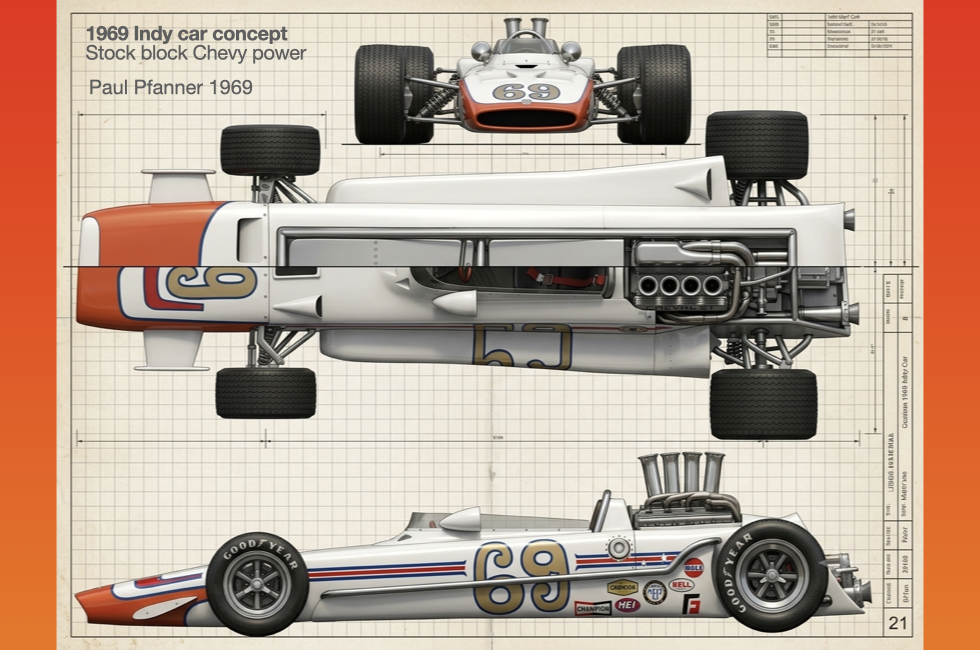
I drew this normally aspirated, stock-block Indy car concept in early 1969, inspired by what Dan Gurney was doing. I had never seen an Indy car race in person and no real sense of an Indy car’s actual dimensions or wheelbase. Attending the 1969 Rex Mays 300 at Riverside would soon change my perspective. Gemini did a nice job rendering the concept while faithfully preserving the goofy proportions.
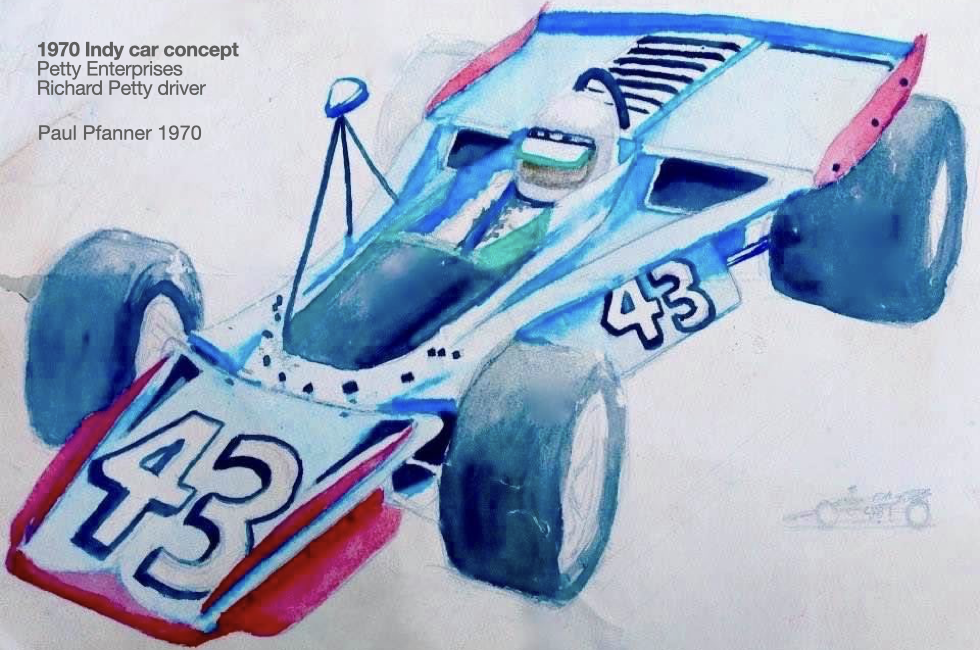
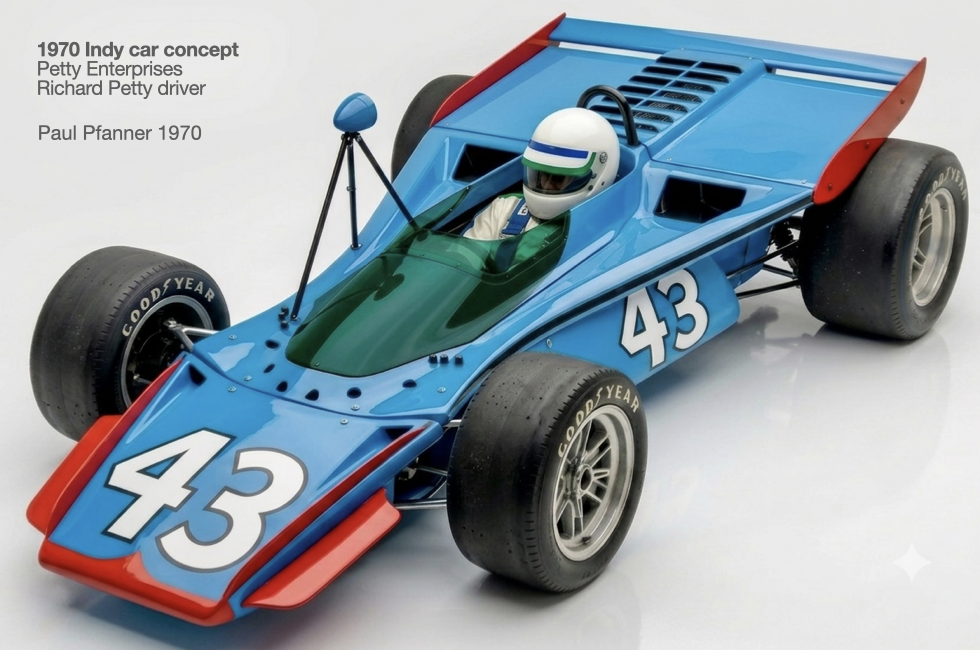
I painted this quickly in watercolor in early 1970, when Indy cars were beginning to sprout winglets and decks and aerodynamics was suddenly becoming visible. I was also a huge Richard Petty fan. Who wasn’t? I dreamed of seeing him race in the Indianapolis 500, so I designed an Indy car for him, complete with a wedge nose, deep Plexiglas windscreen, high radiator intakes beside the cockpit and even a full-face helmet, although I never saw Petty wear one. The drawing predated the similar radiator arrangement on Lola’s 1972 T300 and 1973 T330 Formula 5000 cars, though neither had a rear deck like this. I liked the shape. I used both Gemini AI and ChatGPT to create a photorealistic render. Now I like it more.
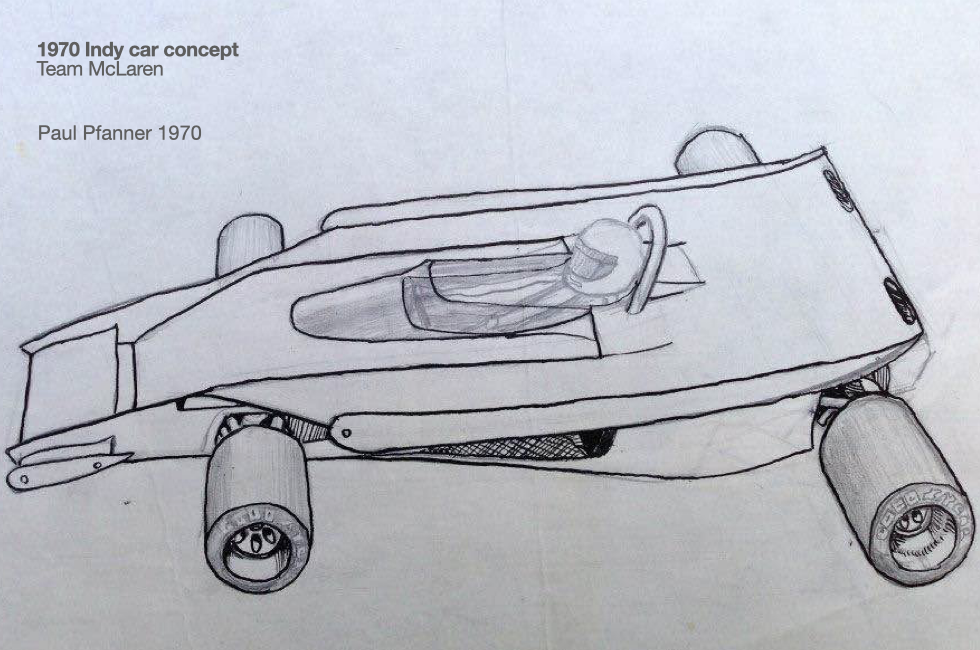
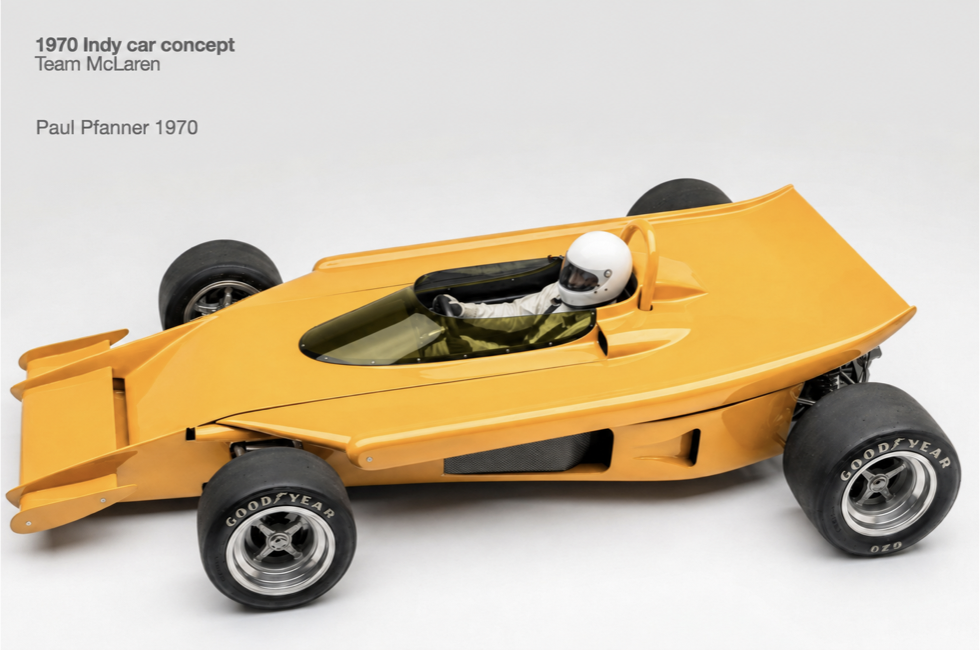
This was my fantasy Team McLaren Indy car, drawn in 1970 after I saw photographs of the McLaren M15 Offy. I was not impressed. It looked chunky rather than cutting edge. Visually, it seemed fat and old, although the wings sprouting from the engine cover behind the driver’s head caught my attention. My answer was a car that was almost entirely aero downforce surface, with an adjustable front-wing arrangement to balance it. It probably would have been incredibly draggy, but I liked it. I also had not learned how to draw racing tires, so these looked more like the tires on my slot cars. Gemini AI made the idea look surprisingly sophisticated for 1970 but the real world next McLaren was far better. The wedge-shaped and winged 1971 McLaren M16 Offy made this idea look old, and launched a brave new era of rapid aero-driven speed escalation.
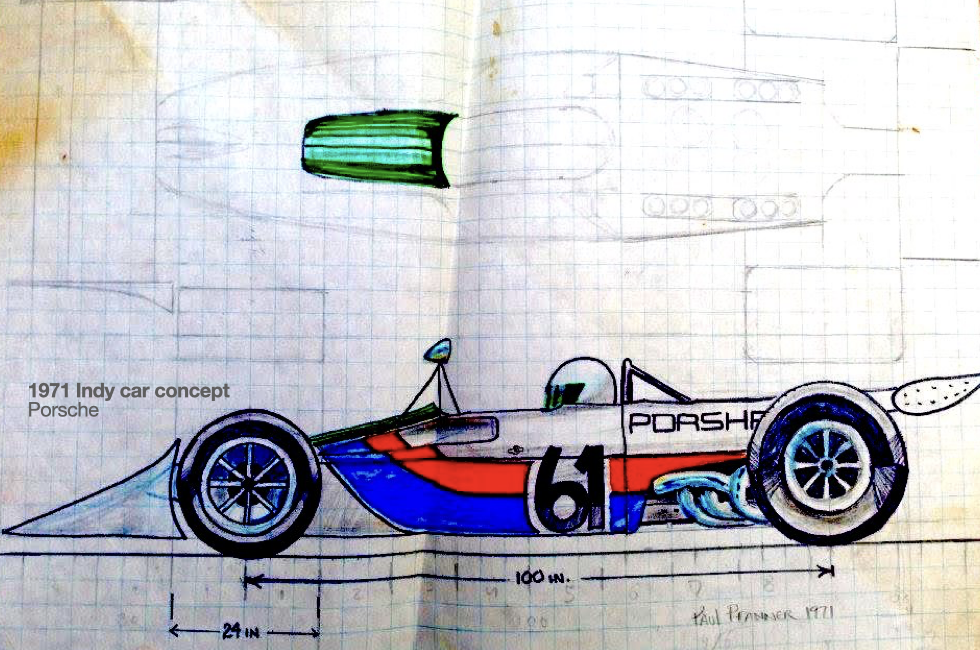
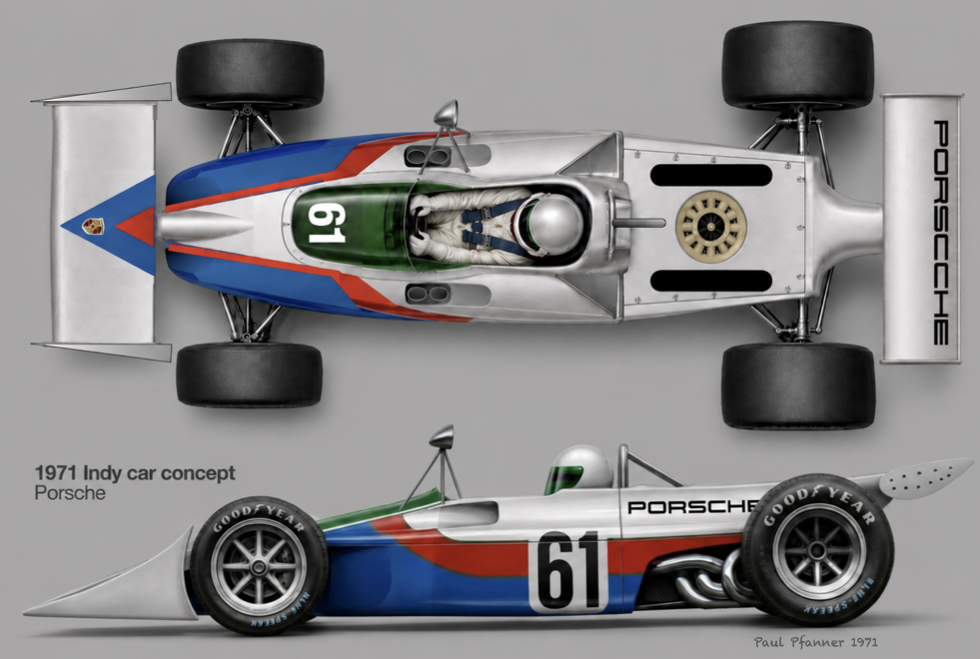
I drew this Porsche Indy car in 1971, when wings were beginning to sprout everywhere. I had loved Porsches since first sitting in my grandfather’s 356 as a kid, and I imagined the company arriving at Indianapolis as a serious threat. My car was low, lean and normally aspirated. It had an unusual front-wing arrangement that is clearest in the unfinished top view. By then I had seen real Indy cars, Formula One cars and Formula 5000 cars, and I was finally learning how to draw what I was seeing. The irony came eight years later. In December 1979, my new company, Pfanner, Catheron & Brown Publications, Inc., launched with a top-secret assignment from Interscope Racing involving an actual Porsche Indy car designed by former Eagle designer Roman Slobodynskyj. The Porsche program was stillborn, but the Interscope chassis later raced at Indianapolis with Cosworth power. Something I had imagined as a teenager had become real by the end of the decade, and somehow I was working on it. One final detail: I had misspelled Porsche on the side of my car. Gemini AI graciously corrected it.
Moments when the whole sport reinvented itself
Those sketches came out of a particular stretch of time. If you weren't there, here's roughly what a young fan was watching between 1964 and 1971:
The front-engine roadster went from king to relic in about a year. A.J. Foyt won with the engine up front in '64. By '65 Jim Clark won in a Lotus. 38 with it behind him, and the roadster was a museum piece.
Ford showed up with a real racing engine and Detroit money behind it in 1964, and parked a Mustang out front as the pace car.
Turbines. Twice a near-silent whooshmobiles almost stole the 500 in 1967 and 1968, and the rule-makers kept reaching for a pen to slow it down.
Turbocharging turned an old four-cylinder engine into a beast. The Offenhauser, engine, had powered Indy cars for decades, and a turbo bolted on woke it up in the space age. Bobby Unser won the '68 race in a turbocharged Offy in his Eagle,
Wings arrived near the end of that run and speed went a little berserk. Pole sat just under 159 mph in '64 and reached nearly 179 by '71. The next year, with wings, it jumped to nearly 196 mph
Thirty-three cars start the 500. A lot more than thirty-three cars that represented competing ideas came to try, and getting bumped out of the field meant something more than human theater, it was also a hard verdict on the perfomance of an idea in the real world.
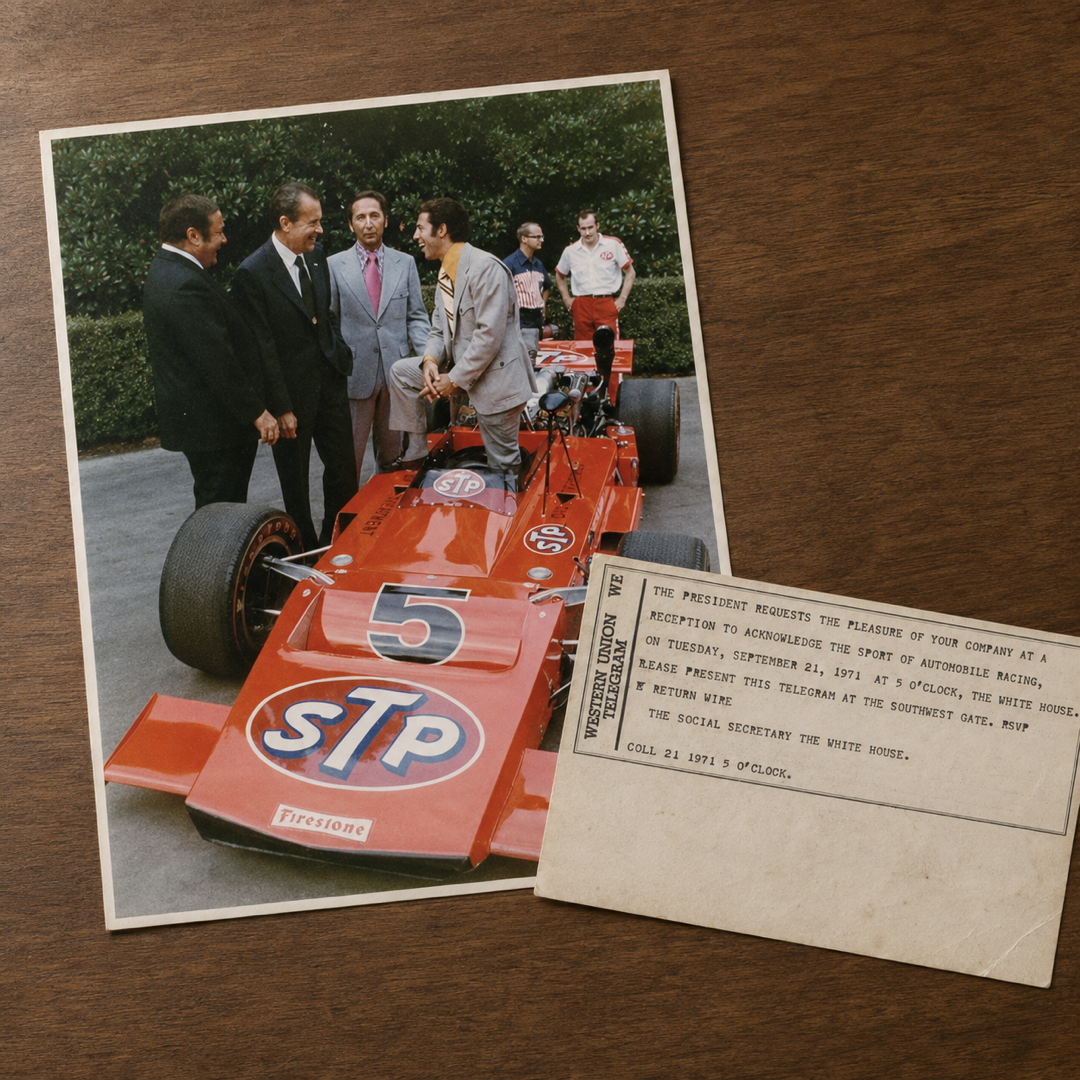
At the White House in 1971, Mario Andretti shows President Richard M. Nixon his McNamara-Ford Indy car as Andy and Vince Granatelli look on. Nixon was a fellow Whittier High School graduate, Class of 1930, although four decades ahead of me. The accompanying telegram carries the invitation to an event that elevated and validated the sport, establishing a presidential tradition that continues.
And Richard Nixon was in the White House. He'd graduated from my high school in Whittier four decades ahead of me, and in the fall of '71 he invited more than a hundred of the sport's best to a reception and dinner. Andretti, Parnelli, the Unsers, Penske, Granatelli. He'd caught the bug after flying over the Ontario Motor Speedway the year before at the Inaugural California 500 I’d attend with my late father. I loved that the sport felt big enough to earn the invitation.
Why I still care what an Indy car is
Racing wasn't the only place this was going on. Around the same time I was scheming my way into the paddock to see these cars, a computer scientist named Alan Kay said, at a gathering in Palo Alto, that the best way to predict the future is to invent it. Then he and the people around him went and did it. It's the same instinct that kept putting strange cars on the grid at Indy.
I want to be fair about the show. IndyCar is partly owned now by a television network which is an entertainment company, and if those are the people you answer to, building a show is a reasonable thing to do. I get it.
What I keep coming back to is that meaning is what pulls people in and holds them. It's an attractor. In an age where the audience is the medium, where people carry a passion out to everyone they know and pass it around for you, that matters more than it used to. If you stand for something past the next thrill, you keep growing. Thrill on its own has a ceiling, because a thrill you can see coming quits being one, and people go numb.
I learned that watching the sport almost wreck itself. What I couldn’t stand about the Indy Racing League, and the managed pack racing that came with those years, was that it was lethal, and the people in the grandstands paid for it right along with the drivers. I was sad to see CART devolve to this level, again with lethal consequencs. That was a sport trying to be right about the wrong thing. I’ll say it bluntly, because it cost lives, credibility and stature.
That is not where IndyCar sits today. What they’re running now is far safer and a lot smarter, and they’re not bunching cars in dangerous packs and calling it racing. None of this is about safety. A show can be run beautifully and still not stand for much, and what holds an audience over the years is the meaning under it. This matters now more than ever.
That’s why I still care what an Indy car is, and what it’s for. The drawings on this page were created by teenaged me insisting the future ought to look like it. I still think that’s what the sport is for. Proving in public about where we go next, faster..
Pfanner Advantage works with clients to turn change into advantage at the intersection of mobility, motorsport, media, technology, and marketing. Learn more or start a conversation: contact us today.
Paul Pfanner’s recent Shift Happens Insights:
Standing Still at 230 Miles Per Hour
A Moonshot Run Out of a Race Shop
The Advantage Journal arrives every week. What matters in sport, mobility, media, and technology — curated and contextualized by Bill Sparks, Bill Long, and Paul Pfanner. No hedging. No filler. Subscribe — It’s Free

