
Open Track
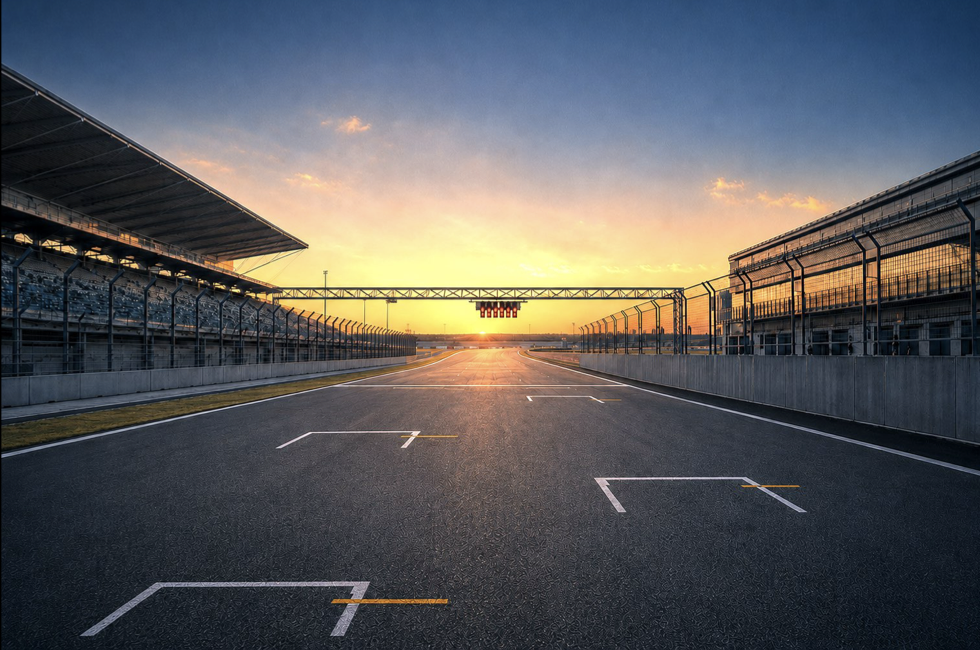
The light comes up the same for the ready and the not. Only one moves first.
What would you go after if the only thing that could stop you was whether your idea was any good? Paul Pfanner has spent five decades building things in motorsport and automotive media, and he thinks that is now the real situation we are all in — less comfortable, and a lot more exciting, than it sounds.
For most of my working life, the distance between having an idea and finding out whether it was any good got measured in years and paid for with money I mostly did not have. I got a lot of things built across those years. Websites, agencies, magazines, a mountain of client work. What I remember is what each one cost to get to the point where anybody could finally judge it, and how many good ideas never got that far because the toll was more than a person could pay.
That toll is the thing that has changed. I want to walk through how it got so high, and then talk about what happens now that it has dropped through the floor.
What a thing used to cost
The first venture I built to any real scale took fourteen years to get from a conversation with a friend in his yellow Porsche 914-6, driving North from LA, to a finished thing a stranger could pick up and hold at a newsstand. The idea we had in about 30 minutes, for free. The fourteen years went to everything else.
You could not just have the idea and make it. You had to build the whole apparatus that would let you make it. People who knew things you did not, who had to be found and paid and given somewhere to sit. Contracts. Supply lines. A business already earning enough to carry the new thing while it got on its feet. By the time we launched there were eighteen of us walking into the same building every morning, because there was no other way for the thing to exist.
That was not some quirk of what I happened to be building. It was the shape of almost any serious attempt at anything. A restaurant. A product. A research idea. A small manufacturer. A film. The idea was the cheap part every time. The machine you had to build around it was what cost you, and most people never got past building the machine.
The wall we kept hitting
I spent the next twenty years building the next thing, and then the one after that, usually before anybody had settled on a name for it. When it was time for a website, we built one. When it was time for video, we built a channel and made documentary series about worlds nobody else was pointing a camera at yet. One of them ran thirty episodes and treated a whole field fairly instead of flattering any single player in it. Some of that work outlasted the companies that made it, which is how I know the work was good.
But we kept hitting the same wall wearing a different coat. We could usually see where things were headed, often years early, and we still could not always get there. Seeing it was never the hard part. Getting the people and the room and the runway together to act on it was the hard part, and the runway was the thing that always ran out. We had the idea. We had the instinct. We did not have enough time or enough money to finish turning them into something real.
None of that was a media problem. That is the physics of turning any idea into a real thing with a small team and a shorter financial rope than the job needs.
What just changed
Those costs have collapsed. Not all costs. The specific ones I just described.
It is the apparatus that fell away. The dozen people who were not the idea but were needed to deliver it. The building they sat in. The years of overhead you carried before you could test a single guess. One capable person with the tools we have now can stand up most of that apparatus alone, in an afternoon, for close to nothing. The teammates you still want are out there right now, awake somewhere, reachable, and not one of them has to sit down the hall from you. That last part is exactly the thing that used to beat us.
And this is not a media story, or a content story, or a story about any one industry. The wall that just came down stood in front of business ideas, product ideas, whole shifts in how people live and buy and gather. It stood in front of nearly everything. It is coming down in front of nearly everything.
Some people find that frightening. I understand why, because a wall is also a comfort. As long as it stands, you never have to find out. I do not find it frightening. I find it the most open piece of track I have seen in a career spent looking for open track.
What did not change, and one warning
Two things are sitting right where they always were.
The first is that knowing how to make a thing is not the same as knowing whether it should be made, or what it should be. The people I built those companies with knew things the tools do not know, about taste and timing and what an audience actually wants. Cheap production has not replaced one ounce of that. If anything it made that judgment rarer and worth more, because now everybody has the production and hardly anybody has the judgment.
The second is a warning about the tools, and it matters. They agree with you. They will help you build the wrong thing beautifully and tell you it looks great the whole way down. A lathe never did that. When a part let go on the dyno, the world handed you a fact and you got no say in it. So in a moment when every tool says yes, the most valuable person you can find is the one who will tell you no while it still costs nothing to hear it.
How to know if you are really doing it
There is failing because you tried, and there is failing because you got comfortable and told yourself you were trying. From the inside those two feel almost the same.
One thing tells them apart. After the attempt, can you say something you know now that you did not know before, in a sentence, something you could have been wrong about? Name a wrong guess and the whole exercise paid for itself. If all you have is a warm feeling that it went well, you were in motion, not in an attempt.
Get in
I have spent a career building better views for people watching from the grandstand. Better cameras, better pages, better screens, all of it trying to close the gap between watching the race and being in it. That gap never fully closes. There is one way to know what a corner is like, and it is to take it yourself.
Most people are going to watch this one arrive from the grandstand. Reading about it, arguing about it, waiting to see how it shakes out before they touch a thing. You can do that. You can also climb in, because the car is unlocked, the pit lane is empty, and nobody is coming to wave you out.
So pick the one thing you have been meaning to build for five years or more. Give it seven days. Tell somebody who will ask you how it went, so there is a witness and a date on it. At the end, write down the one thing you learned.
I am still building things that do not exist yet, and what sits on my desk this morning would have saved me a dozen years on the first one. I am not saying that to cheer you up. I am saying it because the track is open, the flag is up, and the only question left is whether you want it badly enough to find out what you can do.
So what is in you that you have been waiting to bring into the world, and what exactly are you waiting for?
Pfanner Advantage works with clients to turn change into advantage at the intersection of mobility, motorsport, media, technology, and marketing. Learn more or start a conversation: contact us today.
Paul Pfanner’s recent Shift Happens Insights:
Are Creators Formula One’s Most Effective Media?
The Advantage Journal arrives every week. What matters in sport, mobility, media, and technology — curated and contextualized by Bill Sparks, Bill Long, and Paul Pfanner. No hedging. No filler. Subscribe — It’s Free

