
The Reskilling Race
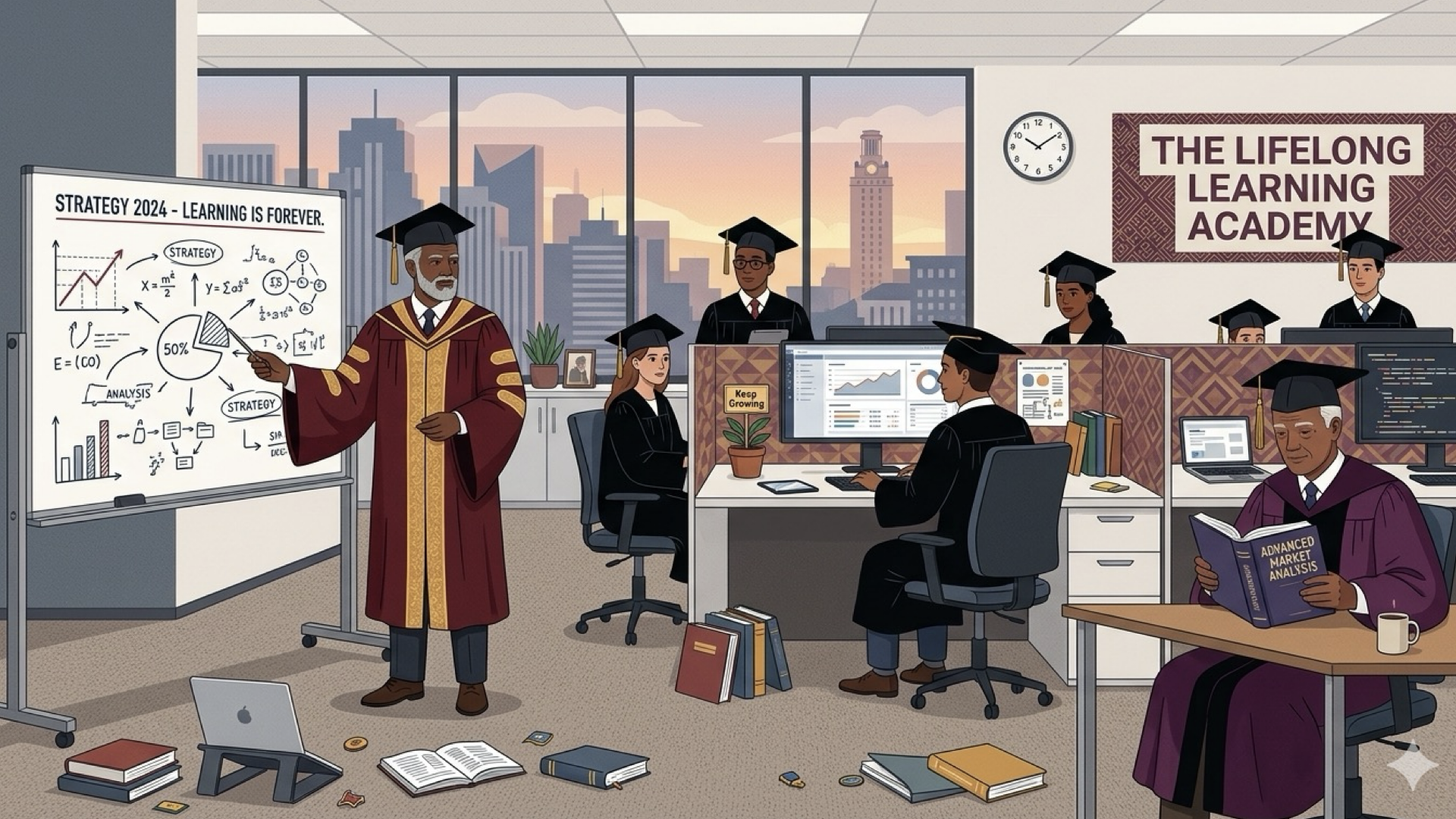
Half of what your workforce knows today will be functionally obsolete within four years. Life-long learning is the new normal.
Bill Sparks runs his Cold Read across the workforce this week. The big number everyone quotes — 78 million net new jobs by 2030 — only pays out if companies can teach their people fast enough to fill them. Bill looks at why advantage now belongs to whoever learns quickest, and what that costs the companies still trying to hire their way around the problem.
The half-life of a professional skill has dropped to under five years. For technical skills like AI, cybersecurity, and software engineering, it is as short as two and a half years. That means roughly half of what your workforce knows how to do today will be functionally obsolete before the decade is out.
The World Economic Forum's Future of Jobs Report projects that 170 million new jobs will be created by 2030, while 92 million will be displaced. That is a net gain of 78 million, but the gain only materializes if people can actually move from the old roles to the new ones. Employers estimate that 39% of workers' core skills will change by 2030, and 63% already identify skill gaps as a major barrier to business transformation. The jobs are coming. The question is whether anyone will be ready to fill them.
The competition for competitive advantage has quietly shifted. It is no longer primarily about who has the best technology, the best strategy, or even the best people. It is about who learns faster. The organizations that can continuously reskill their workforce to match the pace of change will win. Everyone else will find themselves paying a premium to hire skills they could have built, or discovering that the skills they need simply aren't available on the open market at any price.
Hiring is more expensive than retaining
The instinct when facing a skills gap is to hire. It feels faster and more certain than developing existing talent. The economics say otherwise.
The total cost of a new hire runs approximately three to four times the position's salary when you account for recruitment, onboarding, ramp-up time, and the productivity gap during transition. Companies with high internal mobility save roughly $4,700 per vacancy they fill internally rather than externally, and they reduce aggregate recruitment costs that average $400,000 annually. These are not marginal savings. They compound across every open role, every quarter.
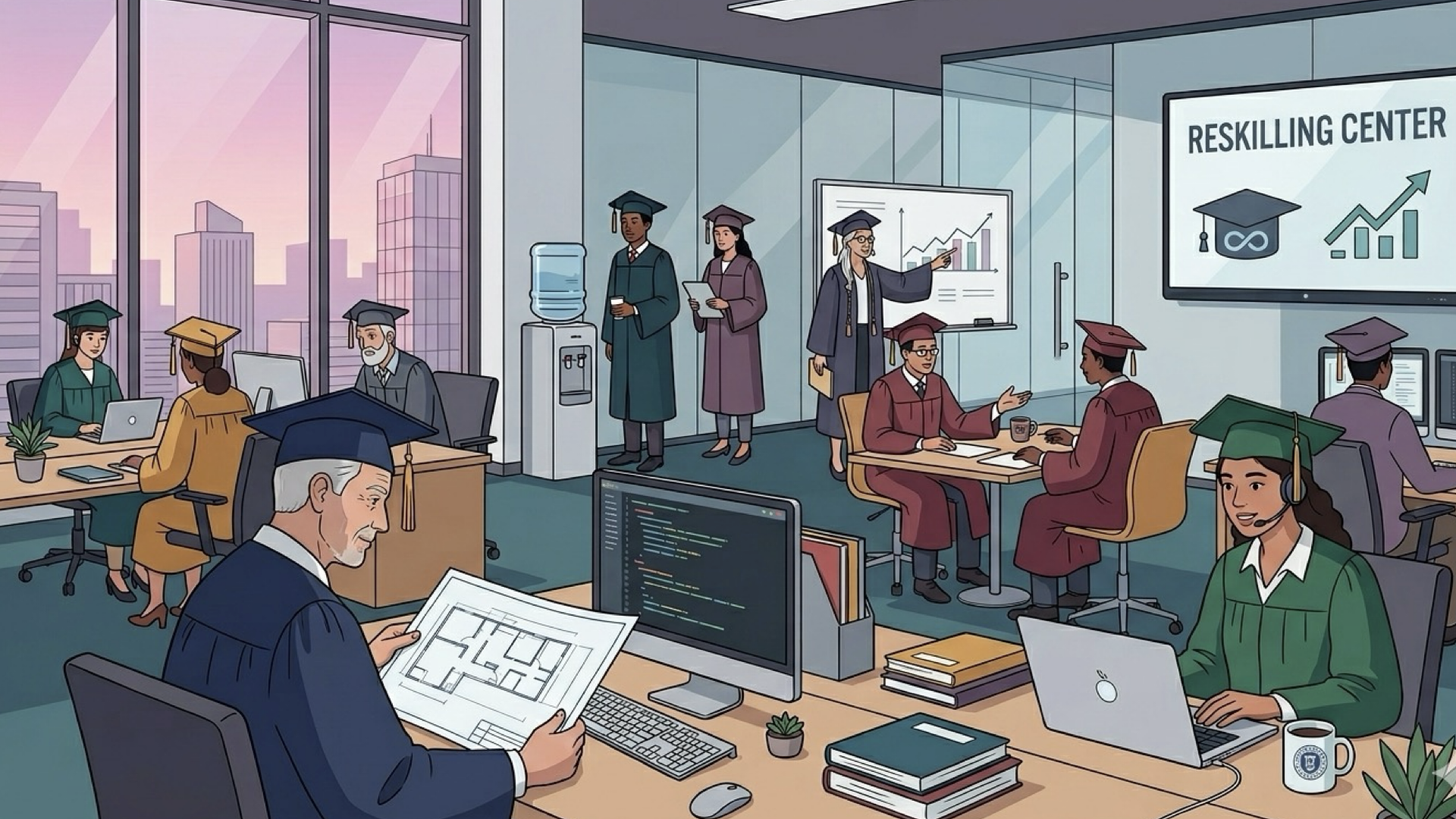
Retraining existing employees creates an adaptive workforce that can fill skill gaps without the need for constant hiring.
But the retention numbers are where the argument gets decisive. Companies that excel at internal mobility retain employees for an average of 5.4 years, nearly twice the 2.9-year average at companies that struggle with it.Employees at high-mobility companies stay 60% longer. Organizations that prioritize talent mobility are twice as likely to report significant impact on both performance and retention. When you hire externally, you get a skill at a single point in time. When you reskill internally, you get a workforce that can continuously adapt. In an environment where 39% of core skills change every five years, the point-in-time skill is already depreciating the day the new hire starts. The adaptive workforce compounds in value.
This calculus is especially acute for legacy businesses, where institutional knowledge is a genuine asset that cannot be replicated through onboarding. An employee who understands your systems, your customers, and your culture is not interchangeable with someone who has a newer credential but no organizational context. Reskilling preserves what is hardest to replace while adding what the market demands next.
Learning is essential
The World Economic Forum reports that 50% of the global workforce has now completed training as part of learning and development initiatives, up from 41% in 2023. 85% of employers say they plan to prioritize upskilling. That sounds like progress, but it masks a critical divide between organizations that are building learning systems and those that are simply spending money on training.
PricewaterhouseCoopers's 2026 AI Performance Study found that three-quarters of AI's economic value is captured by just 20% of organizations. One defining characteristic of those organizations is that they don't just deploy AI and bank the efficiency gains. They reinvest the time AI saves into building skills and redesigning roles, turning productivity into sustained capability. The other 80% save a few minutes per task and call it transformation.
AT&T's well-documented reskilling program, IBM's apprenticeship model, and Unilever's future-fit initiative are the visible examples that get cited in conference presentations. But the common thread across companies that actually succeed at reskilling is structural, not programmatic. They have moved from event-based training to continuous capability-building embedded in the flow of work. They measure learning through performance impact, not completion rates. They use people analytics to identify skill gaps before they become business problems. McKinsey's research shows that organizations applying people and learning analytics effectively achieve productivity gains of up to 25%.
Deloitte's 2026 Global Human Capital Trends report, drawing on a survey of over 9,000 leaders across 89 countries, found that one-third of workers experienced 15 major changes in the past year alone. Yet only 27% of respondents believe their organizations manage change effectively. The gap between the rate of change and the organizational capacity to absorb it is the reskilling problem distilled to a single statistic. The companies that close that gap are not spending more on training. They are building systems that treat learning as infrastructure, as permanent and as essential as the technology stack itself.

The traditional career ladder has been replaced by a more complex skill-based matrix.
The Ladder Is Gone. What Replaced It?
The reskilling imperative sits inside a broader structural shift in how careers work. 82% of senior executives now acknowledge that the single-career-path model is finished, according to IMD's 2026 workplace trends research. Deloitte frames it with characteristic bluntness: reinvention is no longer episodic; it is the new operating baseline.
Traditional credentials and rigid experience requirements are declining in relevance as employers hire and promote for potential, curiosity, and growth capacity. The currency of the new labor market is adaptability, skills breadth, and learning velocity. Linear ladders are giving way to skill-based lattices that reward mobility across roles rather than tenure in one.
The implications for workforce planning are significant. 66% of C-suite leaders in Deloitte's survey agree that pushing beyond traditional organizational boundaries is very or extremely important, but only 7% say they are making great progress in doing so. That gap between recognition and execution is where most organizations are stuck, and it is a particularly difficult gap for legacy businesses. Many have promotion structures, compensation models, and cultural norms built around the linear career assumption. Seniority still counts more than skill breadth. Lateral moves are seen as detours rather than development.
Reskilling at scale requires more than new training programs. It requires new career architectures that make lateral movement as rewarding and as visible as upward promotion. Without that structural change, even the best learning programs will struggle to retain the people they develop, because those employees will find the lattice at a company that has built one.
Speed of Learning as Competitive Strategy
Seven in ten business leaders say their primary competitive strategy over the next three years is to be fast and nimble, to quickly adapt to and capitalize on changing conditions. That aspiration is meaningless without a workforce that can match the speed. You cannot be an agile organization with a rigid workforce.
The companies that treat learning as a core strategic capability, with the same seriousness they apply to technology investment or market positioning, will compound their advantage over time. Each cycle of reskilling makes the next one faster, because the workforce develops the meta-skill of learning itself. Organizations that have been through one major reskilling effort find the second one easier, not because the content is simpler, but because the institutional capacity to absorb change has been built.
The question for senior leaders is not whether their workforce needs reskilling. Every survey from every major consultancy for the past three years has confirmed that it does. The question is whether they are building the organizational infrastructure to do it continuously, or whether they are still treating it as a periodic training initiative that competes for budget with everything else. The answer will determine which companies are still competitive in 2030 and which are still trying to hire their way out of a skills gap that only gets wider.
Pfanner Advantage works with clients to turn change into advantage at the intersection of mobility, motorsport, media, technology, and marketing. Learn more or start a conversation: contact us today.
The Advantage Journal arrives every week. What matters in sport, mobility, media, and technology — curated and contextualized by Bill Sparks, Bill Long, and Paul Pfanner. No hedging. No filler. Subscribe — It’s Free