

As consumers become increasingly disenchanted with AI-generated social media and advertising content, real-life experiences and human-in-the-loop content are becoming more powerful than ever.
This is Part 1 of a four-part series on the rise of human-curated media. In this installment, Bill Sparks looks at the latest research on consumer sentiment toward AI-generated marketing and social media content.
On the last day of 2025, Instagram head Adam Mosseri published a 20-slide Instagram post that amounted to a white flag. "Nothing is real by default anymore," he wrote. AI-generated photos and videos had become indistinguishable from captured media. Platforms could no longer assume that what users uploaded was something that had actually happened. His conclusion was striking: "It will be more practical to fingerprint real media than fake media."
The person running one of the largest content platforms on Earth is saying it is now easier to prove something is real than to prove something is fake. The volume of synthetic content has made authenticity the exception rather than the rule.
Mosseri framed this shift as an opportunity, arguing that "authenticity is becoming a scarce resource, driving more demand for creator content, not less." But the underlying admission is hard to ignore. The content environment that platforms spent two decades building has been flooded with machine-generated material so quickly that the infrastructure of trust is failing.
The consumer response is not subtle, and it is no longer anecdotal. It is showing up in large-sample research from multiple firms, across multiple geographies, with consistent findings. Consumers are not confused about AI content. They are rejecting it.
The numbers are unambiguous
Gartner surveyed 307 U.S. consumers and presented the findings at its Marketing Symposium in June 2026. Nearly half, 49%, said generative AI had made online content worse. Among Gen Z and millennials, the number was 57%. This is not a fringe complaint from people resistant to technology. The cohort most fluent in digital media is the one most critical of what AI is doing to it.
Billion Dollar Boy, working with Censuswide, ran a larger study across 6,000 respondents including consumers, creators, and marketers between June and July 2025. The headline finding: consumer willingness to engage with AI-assisted creator content dropped from 60% to 26% in two years. That is not a gradual cooling. That is a collapse in receptivity.
The Harris Poll, partnering with Quad, surveyed 2,004 U.S. adults in July and August 2026 and found the backlash extending into purchase behavior. Seventy-five percent said AI makes online shopping harder to trust. Sixty-four percent said they would pay a premium for products designed or handcrafted by humans. Eighty percent said brands that feel human and imperfect are more memorable than polished, algorithmically optimized ones.
Each of these studies uses different methodologies, different sample sizes, and different question framing, but they arrived at the same conclusion. The market is telling us, clearly and repeatedly, that AI-generated content is becoming a liability rather than an asset.
The unexpected speed of change

Ever see images that don’t look completely right for some reason? Welcome to the brave new world of AI slop.
The backlash did not happen because consumers woke up one morning and decided they disliked AI. It happened because the content environment changed faster than anyone expected.
Sprout Social's Q1 2026 data estimates that 48% of brand social content is now AI-generated or AI-assisted, up from 39% in 2024. In less than two years, nearly half of what brands publish on social platforms was produced with significant machine involvement. The speed of adoption outran any conversation about whether the output was good enough to maintain audience trust.
The result is what is now generally referred to as "slop," a term that has migrated from Reddit threads to earnings calls in under a year. Fifty-six percent of consumers in the Sprout Social data say they encounter AI-generated slop frequently. The word itself tells you something. Consumers are not describing AI content as "different" or "experimental." They are describing it the way you describe cafeteria food. Among Gen Z, 50% report having unfollowed accounts specifically because they suspected the content was AI-generated. Content that audiences identify as AI-produced takes roughly a 12% engagement penalty compared to equivalent human-created content.
A 12% engagement penalty means that brands using AI to increase their content volume are simultaneously decreasing the effectiveness of each piece they publish. More content, less impact per piece, lower aggregate trust. The efficiency gains from AI production are being offset by the audience response to AI production.
The advertising trust problem
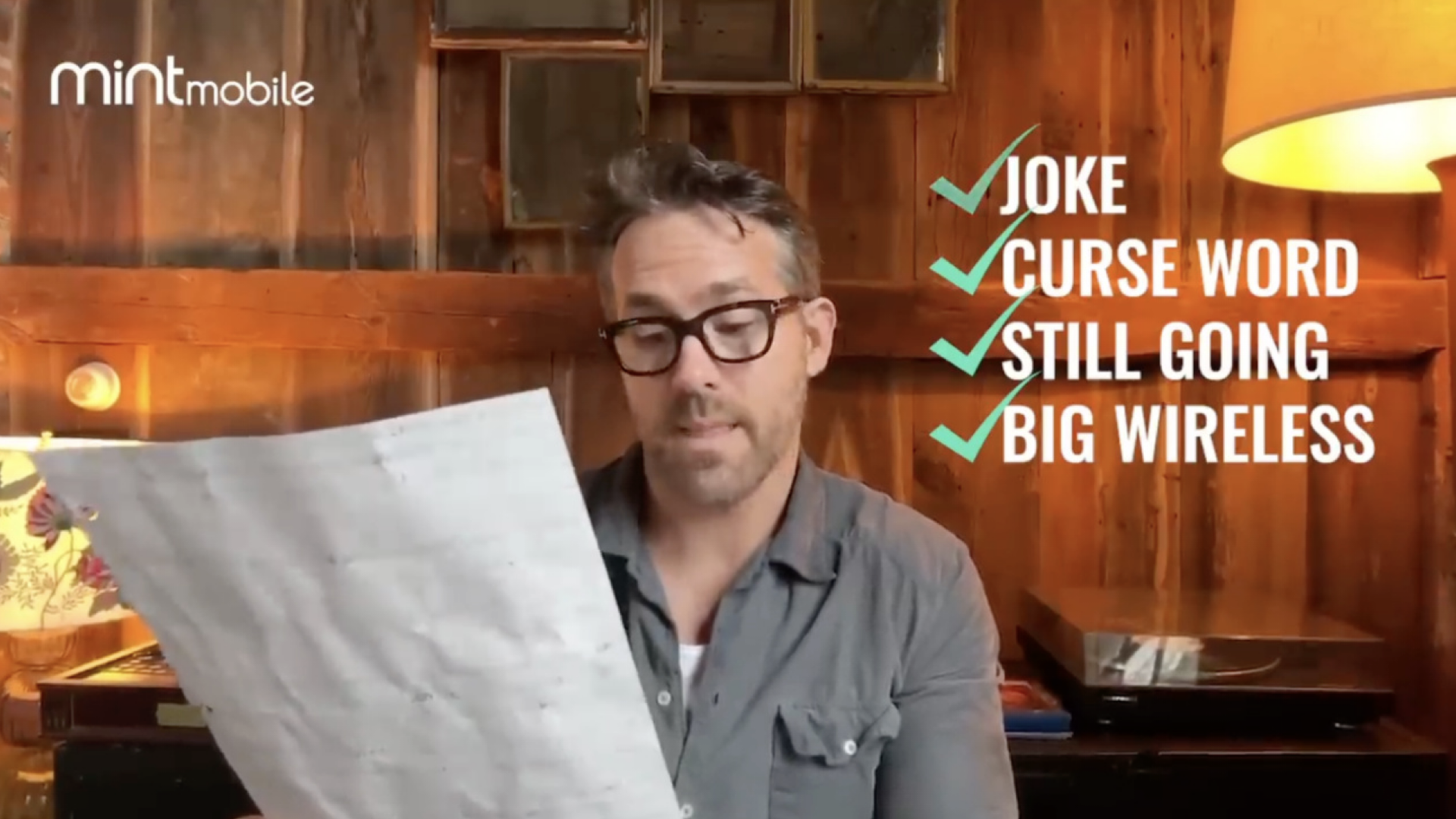
Ryan Reynolds made a Mint Mobile ad by reading a ChatGPT-written script word-for-word. It has 2,000,000 views on YouTube, but you probably shouldn’t try this unless you’re Ryan Reynolds.
The damage extends beyond organic content into paid media, where the financial stakes are higher.
The Harris Poll, working with the 4As and Infillion, found that 78% of consumers believe AI makes advertisements feel less authentic. Sixty-three percent said they are less likely to purchase from a brand that uses AI-generated advertising. Those are not sentiment numbers. Those are purchase-intent numbers. When nearly two-thirds of consumers say AI ads make them less likely to buy, the cost-per-acquisition math for AI-generated creative changes fundamentally.
The same study surfaced a broader fatigue that goes beyond content quality. Fifty-four percent of respondents said they are annoyed by hearing about AI constantly. Sixty-five percent want brands to stop using what the survey describes as "meaningless AI marketing language." Consumers are not just rejecting AI-made content. They are rejecting AI as a selling point.
This creates an unusual strategic trap. Brands that use AI to produce content risk alienating audiences who can detect or suspect it. Brands that use AI and then advertise that fact risk alienating an even larger group that is tired of hearing about it. And brands that stay silent about their AI use face a different problem: if consumers discover it on their own, the trust penalty is likely worse than disclosure would have been.
What the backlash is actually telling us
It would be a mistake to read this data as a Luddite moment. Nobody is asking for the internet to go back to 2019. Consumers are not opposed to technology. They are opposed to a specific experience: the feeling that the content they consume was not made by or for a human being. The rejection is not about the tool. It is about the absence of judgment, taste, and editorial intent that the tool makes it possible to skip.
Mosseri put it precisely in his memo: "We're going to move from assuming what we see is real by default, to starting with skepticism." That skepticism is already here. It is measurable in the survey data, visible in the engagement metrics, and showing up in stated purchase intent.
The question is not whether consumers are pushing back. They are, with their attention, their wallets, and their unfollow buttons. The question is what fills the space that synthetic content is vacating. A new market is forming around human curation, human verification, and human-only content tiers. Consumers are proving willing to pay for the guarantee that a human being decided something was worth their time. The economics of that market are the subject of Part 2.
Pfanner Advantage works with clients to turn change into advantage at the intersection of mobility, motorsport, media, technology, and marketing. Learn more or start a conversation: contact us today.
More Cold Read Insights from Bill Sparks:
When the Customer is a Machine
Should You Allow AI Bots to Crawl Your Site
How AI Is Getting Between Brands And Customers
America Is Building Cars The World Has Stopped Buying
What 1979 Tells Detroit About 2026
Why Aren’t Americans Buying EVs?
Part 8: State of the Art Branding Case Studies
Part 7: How the Ad Industry is Reinventing Itself
Part 6: AI and the Personalization of Brand Narrative
Part 5: Building Brand Loyalty Through Community
Part 4: Independent Creators as Brand Storytellers
Part 3: Brands as Publshers: The Rise of Owned Media
The Advantage Journal arrives every week. What matters in sport, mobility, media, and technology — curated and contextualized by Bill Sparks, Bill Long, and Paul Pfanner. No hedging. No filler. Subscribe — It’s Free