
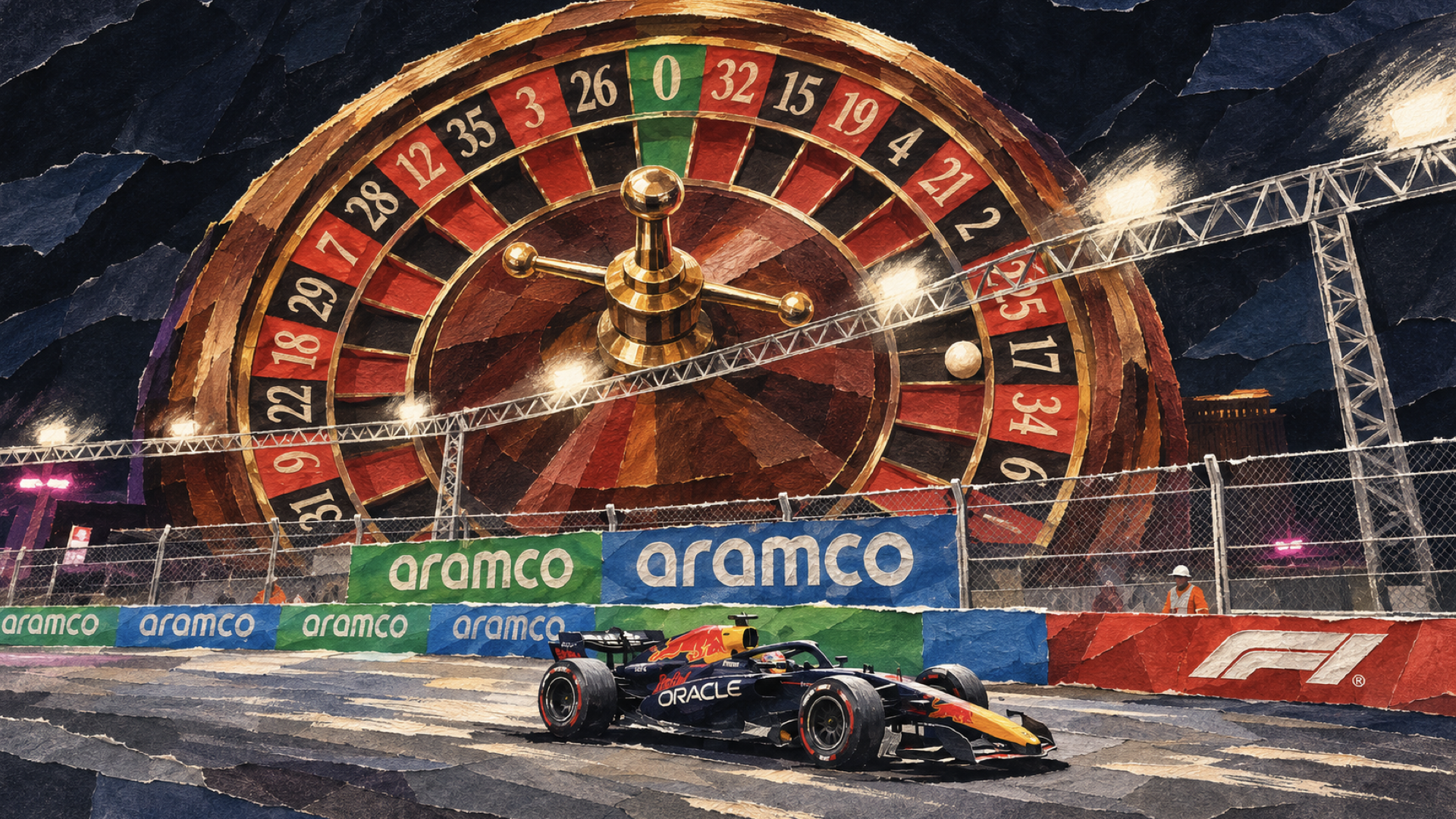
352 passes on the Las Vegas Strip, and the drivers who made them weren't impressed.
Las Vegas gave Formula 1 a record 352 overtakes. Paul Pfanner listened to what the drivers said about them afterward. He has watched American open-wheel racing try to manufacture close finishes before, and here he explains why he trusts the people in the cars over the count.
Formula 1 left Las Vegas with a number it can put in a press release. F1's own count came to 352 overtakes, a record. Then the drivers were asked about it. Max Verstappen called it cruising and compared it to Mario Kart. Sergio Pérez called it very artificial. Alex Albon said it reminded him of Formula E.
A pass at the push of a button
The cause is overtake mode, the extra electrical boost this year's rules give a car chasing another. In Vegas it opened up speed differences so big that a pass came down to who had the energy available, and the driver in front could do very little about it. Lando Norris, who finished second by six-tenths, said it plainly: "some of the overtakes weren't overtakes: you press boost and you go past someone." On a television screen that looks like racing. To the people in the cars it felt mechanical.
Contrived competition has a history
I've never been a fan of contrived, managed competition, and I'll say why. I watched the "wheel-to-wheel excitement" days of the IRL, when pack racing on the high banks gave us close finishes almost every weekend. It proved dangerous, and ultimately deadly. When we lost Dan Wheldon in Las Vegas in 2011, the folly of the experiment was laid bare. And in the end it didn't work anyway. The crowds went away because it was predictable, and because what they were watching lacked meaning. Meaning matters most in live sports. It has to be real, believable, and a feat of human origin.
This year in Vegas was nothing like that physically, and nobody was put at risk by 352 passes. The thinking behind it is the same, though. When the people writing the rules decide the show needs more action and engineer it in, they take something away from the drivers and hand it to the rulebook.
Courage you can see
Motor racing isn't a thrill show. We don't create a racing environment simply to entertain people for two hours. We're here to inspire them with human courage and ingenuity and commitment. A pass a driver has to set up for three laps, risk the car for and then defend all the way to the flag shows you every bit of that. When the battery does the passing, there's a lot less of the driver left to see.
Go with the drivers
The rulebook is never finished, and F1 deserves credit for admitting a miss inside the first season. Vegas hands the people working on the fix a clearer brief. The drivers best placed to judge the racing have said what they think of it. Verstappen, who won the race, put it this way: "When I look at it from my racer heart, not. When you look at it as a show spectacle, yes." The record says one thing and the drivers say another, and I'd go with the drivers.
Every business has a version of this. It's easy to build a count that keeps going up and call it success. The harder question is whether the people who know your work best would call it real.
Pfanner Advantage works with clients to turn change into advantage at the intersection of mobility, motorsport, media, technology, and marketing. Learn more or start a conversation: contact us today.
Paul Pfanner’s recent Shift Happens Insights:
Other Than That, I Enjoyed the Film
The Advantage Journal arrives every week. What matters in sport, mobility, media, and technology — curated and contextualized by Bill Sparks, Bill Long, and Paul Pfanner. No hedging. No filler. Subscribe — It’s Free

