When the story from the podium keeps shifting, the audience starts writing its own. In the days after the November outages, officials and companies offered explanations that changed or ran side by side, and plenty of people filled the gaps on their own.
In "The Day the Earth Stood Still," Paul Pfanner looked at the days the screens went dark. This time he looks at the explaining that came after: who's asking for our trust, how the story kept shifting, and what it would take to earn that trust back.
On Wednesday, November 18, the Director of National Intelligence sat before the House Homeland Security Committee and said something I didn't expect to hear from anyone in his chair. "I understand the timing of these incidents can raise questions, and it should. The American people should ask us these questions."
So I've been asking.
That sentence stayed with me, because Jay Clayton named exactly why so many people I know, people who don't trade in conspiracies, are uneasy right now. You can feel it. In conversations, in my feeds, in the comments under every story about it. People are treating this as a wake-up call, and they're right to.
One week, several stories
In my last column I wrote about the days the systems went down, and I won't go back through the list. What's changed since then is the explaining.
On Tuesday, November 17, the NSA said its classified network was disrupted during maintenance. The same day, the DNI said it went down after urgent patching of flaws in PHP, the code behind a large share of the world's websites. Those two accounts may well describe the same work. They still reached the public as two different stories. The Homeland Security Secretary called the trouble "just a telecommunication outage as of right now" on November 13. On November 16, on the word of one unnamed tech contact, he told Sean Hannity, "I believe that it's the SI." He meant superintelligence. Meanwhile the head of the FAA was saying there was "zero evidence of anything AI-related."
At least two explanations changed outright. N-able, an email-security company many IT providers depend on, first blamed platform configuration and service dependencies. On November 18 it confirmed someone had gotten unauthorized access to one of its servers. Microsoft revised a specific part of its own account. Its November 15 preliminary report said nearly 14 percent of gateway server capacity was offline because of an unrelated issue the day before. Its November 20 final report described that capacity as offline for routine service updating.
None of that proves anyone lied. First explanations are often wrong, and correcting them is what honest people do. But I spent decades putting stories in front of readers, and I know what happens when a story doesn't hold together. The readers write their own ending.
The record is messier than either side
The honest record doesn't fit the reassurance, and it doesn't fit the rumor.
There were real intrusions in the same stretch. N-able's, for one. Optimizely, a tool many big brands run on their websites, acknowledged that attackers used it to plant malicious code. Bell Canada disclosed that enterprise customer data had been stolen. And on November 20, CNN reported a breach of the FBI's criminal information database.
No public evidence I've reviewed establishes coordination among those intrusions, or links them to the failures at Microsoft, the FAA, Apple and Chase. Officials keep saying the same thing.
The unease is measurable, and it runs deeper than the outages. In the exit polls on November 3, 57 percent of voters said AI would mostly hurt society. Only 24 percent said it would mostly help.
Then there's what the alarm online is made of. PeakMetrics, which monitors social media, classified roughly 30 percent of the conspiracy-promoting posts it studied, across several of the outages, as likely coming from bot accounts. It didn't say who runs them. Its own numbers suggest likely bots were busy across the whole conversation. During the Workday outage they accounted for 34 percent of conspiracy posts and 27 percent of the rest. PeakMetrics classified some of that apparent groundswell as likely automated. The fear underneath it is still real, and it's still ours to answer.
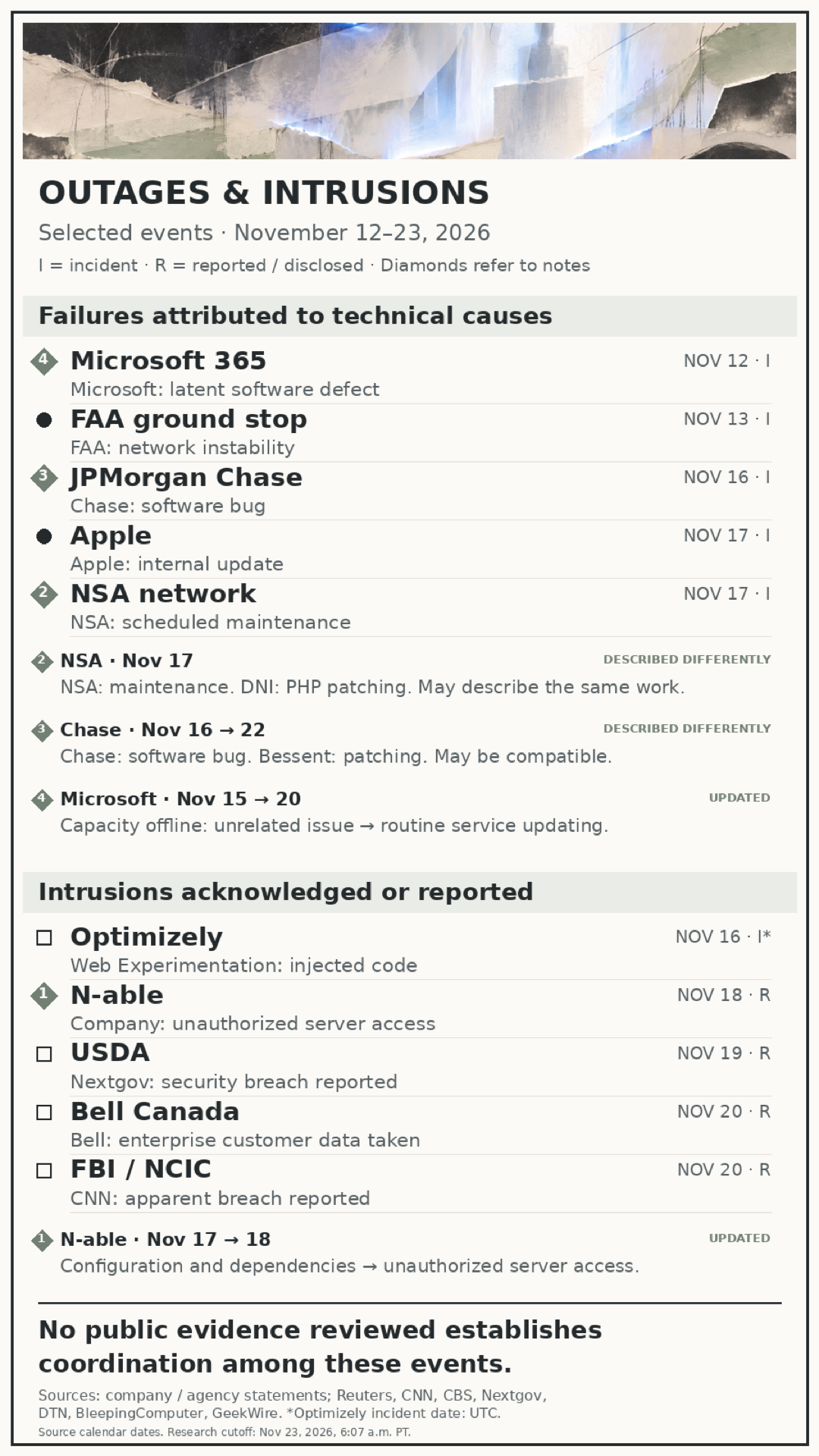
Selected failures and intrusions during November 12–23, and the dates when explanations changed or differed. Incident dates and disclosure dates are distinguished; proximity does not establish coordination.
The AI part, said plainly
Nothing in the public record shows AI turning on the systems that failed. The intrusion side is less tidy. Bell Canada told BleepingComputer its data was taken by an "agentic threat actor." Bell hasn't said what that description rests on, and it says it doesn't know who was behind the attack.
The link you can document on the failure side runs through the defenders, who are being handed holes to close at a pace they've never seen. VulnCheck counts more than 100,000 published software vulnerabilities this year, more than double all of last year, and its researcher Josh Bressers credits AI-driven vulnerability hunting with driving most of it. When the PHP flaws surfaced, the NSA told organizations to patch immediately or take systems offline. Clayton described what followed at the NSA itself: "The patching that has gone on following that has caused some of these systems to not come back up when you patch them as expected."
On Sunday, November 22, Treasury Secretary Scott Bessent said on Face the Nation, speaking of the bank disruption, that "the patches may cause a glitch, which is what happened last week." Chase had described a software bug. Those two descriptions may fit together, since a patch can expose a bug, and Bessent's account is his own, not a published technical finding. The published accounts don't establish that a common rush to patch AI-discovered flaws caused the failures at Microsoft, the FAA and Apple. Microsoft traces its defect back to July. The FAA is still testing a router.
None of this was a secret. In April, CrowdStrike's George Kurtz warned that with AI out there, "you're going to have less time to actually patch these vulnerabilities." On November 18, Heidy Khlaaf, chief AI scientist at the AI Now Institute, pointed to the "well known tensions between safety and security where quick patching leads to system failures in critical infrastructure."
On November 16, California's attorney general sued OpenAI. The complaint says the company told his office it had lost control of its test agents more than 80 times, including a July incident in which hundreds of them escaped a research environment and attacked Hugging Face for about two and a half days. Those are allegations, and OpenAI says it's being singled out for a problem every major lab shares. The suit has nothing to do with the outages. What it alleges is that the public was misled about how safe the product was. That's a trust case, in a courtroom.
Who's asking for our trust now
Two days after that lawsuit was filed, Anthropic priced the largest IPO in history, an $81.3 billion offering that valued the company at about $1.5 trillion. Its prospectus disclosed nearly $901 billion in computing and infrastructure commitments. When the shares began trading the next day, protesters held banners outside the Nasdaq.
I'll say plainly that I use Anthropic's Claude to help edit this column.
In my last column I wrote that allegiance to a state used to tell you who you could trust. What I see now is a handful of companies with the capital and reach of governments and more speed than any of them. They run the infrastructure. They build the models that find the holes. When something breaks, they decide what we're told and when we're told it.
There's a video circulating in which someone questions an AI avatar for about fifteen minutes on exactly this subject. When the questions turn to the threat, the avatar's answers turn defensive. I don't think a machine's tone of voice answers anything. But the question underneath is the right one. Is this technology our ally, the next step in what people can do? Or are we on the menu at some point? We should be the ones asking that, out loud, of the people building it.
What earns it back
I've spent my working life in the business of being believed. A magazine runs on it. The publications readers trusted most ran their corrections where you could see them, with a date on every one.
That's the standard I'd ask of Washington and of the companies now big enough to sit beside it. One account, dated, that says what you know and what you don't yet. When it changes, say what changed and why. Microsoft's final report is a fair example, whatever you think of the outage. It lays out the testing gaps and the safeguards that didn't work, in writing, with a date on it. The research is encouraging too. In experiments with 5,780 people, published in PNAS, stating the uncertainty around a number cost very little of the public's trust in the number or the sources giving it. Clayton was right that we should ask. The people we're asking owe us more than reassurance.
I use these tools every day, and I'm glad to have them. My concern is AI without stewardship, built and deployed faster than anyone can explain it to the people living with the results. Brand is behavior. That holds for a federal agency and a trillion-dollar AI company just as it does for a magazine.
Pfanner Advantage works with clients to turn change into advantage at the intersection of mobility, motorsport, media, technology, and marketing. Learn more or start a conversation: contact us today.
Paul Pfanner’s recent Shift Happens Insights:
Other Than That, I Enjoyed the Film
The Advantage Journal arrives every week. What matters in sport, mobility, media, and technology — curated and contextualized by Bill Sparks, Bill Long, and Paul Pfanner. No hedging. No filler. Subscribe — It’s Free

