
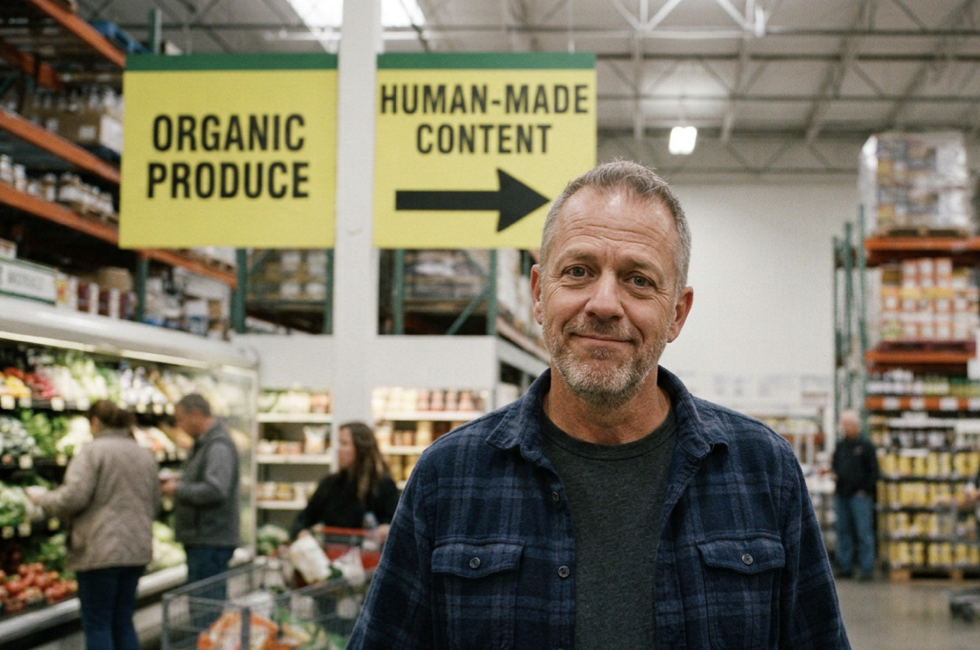
What can be called “organic” has been legally defined since 2002. The legal definition of what can be considered “human content” is still under development.
Part 3 of 4. “Human-made” is now considered a premium value proposition. Bill Sparks looks at how a multi-layered technology stack capable of verifying content provenance is being developed in real time.
In Part 1 of this series, we noted Instagram head Adam Mosseri's year-end prediction that it would soon be "more practical to fingerprint real media than fake media." That sentence implied a technology stack that could verify the origin and authenticity of content at scale. At the time he wrote it, the stack barely existed. Less than a year later, the core components are operational. They are not yet reliable enough to function as consumer-facing guarantees, but they are moving faster than most brand strategists realize.
The parallel to organic food is useful here. "Organic" began as an unregulated marketing claim in the 1970s. It became a USDA-certified standard in 2002. It now represents a market worth more than $60 billion a year in the United States. "Human-made" is following the same trajectory. The marketing claims are already appearing. The certification infrastructure is under construction. Regulation has arrived in Europe.The question is not whether provenance verification will become a market standard, but how fast.
The Coalition for Content Provenance and Authenticity, known as C2PA, has built an open standard that functions as a digital chain of custody. Camera hardware and editing software record tamper-evident metadata directly into file headers at the point of creation: capture device, time, location, edit history. The metadata is cryptographically signed, meaning any subsequent alteration breaks the seal.
The coalition's membership reads like a roll call of the industry. Adobe, Google, Microsoft, and Sony are founding members. On the hardware side, Leica shipped the first C2PA-capable camera, the M11-P, in October 2023. Canon added signing to its EOS R1 and R5 Mark II through 2025 firmware updates. Sony's professional camcorders and Alpha series bodies gained support through firmware and licensing programs aimed at news organizations. Google's Pixel 10 signs every photo by default, making it one of the first mass-market smartphones to treat provenance as a default feature.
On the AI generation side, Adobe Firefly, OpenAI's DALL-E 3 and Sora, and Google's image models all attach C2PA manifests to their output. The creation layer, in other words, is filling in. Major cameras sign photos. Major generators label their output. The infrastructure exists to mark content at the moment it comes into being.
The problem is what happens next. Social platforms re-encode uploads, messaging apps compress images, and content management systems strip metadata during processing. X removes manifests entirely and does not display them. Meta uses C2PA signals internally for "AI info" labels but does not show the underlying manifest to users. No major web browser displays Content Credentials by default. The Reuters Institute found thatfewer than one percent of news images published globally include C2PA metadata in their final form.
That number is the gap between promise and reality.The creation layer signs content. The distribution layer erases the signature. Until platforms preserve provenance metadata as reliably as cameras and generators produce it, the chain of custody has a missing link.
The fragility of the system showed up in an unexpected way in September 2025, when Nikon suspended its C2PA signing service for the Z6 III after researchers demonstrated that multiple-exposure composites could carry valid signatures. Nikon revoked its certificates and had not restored the service as of mid-2026. A standard designed to prove authenticity was temporarily undermined by the complexity of defining what "authentic" means when a camera does computational processing on a photograph.
Proving provenance
Google's SynthID takes a fundamentally different approach. Instead of recording metadata about a file's history, SynthID embeds imperceptible mathematical signals directly into pixels, audio waves, or text tokens during the generation process.The watermark is part of the content itself, not a label attached to it.
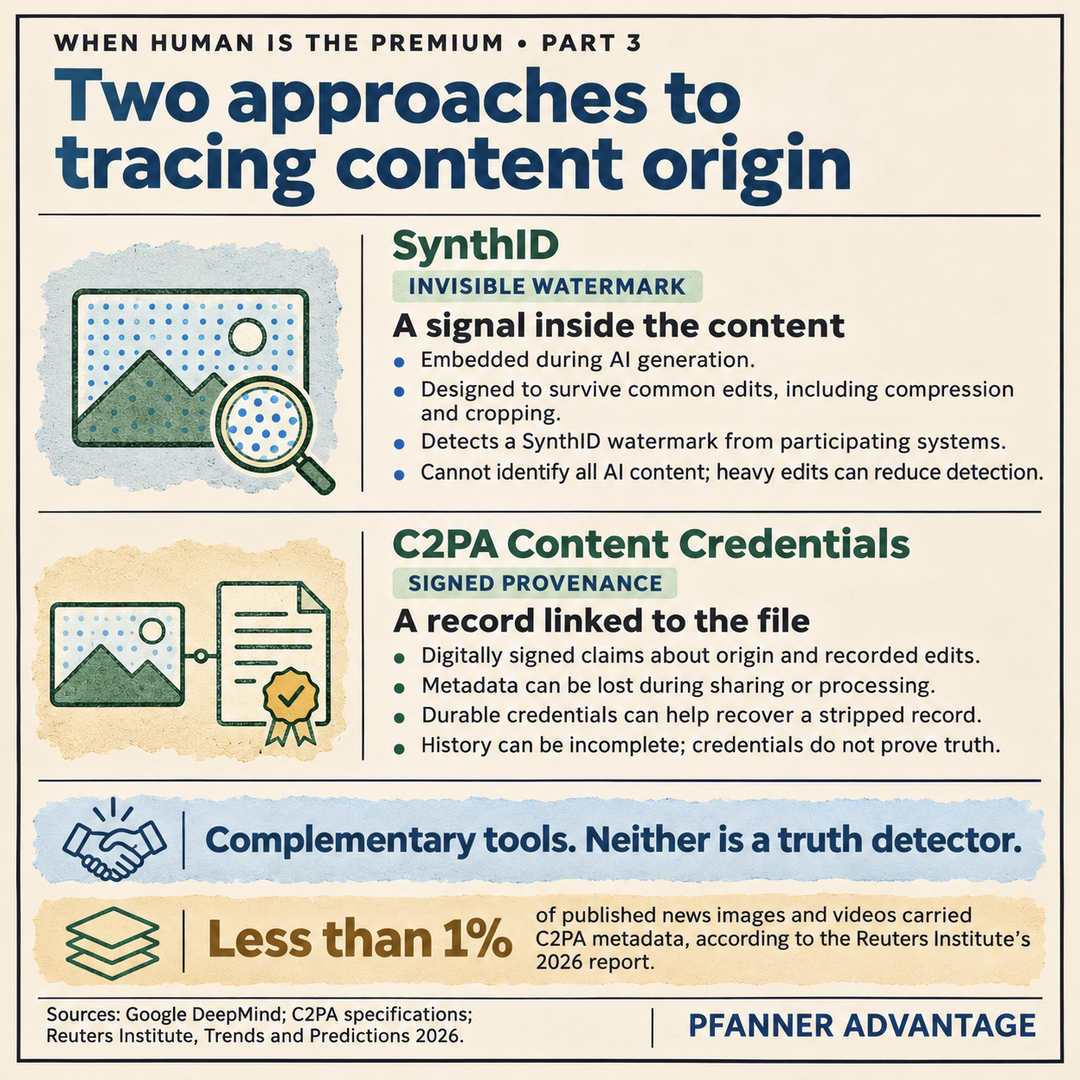
SynthID embeds mathematical signals into content to identify its source. C2PA uses metadata information to identify provenance, but fewer than 1% of published news images retain the metadata. The system is still far from perfect.
The scale of deployment is significant. Google reports that more than 180 billion images and videos and the equivalent of 240,000 years of audio have been watermarked with SynthID since 2023. Verification built into Google Search, the Gemini app, and Chrome handles over one million requests daily. In October 2026, Google opened the SynthID Detector at synthid.com to the public, allowing anyone to check whether an image, video, or audio file carries a SynthID watermark.
The system is no longer a Google-only tool. OpenAI, NVIDIA, and Kakao have adopted SynthID watermarking for their own AI outputs, with Apple reported as a forthcoming partner. This cross-platform adoption matters because a watermarking standard is only as useful as its coverage. A detector that only catches Google-generated content misses the majority of AI output. One that catches Google, OpenAI, and NVIDIA output covers a much larger share of the market.
The distinction between C2PA and SynthID is worth understanding clearly. C2PA proves what something is: a photograph taken with a specific camera at a specific time. SynthID proves what something came from: an AI model made by a specific company. Together, they form complementary layers of a verification stack. C2PA certifies where content came from and what was done to it. SynthID identifies which AI system generated it. Between the two, a piece of media can be verified from both directions.
The limitation is that SynthID detects only watermarks from participating platforms. It is not a general-purpose AI detector. Content from open-source models like Stable Diffusion, or from companies that have not adopted the standard, produces no signal. The detector's own documentation states explicitly thata negative result does not rule out AI generation.
Regulation as a forcing function
The technology might have remained voluntary and uneven for years if not for regulation. The EU AI Act's Article 50 transparency obligations took effect on August 2, 2026, creatingthe first major regulatory framework that treats content provenance as a compliance requirement.
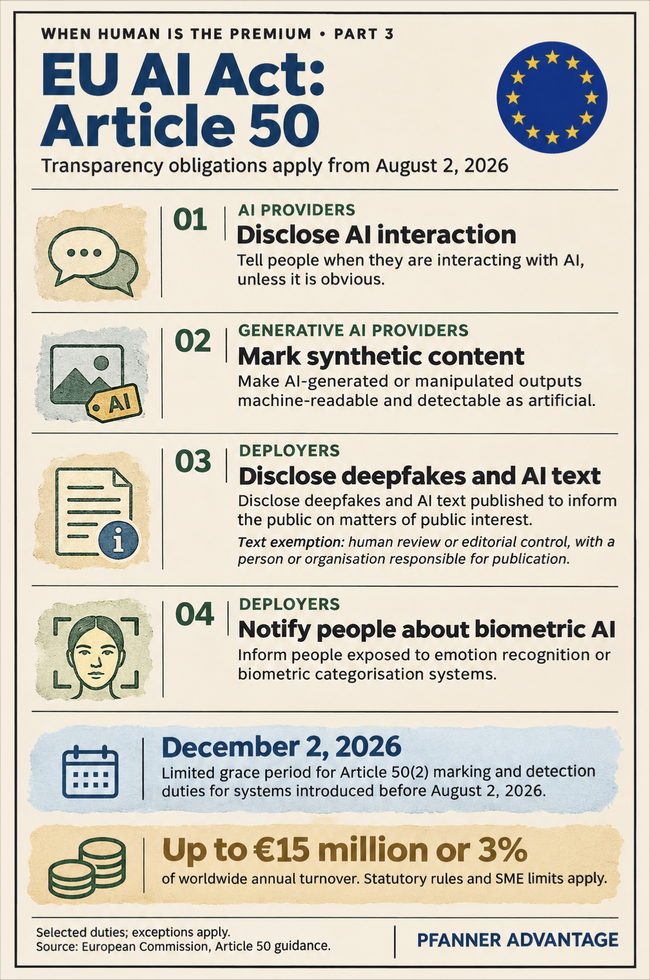
EU is leading the way in legally defining AI transparency obligations. Most international commercial AI generators are working on compliance to the EU standards.
The rules impose four categories of obligation. Providers of AI systems that interact with people, such as chatbots, must disclose that the user is dealing with AI. Providers of generative AI must embed machine-readable signals in synthetic content so software can detect its origin. Deployers must disclose deepfakes and AI-generated text on matters of public interest, unless the content received human editorial review and a named person takes responsibility for publication. And deployers of emotion recognition or biometric categorization systems must inform exposed individuals.
The penalty structure makes compliance non-optional: violations can bring fines of up to 15 million euros or three percent of worldwide annual turnover, whichever is higher. Systems already on the market before August 2 have until December 2, 2026 to add required markings.
The regulation has a predictable accelerant effect. News organizations including the BBC, the CBC, and The New York Times are already surfacing Content Credentials on selected published pieces through a consortium called Project Origin. YouTube now uses C2PA data to display a "Captured with a camera" label. TikTok reads manifests to auto-label AI uploads. LinkedIn displays a Content Credentials icon. The direction is consistent across platforms, even if execution remains uneven.
The distribution gap
The verification stack is no longer theoretical. Cameras sign content at the hardware level. The largest commercial AI generators watermark their output. Regulation requires disclosure. Detection tools are publicly available. These are not pilot programs. They are operational systems processing billions of pieces of content.
But the stack works at the endpoints, not in the middle. Content is verified when it is created and can be checked when it arrives, but the path between those two points strips, compresses, and re-encodes the signals that make verification possible. Apple, the world's largest smartphone maker, is not a C2PA member. In September 2026, rather than joining the coalition, Apple launched its own proprietary signing mechanism called Reference Image, a hardware-rooted system that is incompatible with C2PA. The result is not just a gap in adoption but a fragmentation of the standard itself. The gap between what the technology can do at the point of creation and what consumers can see at the point of consumption iswhere “certified human” will be won or lost.
For brands evaluating this landscape, the implication is practical. The infrastructure to verify human-made content exists and is maturing.Adopting it now, before consumer-facing verification tools are ubiquitous, creates a positioning advantage when those tools arrive. What that adoption looks like is the subject of Part 4.
Pfanner Advantage works with clients to turn change into advantage at the intersection of mobility, motorsport, media, technology, and marketing. Learn more or start a conversation: contact us today.
More Cold Read Insights from Bill Sparks:
When the Customer is a Machine
Should You Allow AI Bots to Crawl Your Site
How AI Is Getting Between Brands And Customers
America Is Building Cars The World Has Stopped Buying
What 1979 Tells Detroit About 2026
Why Aren’t Americans Buying EVs?
Part 8: State of the Art Branding Case Studies
Part 7: How the Ad Industry is Reinventing Itself
Part 6: AI and the Personalization of Brand Narrative
Part 5: Building Brand Loyalty Through Community
Part 4: Independent Creators as Brand Storytellers
Part 3: Brands as Publshers: The Rise of Owned Media
The Advantage Journal arrives every week. What matters in sport, mobility, media, and technology — curated and contextualized by Bill Sparks, Bill Long, and Paul Pfanner. No hedging. No filler. Subscribe — It’s Free