
Same moment, different lenses. The media frames through which we encounter a shared world can shape what we notice and how we understand it.
Paul Pfanner has spent five decades building media brands and helping others build theirs. In this column, the second in a series that began with The Great Unwalling, he turns from the people who make media to the people who use it, especially those born this century, and finds more common ground than the usual generational story allows.
One of my daughters reads books. Printed ones, and she goes through them fast.
She's an aerospace engineer and a pilot, and she wants to be an astronaut. You'd have a hard time finding someone more fully of this century. And when she sits down to read for herself, she picks up paper.
I think about that a lot. In The Great Unwalling I wrote about the walls coming down between brands and their audiences, and how people with something to say no longer need the old gatekeepers to reach anyone. That piece was about the people making media. This time I want to look at the people on the other end, especially those born this century who never formed the relationship with traditional media my generation remembers. They're the ones who will shape the next fifty years, and I want to understand how they find what matters to them.
We're all living through the same moment, but what each of us notices in it can be pretty different.
Where the News Finds Them
I've spent my working life in branding, and the first thing it taught me is that a brand gets built in people's heads, one encounter at a time. Where someone meets it shapes what they think it is. Two people can meet the same product and walk away with very different impressions. I think news works that way now. Culture too.
And the generations are meeting the news in very different places. In Pew Research Center's survey from August 2025, 76% of adults ages 18 to 29 said they get news from social media at least sometimes. Among those 65 and older, it was 28%. When Pew asked about getting news regularly on specific platforms, the TikTok gap was enormous, 43% of the youngest adults against 3% of the oldest. YouTube and Facebook were much closer, with real numbers in every age group.
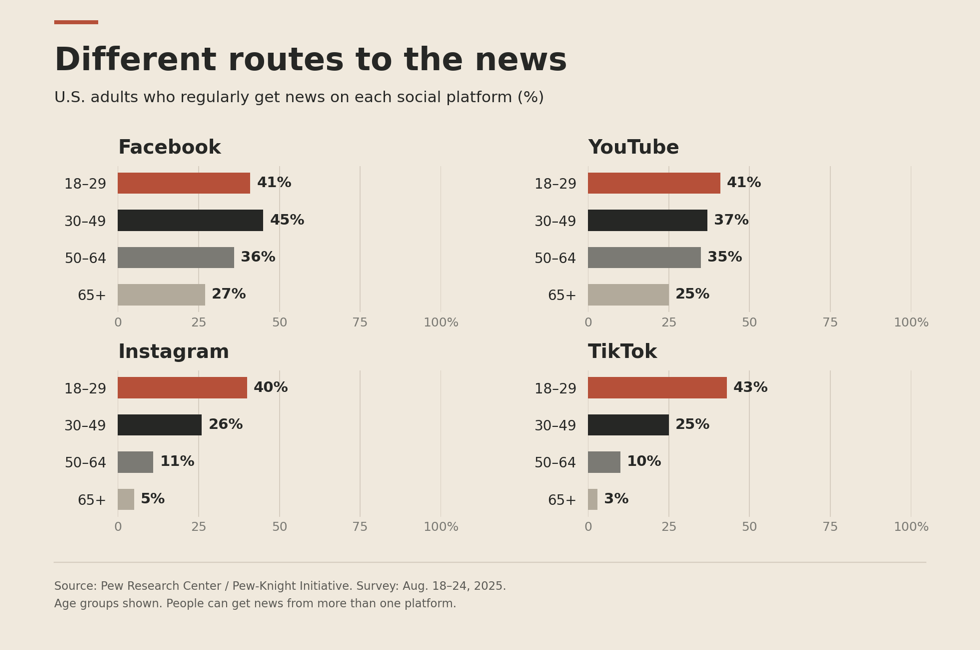
Different routes into the same world. News use on Instagram and TikTok differs sharply by age, while YouTube and Facebook provide more overlap. These figures measure regular news use of each platform, not overall platform use or agreement about the news. Source: Pew Research Center / Pew-Knight Initiative, survey Aug. 18–24, 2025.
What caught my attention was how the news reaches them. Seven in ten adults under 30 told Pew they mostly get political news because they happen to come across it. Among people 65 and older it runs the other way, with most saying they go looking for it. About half of the under-30 group say they have at least some trust in information from social media sites, almost the same share who say that about national news organizations, 50% and 51%. That's trust in whole categories of sources, and it doesn't mean they can't tell good reporting from bad. And they draw a wider circle around who counts as a journalist, with many including newsletter writers and people who make their own news videos.
So the same event can arrive in very different clothes. A story found through a familiar creator, with comments and reaction videos stacked on top of it, is a different experience from the same story read on a news site or watched on an evening broadcast. The facts underneath may be identical, but how much weight they carry, and what's piled around them, can change a lot.
I should be careful here, and this goes for everything that follows. Pew's under-30 group isn't the same thing as "born this century," and an age gap in a survey can't tell us how today's 25-year-olds will behave at 60. Politics and education shape these habits too, and so does money. Still, gaps this size deserve attention from anyone who wants to stay useful to the people coming up.
Culture Has Its Own Routes
Culture works a little differently. Music, film, games and sport, and the communities that grow up around them, follow their own paths.
Deloitte's 2026 Digital Media Trends survey, fielded in October and November 2025, found that about 80% of U.S. consumers call themselves fans of something. Among Gen Z fans, 73% said social media is their main way of discovering new shows, movies, music, games or events. For millennial fans it was 68%. Then many of those same fans leave social media to get the real thing. Among Gen Z fans, 57% said they usually go somewhere else to watch, listen or buy the full version.
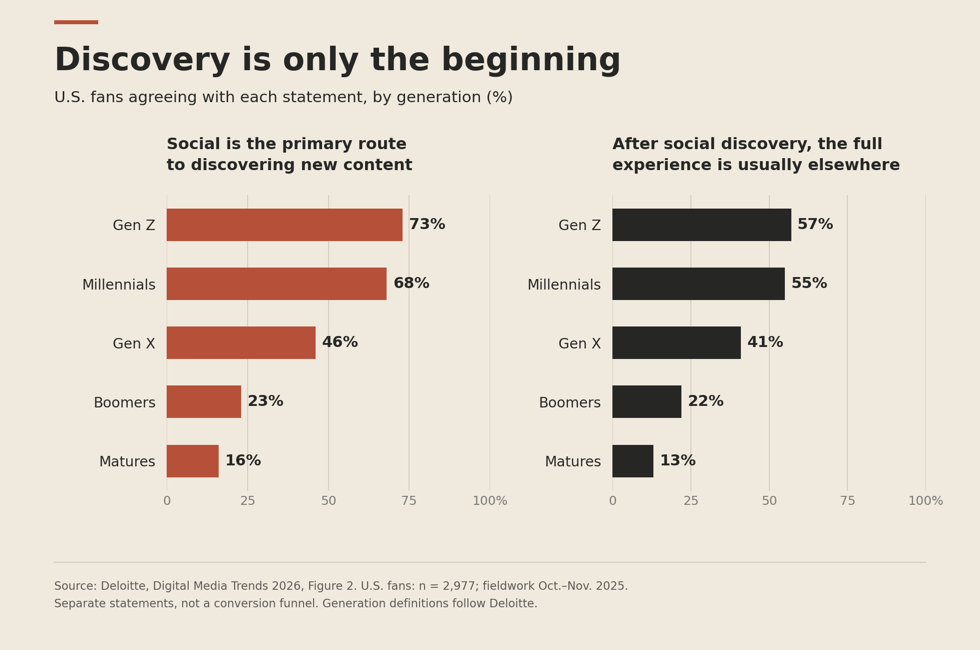
Discovery does not determine the destination. Younger fans are more likely to discover entertainment through social media, and many report going elsewhere for the full experience. The two measures are separate survey statements, not a measured conversion rate. Source: Deloitte, Digital Media Trends 2026, Figure 2; U.S. fans, n = 2,977; fieldwork Oct.–Nov. 2025.
So people find things in one place and enjoy them somewhere else. A short clip sends someone to a two-hour film, or a post sends them to a bookstore. I'd bet plenty of concert tickets start with a creator's video.
If you're in media, that changes the job. Moving the old product onto a new platform doesn't get you there by itself. You have to know where people are finding things and who they listen to when they do.
What I Saw from Inside
I spent most of my working life on the making side, and for years I'd been questioning the business model wrapped around good magazines. From my seat at RACER during the pandemic, I watched the website audience climb as people hungered for the sport. More attention didn't answer how the work gets paid for, and the whole industry was learning that lesson at the same time.
My interest in Taro Koki's work with GT Channel, and in social media and the web, came from wanting to go where the audience was going. We talked about creators contributing to a physical magazine, and about watch-alongs where readers could take part while a race unfolded. Those ideas are still alive in my head, and versions of them are turning up in what younger publishers are doing now.
Then things shifted again. ChatGPT reached the public in late 2022, and Google started putting AI-written summaries at the top of search results in May 2024. When Pew tracked real browsing in March 2025, people clicked a regular search result on 8% of visits to pages with an AI summary, against 15% on pages without one. Google disputed the methodology, and the study shows a pattern rather than proof of cause. Anyone who depended on search to bring readers through the door still felt that number.
By 2025 the Reuters Institute found that more Americans got news weekly through social and video platforms, 54%, than through television at 50% or news websites and apps at 48%.
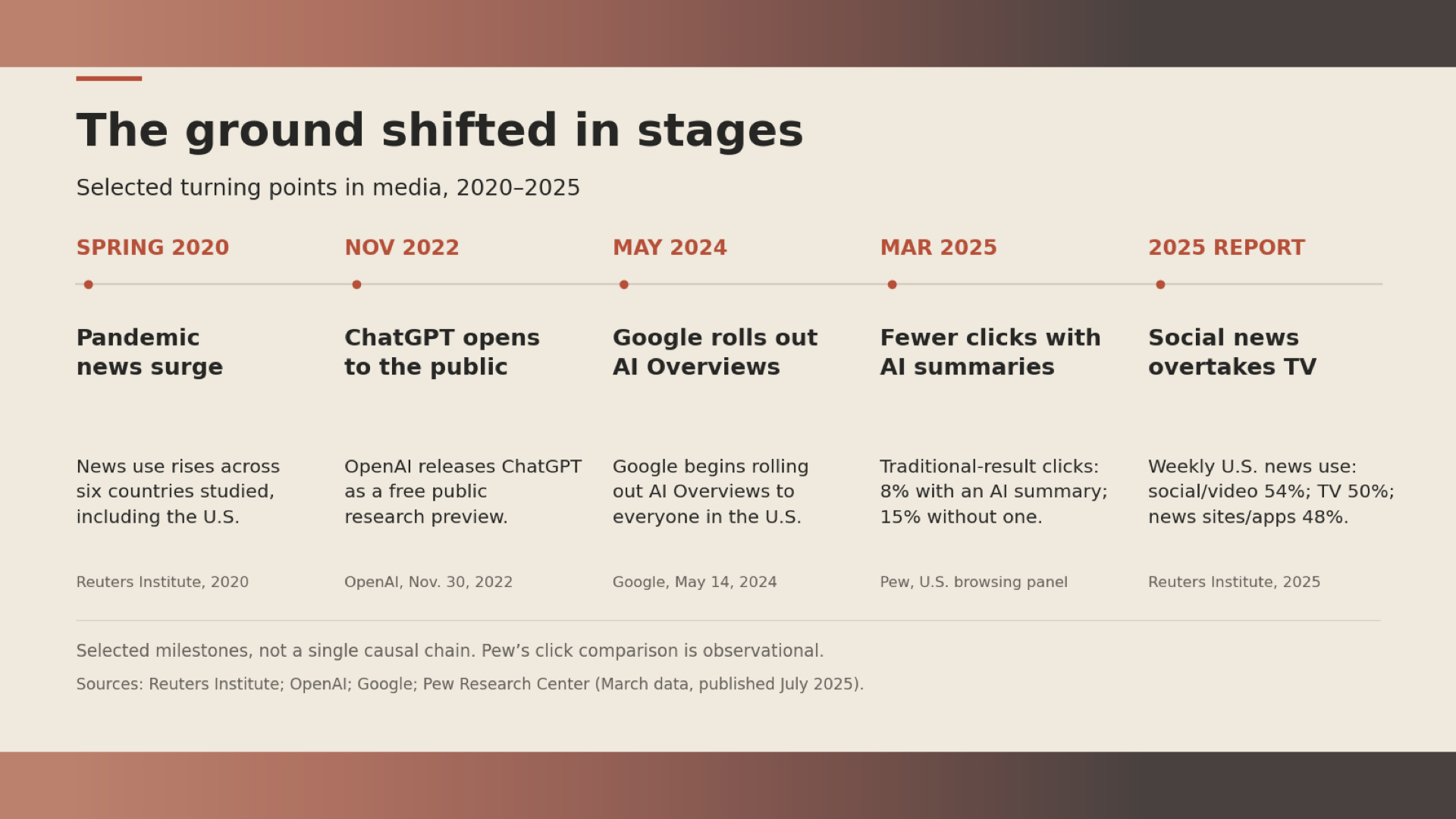
A changing route to the audience. The pandemic’s news surge was followed by the public arrival of ChatGPT, AI-generated answers in search and measurable shifts in how people encountered news. These are selected turning points rather than a single causal chain.
I don't think any one of these explains the rest. It was all happening at once, to everybody in the business.
Maybe We Need a Vacation
I've also been wondering what it's like to live inside all of this.
On my laptop I usually have several things going at once, and a message will interrupt an article, and then a notification shows up while I'm answering the message, and something else needs checking. Some days I can't quite remember how my attention worked before this was normal.
Young people aren't uniformly comfortable with it either. In Pew's survey of U.S. teens taken in the fall of 2024 and published in April 2025, 45% said they spend too much time on social media, up from 36% in 2022, and 44% said they had cut back on social media. Most also said the platforms help them stay connected to friends. So they feel connected and worn out at the same time.
That survey is only about social media, and overload comes from plenty of other places. Still, it pushes back on the idea that kids who grew up with all this are happy with it. Deloitte's 2026 industry outlook lists younger audiences easing off daily social use as one of the signposts it's watching.
I'm not talking about throwing the phone in the ocean. Some days I just want something that lets me stay with one thing for a while, and a printed page does that for me. The reading happens between me and the page. Whether that matters to younger readers is something I'd want to hear from them before I assume it.
Then There's the Book
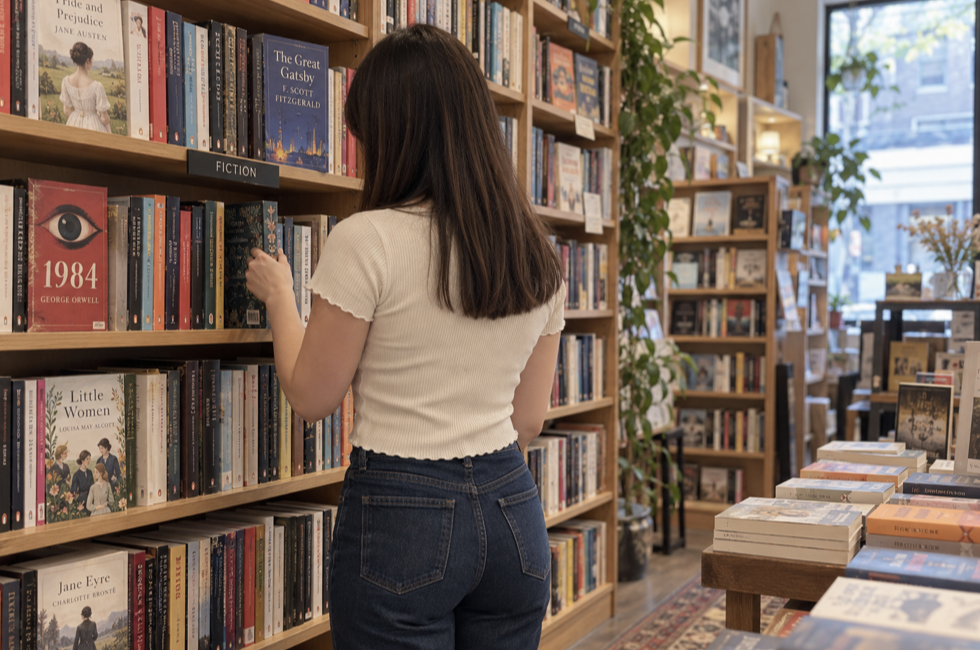
A different kind of attention. Growing up with digital media does not mean leaving paper behind. A printed book offers another way into the world, at a pace the reader chooses.
Which brings me back to my daughter and her books
Pew's book survey from October 2025, published this past April, found that 66% of Americans ages 18 to 29 had read all or part of a printed book in the previous year. Among those 65 and older it was 65%. The younger group used e-books and audiobooks far more, 41% and 32% against 23% and 13%, and they kept reading on paper while they did it.
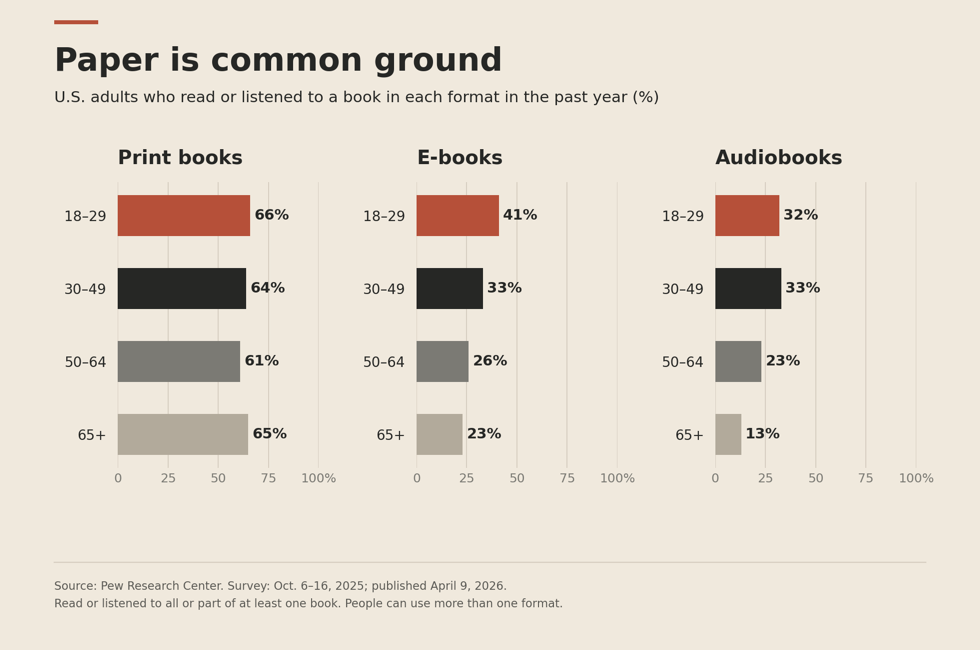
Paper is common ground. Printed books reach similar shares of the youngest and oldest adults, even as younger adults make greater use of e-books and audiobooks. The figures include reading or listening to part of a book, and readers can use multiple formats. Source: Pew Research Center, survey Oct. 6–16, 2025; published April 9, 2026.
We can't tell from this how many books anybody finished, or why they picked paper, and books aren't magazines. Even so, I'd have a hard time telling the easy story now, the one with older people on paper and young people on screens.
Young Publishers Choosing Paper
Something else is happening out on the edges, and it's the part of this I find most encouraging.
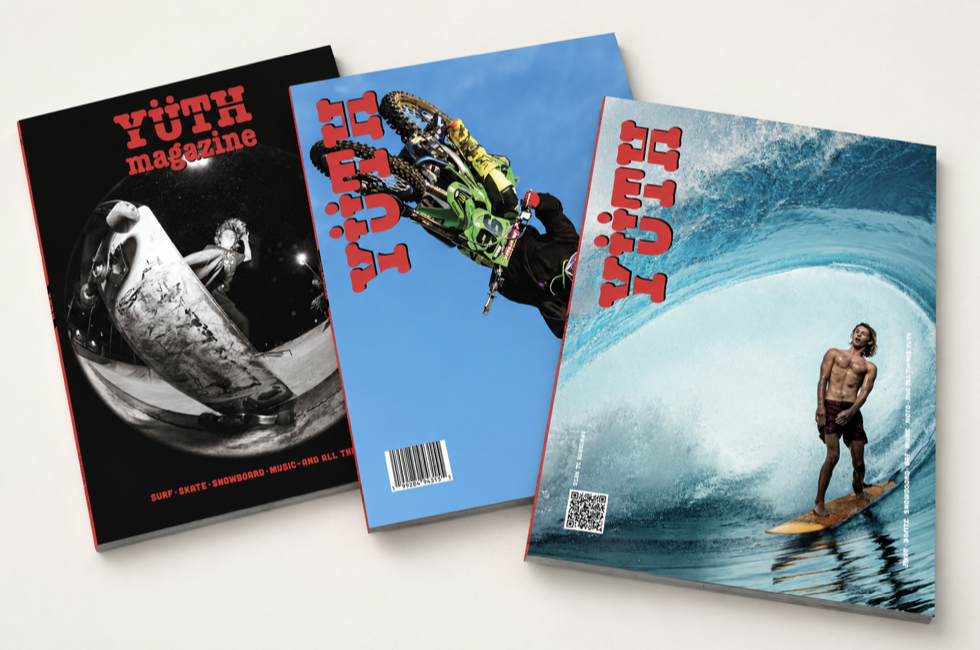
Just down the coast from me in San Clemente, two young locals, Carson Kropfl and Mikey Walshe, started YÜTH, a magazine about action sports and the culture around them. They've said they never plan to release a full digital version, because they want something you can hold that pulls you away from the scroll. They use social media to get people to the physical thing.
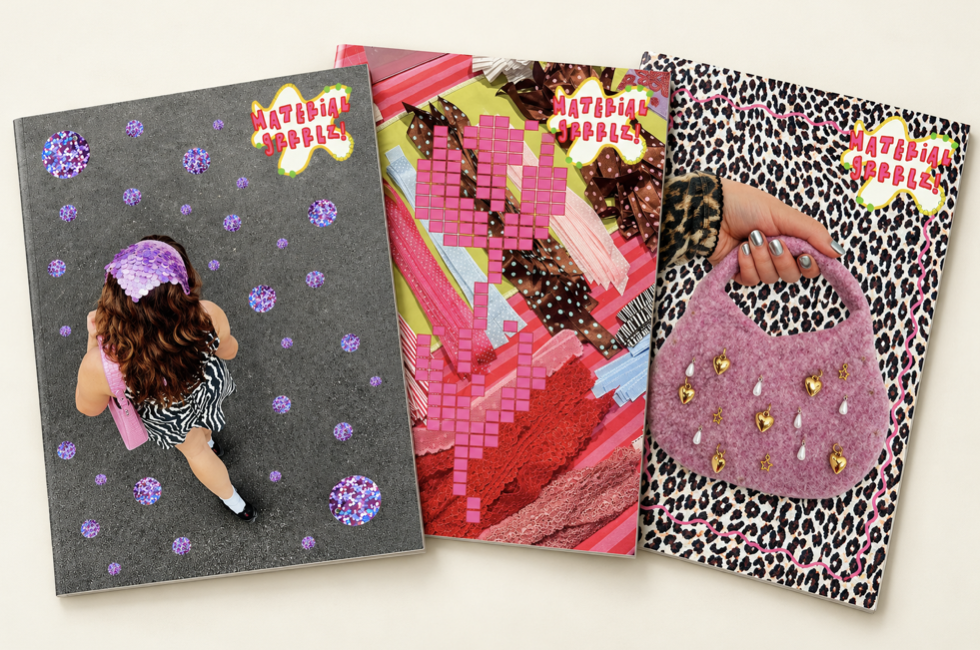
In London, Alexa Kari grew Material Grrrlz out of a fiber-art meme page. It's a quarterly about knitting, crochet and sewing, and the digital edition is free. Print comes with a paid membership, along with workshops and an online community. So print is something members get.
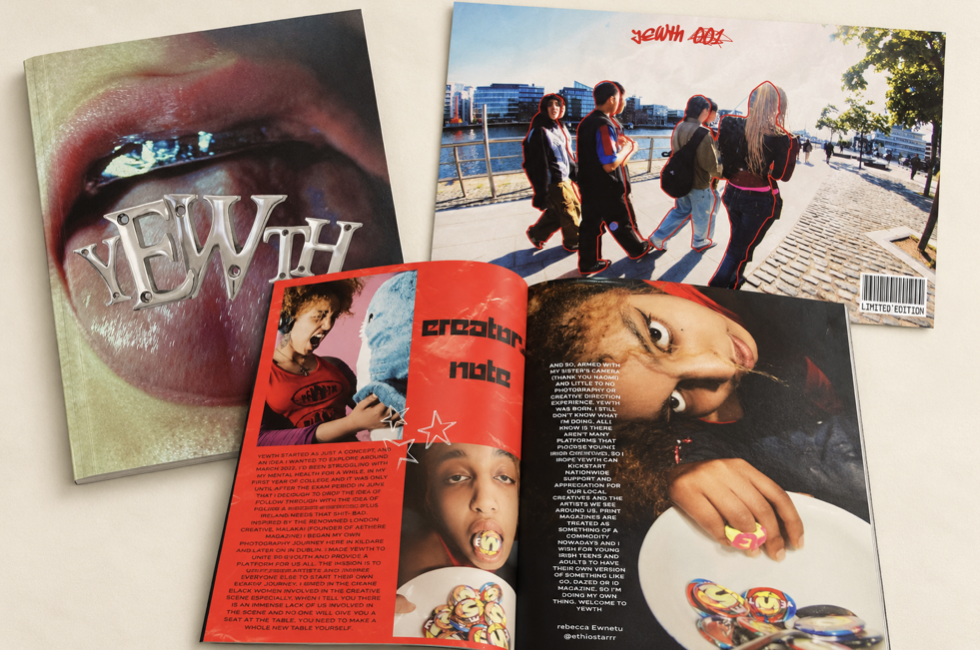
In Ireland, a young Ethiopian-Irish photographer named Rebecca Ewnetu launched yEWth with a 140-page first volume in Dublin in 2023, partly to show what Irish youth looks like now. The National Gallery of Ireland has since profiled her and the magazine.
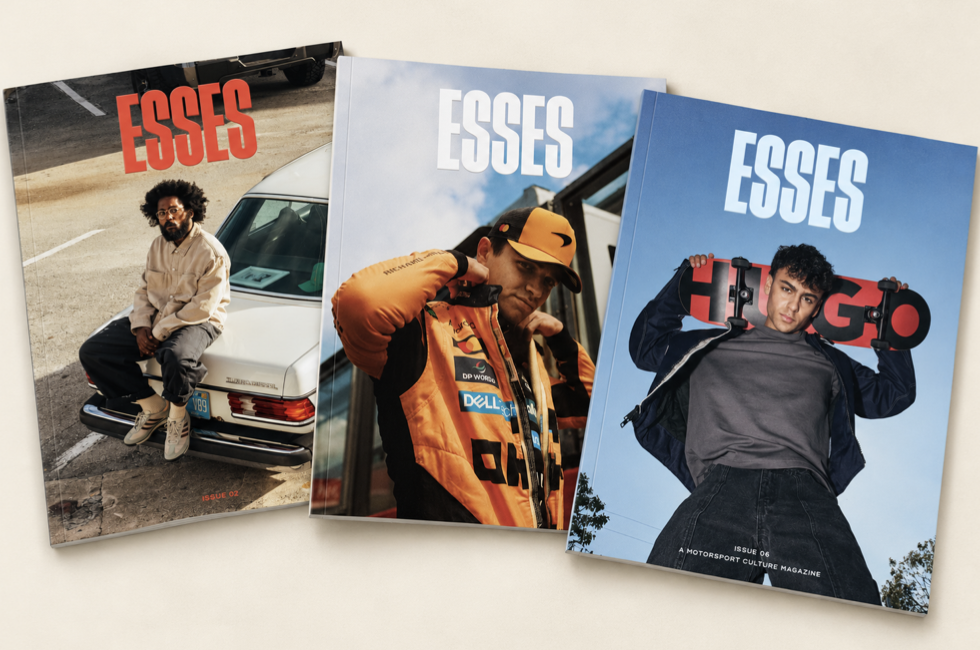
And in Formula One, ESSES put out its first quarterly in October 2024, covering the sport through travel, food, fashion and culture instead of suspension geometry. Founder Ojus Jain calls the print magazine the brand's window, the thing that tells a reader or a sponsor what Esses stands for the moment they hold it. He describes a business where subscriptions and branded work grow alongside events around the race calendar, roughly in balance, though he allows that the advertising side leads for now. He also says the company raised a multimillion-dollar round from motorsport and media investors early this year. Those are his own figures, not audited ones, and that backing puts Esses in a different category from the others here.
I can't tell you any of these will last, and four magazines don't speak for a generation. But here are young people deciding on purpose that paper is right for their work, and they're using it in different ways. YÜTH is selling the magazine itself. Esses uses its magazine as the clearest statement of what the brand is, and a lot of the rest of the business grows out from there.
A Place to Meet
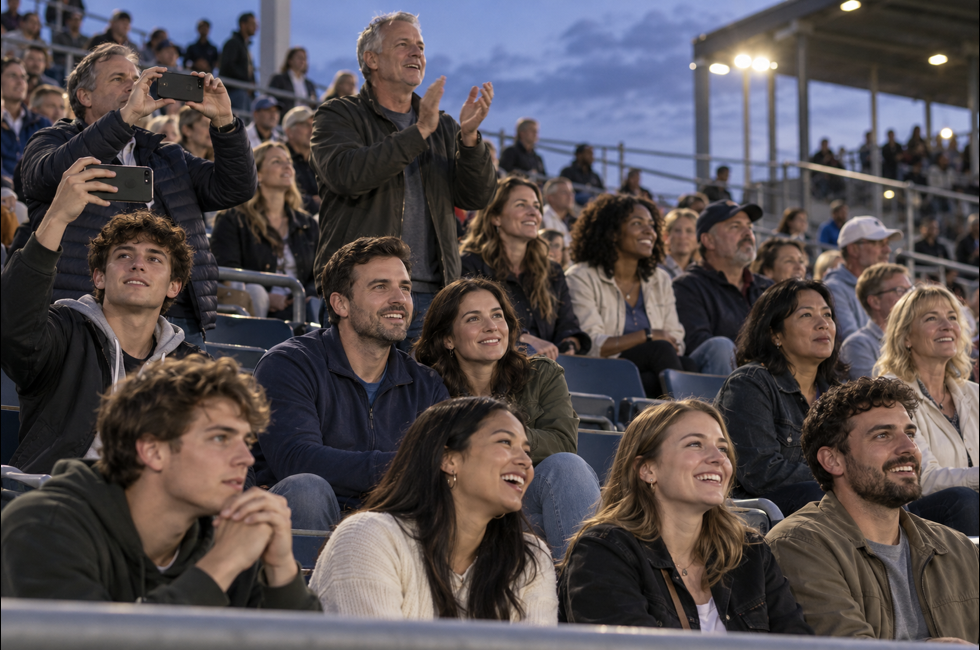
A shared moment, different experiences. Some record it, some applaud, others quietly watch. A live event brings people’s attention together without making their experiences identical
Live events offer another kind of common ground.
Formula One reported a record 6.7 million in combined attendance across its 2025 season, with 19 of 24 races sold out. Live Nation says 159 million fans came to its shows in 2025, up 5%, and for the first time more than half of them were outside the United States. Those are global totals and ticket counts, not unique people, and nobody's proving anyone put their phone down. Still, that's a lot of people who wanted to be there in person.
Often the digital world is what puts them in the seat. Someone finds a driver or a band online, gets attached, and decides they have to go.
At a race or a concert, three generations can stand in the same place and watch the same moment happen. They may have arrived by different routes and they'll leave with different stories. For a few seconds anyway, they're all watching the same thing.
Watching the same thing isn't the same as agreeing about it, though. In marketing we've always said perception is reality, and that's true about how people experience a brand or a story. It's no way to settle whether something really happened. You still have to check, whichever feed it came through.
What Stays Open
As for magazines, I think a printed one may still have a place because it gives you something a feed can't. Somebody picked what's in it for you, and it ends. You can finish it and hand it to a friend.
Whether enough people will pay enough for that is a question each publication has to answer for itself. Printing and postage still cost money, and liking the idea of print doesn't cover the bill. The young publishers I mentioned are answering it in different ways, and I think that's the most useful thing they're showing the rest of us. For some of them, print is becoming the anchor of something larger. I don't know yet if that lasts.
I've made media most of my life, which gives me a point of view and also some assumptions I need to keep checking.
The Next Layer
There's a layer under all of this I haven't touched yet, and it has two sides. One is AI standing between people and work that already exists, summarizing search results and answering questions. Pew found 13% of adults under 30 already get news from AI chatbots at least sometimes. The other is AI helping people make new work. I've made an album with AI tools, and I recently reviewed a film made with Grok. It's early, and art, design, presentations and music are good places to look at what it's doing. I want to give each of those its own column, and that's where the series is headed.
Pfanner Advantage works with clients to turn change into advantage at the intersection of mobility, motorsport, media, technology, and marketing. Learn more or start a conversation: contact us today.
Paul Pfanner’s recent Shift Happens Insights:
Will NASCAR Play the TV Game or Redefine It?
The Advantage Journal arrives every week. What matters in sport, mobility, media, and technology — curated and contextualized by Bill Sparks, Bill Long, and Paul Pfanner. No hedging. No filler. Subscribe — It’s Free

