

For generations, institutions controlled access to the means of creation and distribution. The walls haven't all disappeared, but they no longer determine who gets to participate.
Paul Pfanner spent more than four decades building media franchises the old way, with presses, ad sales, distribution and a lot of people who believed in the work. Now the walls that made those franchises possible are coming down, and he's asking the question most of the industry would rather skip. Who needs whom?
For most of my working life, building a media franchise meant building an institution.
You needed money and talented people. You needed production, distribution, advertisers and an audience willing to give you its attention. It didn’t matter whether you published a magazine, produced television, made films or recorded music, you needed access to infrastructure that relatively few people controlled. And the people who controlled it had a lot to say about who got in.
I spent more than four decades building businesses inside that system. I know its economics and what it does well. I also know where it runs out of road. And I learned early that the institution and the brand were two different things, even when the whole industry behaved as if they were one.
Today that difference is getting impossible to ignore.
The Walls Are Coming Down
Look at what’s happening across media right now.
Start with music. Global recorded music revenue reached $31.7 billion in 2025, the eleventh straight year of growth, according to IFPI, the organization that represents the recording industry worldwide. The record business is doing fine. What’s gone is the old requirement that an artist land a deal, book studio time and secure physical distribution before anyone could hear a note.
In November 2025, Warner Music Group settled its copyright lawsuit with Suno, the AI music company, and the two became partners in licensed AI music. One of the companies that historically controlled recorded music is now doing business with the technology that lets individuals make recordings without it.
Hollywood shows it from another angle. On-location shoot days in greater Los Angeles fell 16.1% in 2025, according to FilmLA, the region’s film permit office. In the second quarter of this year, location filming was down nearly 13% from a year earlier, while shoot days for online content jumped 47%.
There’s more than one force behind those numbers. Other states and countries compete hard for production, viewing habits have changed and money is tight. But two things are happening at once. The established production machine is shrinking while the more accessible kinds of media making keep growing.
Television is telling the same story. In July, streaming accounted for 49% of all television viewing in America, according to Nielsen, and YouTube alone took 14.2%. Someone with a compelling idea no longer needs a network executive, a programming department or a broadcast license to reach viewers.
Then there’s print. On October 13, Northwestern University’s Medill School released its annual State of Local News report. Nearly 80% of American newspaper jobs have disappeared since 2005.
A magazine used to be a whole commercial ecosystem. Specialized knowledge, editorial judgment, creative talent, advertising relationships, production and distribution all lived under one roof. The publisher pulled those capabilities together and built an audience around them, and what came out the other end was a branded franchise.
Today a journalist, a photographer, a filmmaker or a commentator can build a direct relationship with an audience without going through that institution at all.
The work the institution does is as valuable as ever. Its exclusive grip on access is another matter, and that gets harder to defend every year. That shifts the balance of power.
The Brand Is Not the Franchise
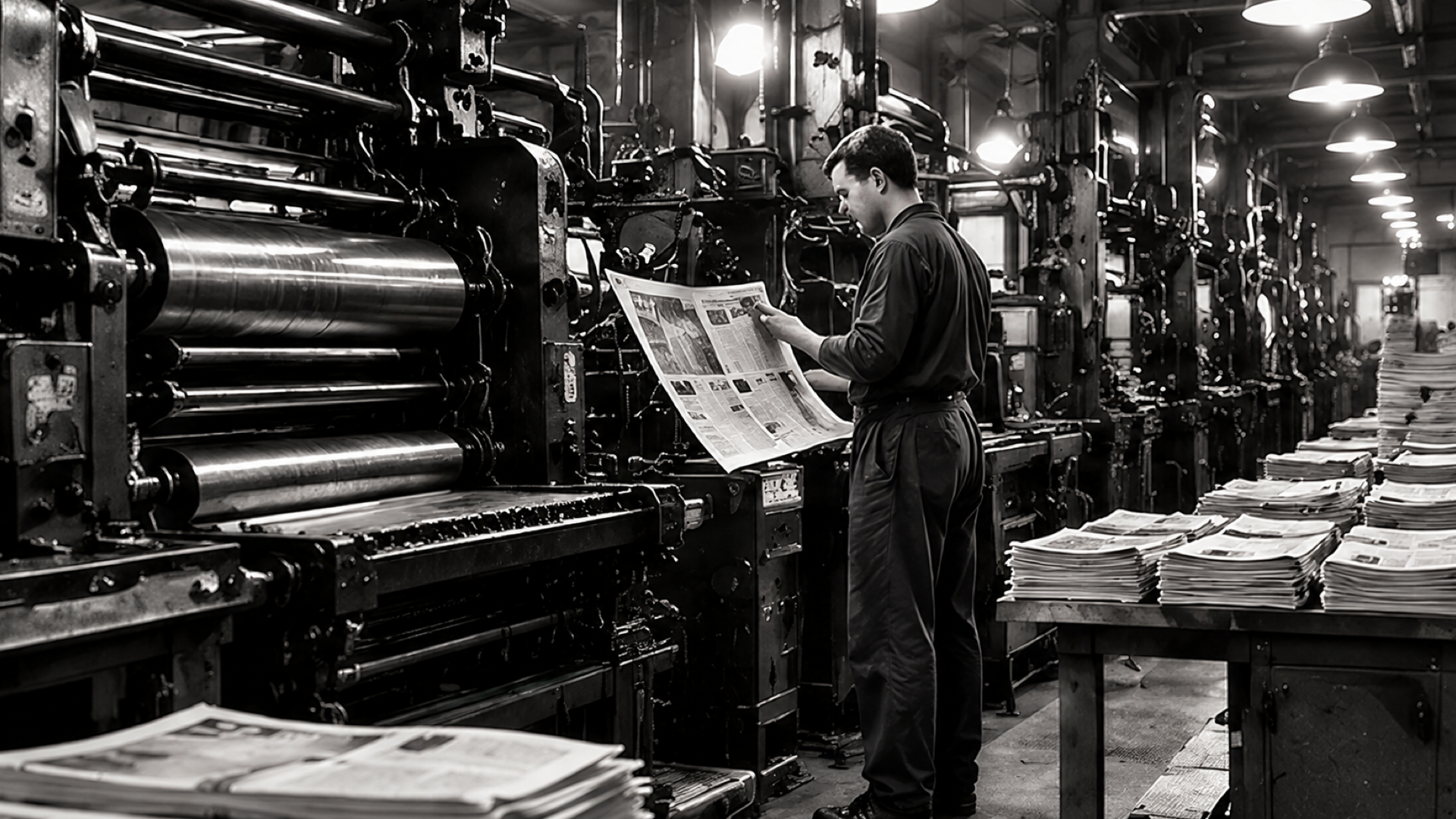
The Power of Infrastructure. Printing presses, recording studios, broadcast networks, and distribution systems once defined the economics of media. Their scarcity gave institutions power—and made their franchises possible.
For decades media companies built franchises around scarce things. Printing presses, broadcast frequencies, recording studios, theatrical distribution and access to advertisers. Scarcity created economic advantages you could protect.
A brand is none of those things. It lives in the minds of the people who experience it. Its value comes from what people expect of it and whether it keeps its promises, and that kind of trust gets earned slowly.
I’ve said for years that brand is behavior, behavior is brand. That hasn’t changed. How you deliver on it has.
For most of the last century the franchise supplied the resources, infrastructure and access that let individuals build reputations and reach an audience. More and more, that relationship is running the other way. The brand may no longer need the franchise, and the franchise increasingly needs the brand.
Think about what that means. A television network needs personalities viewers care about. A record label needs artists people want to hear, and a publisher needs writers, photographers and editors whose judgment readers trust.
The institutions still bring real things to the table: investment, coordination, scale, marketing muscle, editorial standards and commercial relationships. What they’ve lost is the exclusive claim to making creative work possible, and creative people now have alternatives. An individual can build an audience, earn a reputation and create economic value without the institution that once controlled the door.
That doesn’t make everyone a brand. Recognition isn’t reputation. Popularity isn’t trust, and getting attention is a long way from earning loyalty. But the source of commercial power is moving.
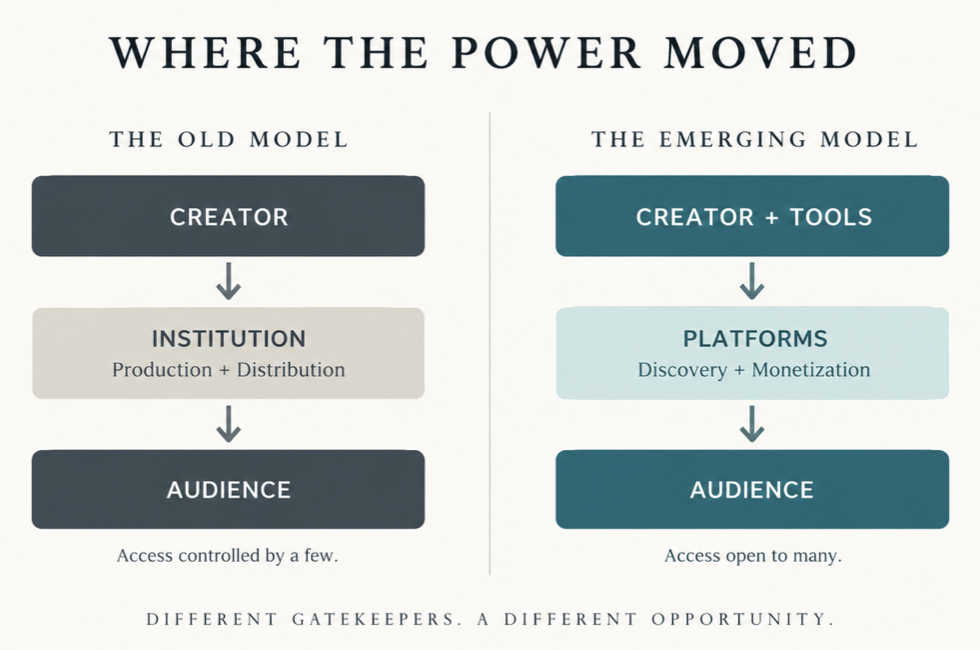
The gatekeepers have changed. Traditional institutions controlled production and distribution; digital platforms increasingly control discovery and monetization. Creative access has expanded, but economic power hasn't disappeared.
Who Needs Whom?
That’s the question traditional media companies are being forced to answer.
A publisher can own a famous title, but readers trusted it because of the people whose knowledge, credibility and relationships made the publication matter in the first place. Those people were always its most valuable asset.
A network can own a channel. It can’t make anyone watch. A record company can own an enormous catalog and it still needs artists who can make something people want to hear.
The infrastructure still has value. Infrastructure without relevance is overhead.
This isn’t a philosophical point either. The Interactive Advertising Bureau reports that U.S. advertising spending on creators hit $37 billion in 2025 and is forecast to reach $44 billion this year. Advertisers are putting money into the relationships audiences have with individuals, and leaning less on the institutional channels that used to gather those audiences for them.
The money follows the relationship. There’s a catch, though.
The Walls Haven’t All Disappeared
Some of them just moved. Traditional media controlled production and distribution. Today’s technology platforms control discovery, visibility, audience data and how creators get paid. Google and its YouTube, Meta, TikTok, Spotify and the rest open the door to enormous audiences while keeping a firm hand on who gets seen and what they earn.
We’ve traded one set of dependencies for another.
And as creative work gets easier to make, the fight for attention gets fiercer. A creator may not need permission to publish anymore, but still has to earn the audience’s attention, build trust and figure out how to make a living at it. The new system opened access to everyone. Success is another matter.
I learned that firsthand this summer. I wrote eighteen songs and made an album in thirty-seven days, videos included. Five weeks earlier none of it existed. I’d never written music before. I’d never used the platforms either, Suno for the songs or Hedra for the videos. I did all of it from almost a dead stop and made something that resembled real music, the kind that would have passed two decades ago. It’s shocking what you can do. I’m not a music savant all of a sudden, and I’ve moved on to other things. I did it to prove you could do it in a medium I’d never worked in at all, and to understand the technology by doing it instead of forming an opinion from the sidelines.
It showed me how far the distance between an idea and a finished production has collapsed. It also showed me what the technology can’t hand you. It can’t hand you judgment. It can’t hand you a life lived, or the instinct for what matters and how to get it across to another person.
A convincing recording isn’t necessarily a meaningful performance. An impressive image isn’t automatically a story worth telling, and being able to publish something doesn’t make it worth reading.
AI is not judgment.
That’s going to matter enormously as the volume of content keeps climbing. Production is getting abundant and attention isn’t. Trust still has to be earned, and trust is where lasting brands live.
Justificationism Is the Enemy
I use that word for the habit of defending decisions, structures and investments because of what they’ve meant to us, instead of looking at what’s changed around them. It gets dangerous when the conditions that made those structures valuable are gone.
There’s no virtue in preserving an institution because it once served an essential purpose. There’s no virtue either in tearing down something valuable without understanding what made it work.
Nobody needs to get rid of publishers, studios, labels or networks. The job is separating the lasting value they create from the infrastructure they once needed to create it.

The Power of Agency. Tools once available only through substantial financial and institutional resources are now within an individual’s reach. The ability to create has expanded dramatically. The judgment to make something matter remains human.
Good judgment matters. Editorial integrity matters. So do great music, storytelling, reporting and filmmaking, and so do intellectual property, fair pay and the ability of talented people to keep doing their work.
What may not matter anymore is getting an institution’s permission before you try any of it.
That’s an extraordinary opportunity. For generations, creative potential was held back by more than imagination, talent and determination. It was held back by access to resources somebody else controlled. A lot of those limits are falling away.
Which leaves a question a lot more interesting than whether the traditional media franchise survives.
If the Brand Doesn’t Need the Franchise, What Should the Franchise Become?
Maybe its future is in opening doors instead of guarding them. I think the franchise that wins helps the people who create value get more of it, and spends its energy putting together the talent, judgment, relationships and money a new opportunity needs, rather than protecting infrastructure whose original job is mostly done.
The next great media franchise may look nothing like a traditional media company. It might be a network of people, ideas and capabilities organized around shared interests and ambition, coming together and re-forming as opportunities show up.
Whatever value it has will come from the people and the work that bring others in.
For most of my career the franchise handed out the permission to reach an audience. The creators don’t need that permission now, so the franchise has to give them a reason to show up, and most of the ones I know haven’t figured out what that reason is yet. I’d like to help a few of them figure it out.
Pfanner Advantage works with clients to turn change into advantage at the intersection of mobility, motorsport, media, technology, and marketing. Learn more or start a conversation: contact us today.
Paul Pfanner’s recent Shift Happens Insights:
Will NASCAR Play the TV Game or Redefine It?
The Advantage Journal arrives every week. What matters in sport, mobility, media, and technology — curated and contextualized by Bill Sparks, Bill Long, and Paul Pfanner. No hedging. No filler. Subscribe — It’s Free

