
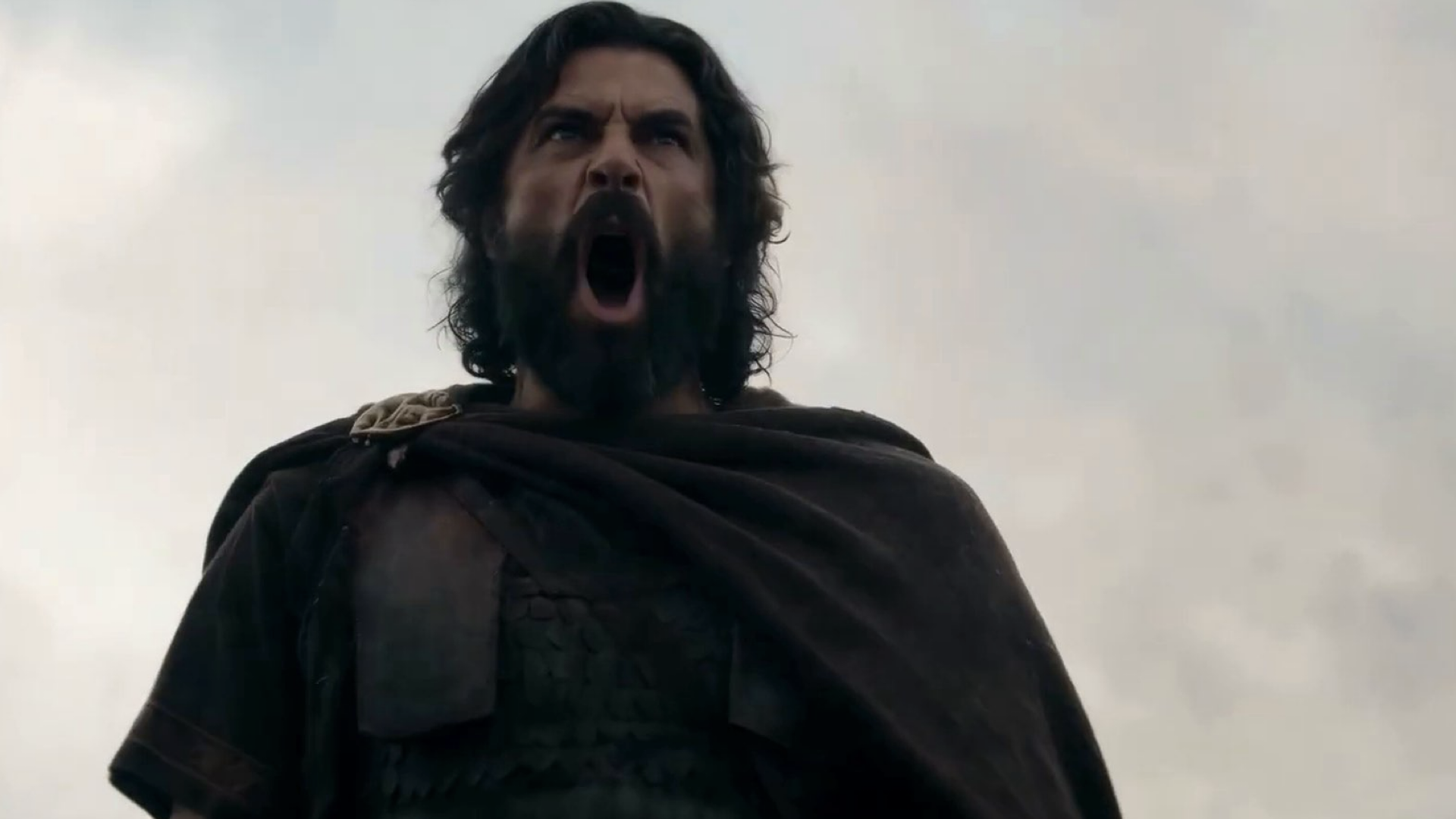
Odysseus at 4:45. I could relate. By the time this moment came, I wanted to scream with him. Image: Grok Imagine / Wonder Studios, The Odyssey, Episode 1
Elon Musk promised a full-length Odyssey made by AI. Paul Pfanner endured the seven minutes and twelve seconds that showed up instead, and came away convinced that Homer’s oldest lesson about pride still holds.
It’s unwise to act on every impulse. It’s also equally unwise to believe your own PR, which is shorthand for believing your own bullshit. I’m breaking the first rule by reviewing this film. You can decide for yourself who broke the second.
I’ve been writing a lot lately about Tesla and SpaceX, and it’s made me particularly aware of all that Elon Musk has going on. Dare I say, this one is perhaps the most telling, for reasons I believe will be obvious if you can endure the gauntlet, also known as watching the whole thing, all seven minutes and twelve seconds of it.
Some context if you missed it. In July, right after Christopher Nolan’s Odyssey opened, Musk went on X and criticized it for reasons I’ll leave unsaid. Then he announced that Grok Imagine would make a full-length, historically accurate Odyssey before the year was out. What showed up on X last Friday was seven minutes, now billed as Episode 1 of a series, made with Wonder Studios and director Dev Walker. A film became an episode. Anyone who has ever missed a deadline knows that move. I’ve made it a few times myself.
7:12 you won’t get back, if you make it that far.
What I saw
What I saw was a childlike discovery of what AI can do without consideration for meaning, story, or most importantly, a reason for someone to continue viewing this experiment outside of the person executing the experiment.
I want to give credit where it’s due. From a pure technology standpoint, this is an impressive display, and the people who built these tools and made this film deserve praise for what they pulled off. That’s not why people watch movies or any entertainment product, though. Nobody buys a ticket for a technical demonstration.
Odysseus sharpens a knife and cuts himself. Penelope tells him he has to go. She hands him a little wooden horse to bring home to their son, which, if you know how the war at Troy ends, is either a clever wink or an accident. I couldn’t tell which, and that’s the problem. Ships sail and men fight and Penelope seems to become a different woman from one scene to the next. Things happen in order. Nothing happens to me.
The attempts at rendering people moving were amusing, I’ll give it that. I’d never seen anything like what we saw here in terms of complete lack of emotional connection. Seven minutes took me to new levels of boredom mixed with numbness that could be a preview of what it feels like to die. The final twelve seconds were the hardest. I thought it was seven minutes long, and there were twelve more agonizing seconds. Drano for the soul, that’s my read. Other than that, I enjoyed the film.
Karma is a glitch
There’s a karmic whack in all this, and it’s ironic how long it took to arrive. Homer’s story is close to three thousand years old, and at bottom it’s about what pride costs. Odysseus blinds the Cyclops and gets away clean, then he can’t resist shouting his own name back across the water so the giant knows exactly who beat him. Poseidon hears it. It costs him ten years and every man who sailed with him.
Calling your victory before you’ve made it home is the oldest mistake in the book, literally. Perhaps it was this story’s destiny to come back around and teach that lesson again to whoever tried to retell it on a deadline announced to the whole world.
Why I care
I’m no AI skeptic. I believe the wall between having an idea and executing it has come down, and my current work is built on that belief. I’ve liked a lot of what Musk’s companies have done. It’s impressive, and few on earth could have accomplished what he has. In 2009 our team at OnCars Studios produced the video that launched the Tesla Model S, so I’ve seen some of it up close. That doesn’t mean everything he does is wonderful. It’s just human nature to occasionally get full of yourself and overreach.
Human talent has an impact on the quality of emotional engagement in art of any type. The ability to understand what moves people is, at least at this writing, not the purview of a machine. The machine can put a ship on the water and a sword in a man’s hand. It has no idea why you should care whether he gets home. That has always been the job, from whoever first told this story around a fire to a clip on X. Somebody has to decide what the thing means before anyone presses go. There is a powerful word that should have been spoken here: no.
The tools are going to get better, probably faster than any of us expect. Seven minutes in, Odysseus still hasn’t left the harbor in any way that counts. Episode 2 will probably be as anticipated as the sequel to Battlefield Earth. I’d like to see what happens when somebody with a story to tell gets their hands on this.
Pfanner Advantage works with clients to turn change into advantage at the intersection of mobility, motorsport, media, technology, and marketing. Learn more or start a conversation: contact us today.
Paul Pfanner’s recent Shift Happens Insights:
Will NASCAR Play the TV Game or Redefine It?
The Advantage Journal arrives every week. What matters in sport, mobility, media, and technology — curated and contextualized by Bill Sparks, Bill Long, and Paul Pfanner. No hedging. No filler. Subscribe — It’s Free

