Why Is Roger Penske Taking His Automotive Business Private?
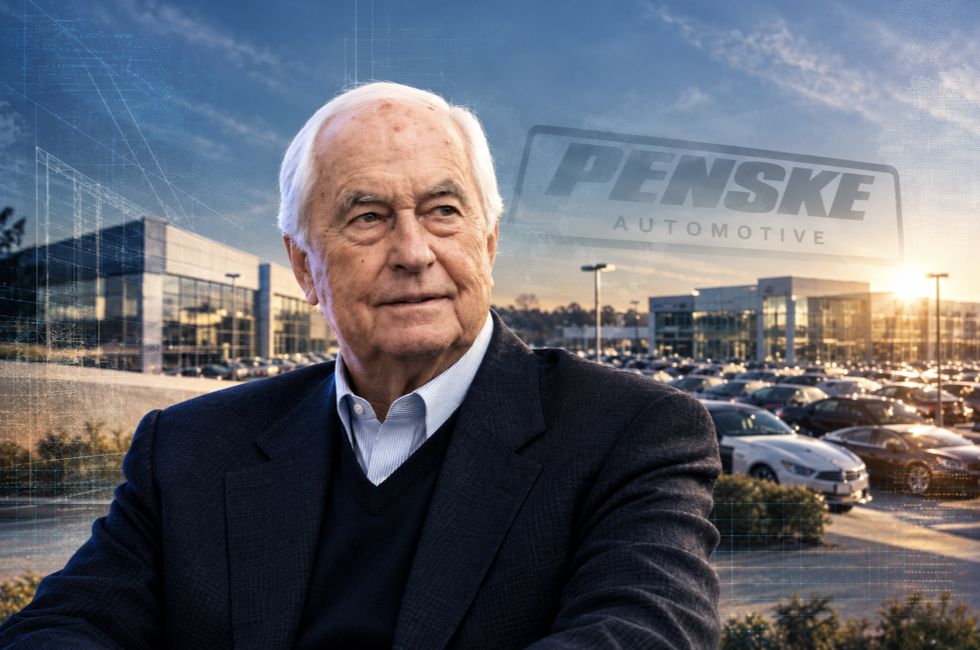
Roger Penske, who with longtime partner Mitsui has agreed to take Penske Automotive Group private. The deal is expected to close in early 2027.
Roger Penske already runs Penske Automotive. So why spend $3.9 billion to buy out everyone else? Paul Pfanner looks past the headline number at what the deal says about where Roger is taking the business, from the service bays in Britain to the paddock at Indianapolis.
Roger Penske is taking Penske Automotive Group private. The agreement was signed October 15, and the numbers are big. Penske Corporation and Mitsui & Co. will pay $212 a share in cash for the stock they don't already own, in a deal that values the business at about $16.3 billion including debt.
It didn't come out of nowhere. Penske and Mitsui put a $210 offer on the table back on July 22. The board formed a special committee of independent directors, the committee hired its own bankers and lawyers, and it pushed the price up two dollars before recommending the deal.
The size of the check got the headlines. What stopped me was the decision.
Roger and Mitsui already controlled about 72.6% of the company. They didn't need the rest of the shares to make the big calls. Roger was already chair and chief executive, and much of the management team around him has been with him for decades.
Buying out everyone else will cost the buyer group roughly $3.9 billion. That's a lot of money to spend on a company you already run.
So why do it? The company's own answer, in the letter Roger sent employees and the questions-and-answers that went with it, is flexibility. More freedom in how it invests, and in how it weighs the long term against the short term, without answering to the market every 90 days. I take them at their word. The question I keep coming back to is what that freedom gets used for, and the answer starts with what kind of business this is.
Bigger than a row of dealerships
Penske Automotive started out as United Auto Group in 1990. Roger took the lead in 1999, and the company became Penske Automotive Group in 2007.
Over those years it grew into a lot more than a chain of American car stores. At the end of June 2026 it ran 362 franchised dealerships, 146 in the United States and 216 overseas, many of them in the UK. Nearly 60% of its dealerships are outside America.
There's more to it. Used-car stores. A big commercial truck dealership business. Truck, engine and power-system distribution in Australia and New Zealand. And a 28.9% stake in Penske Transportation Solutions, the truck leasing, rental, fleet maintenance and logistics operation.
That last piece matters. PTS runs one of the largest truck fleets in North America, and its work reaches well past the retail car business.
Penske Automotive employs more than 28,900 people. PTS employs more than 40,000 more.
Say "Penske Automotive" and most people picture a BMW or Porsche store. The real business touches a much bigger piece of how people and goods move.
Where the money comes from
Penske Automotive reported about $31.8 billion in revenue in 2025, flat with the year before. Net income for common shareholders was about $935 million, down from $969 million in 2024 and about $1.1 billion in 2023.
So it's a profitable company whose profit has been drifting down while sales hold steady.
This year looks a little better on the top line. Second-quarter revenue grew 6% to about $8.5 billion. Reported net income was $260 million, just under the $267 million of a year earlier, and about $238 million once you take out a one-time gain on dealerships it sold.
Nobody should read that as a company in trouble. Management has to work harder to keep the returns it's used to, and that's a different thing.
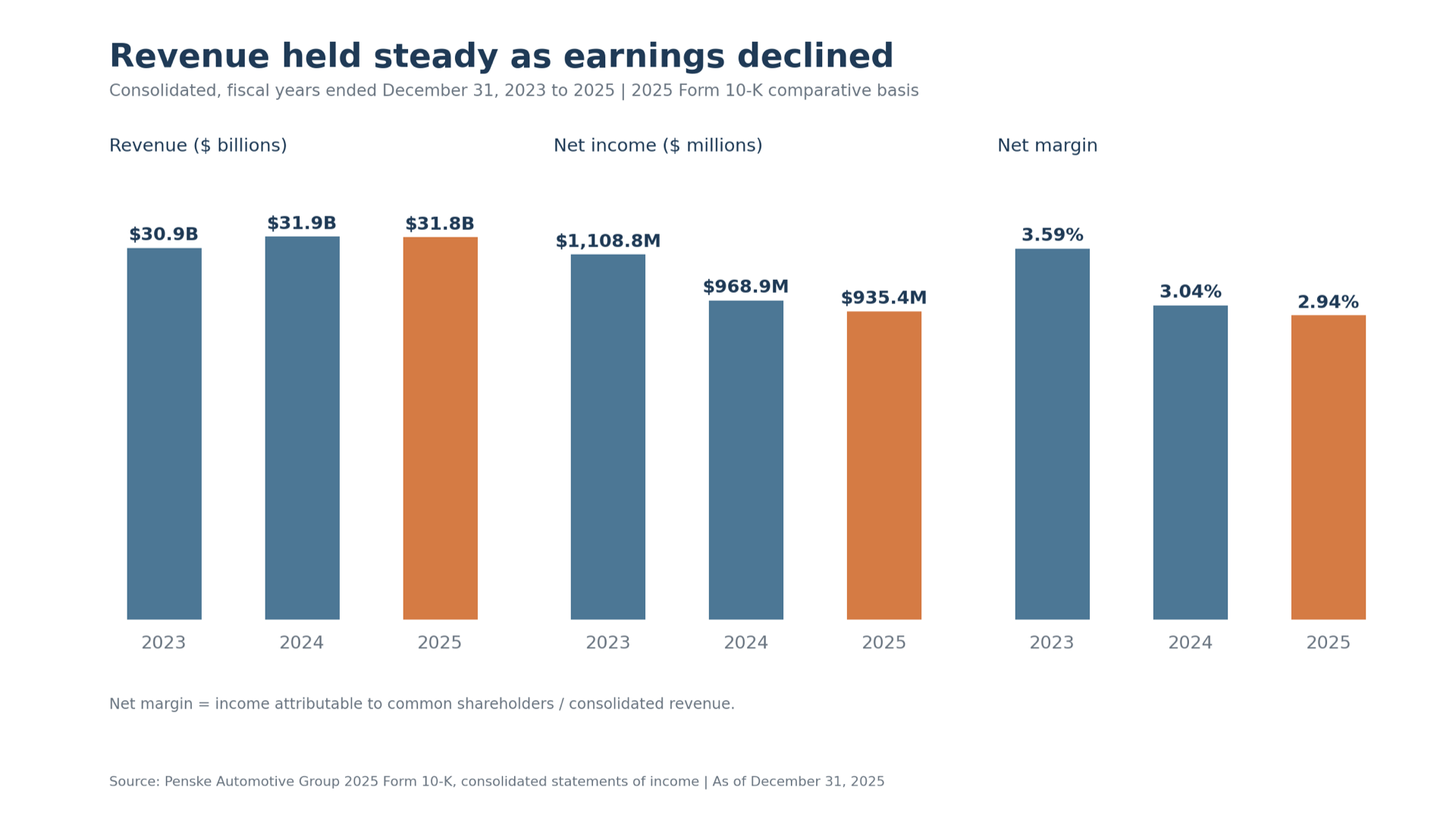
Revenue and profitability, 2023 to 2025 Revenue held near $32 billion while net income slipped from about $1.1 billion to $935 million. Source: company annual reports.
Look at where those returns come from.
In 2025, new cars brought in about 40% of revenue but only around 22% of the gross profit. Used cars were about 28% of revenue and 9% of gross profit.
Service and parts flip that around. They're about 11% of revenue and nearly 38% of gross profit. Finance and insurance adds almost 16% of gross profit on less than 3% of revenue.
Put service, parts, finance and insurance together and they produce more than half the gross profit from a much smaller slice of sales.
Selling the car opens a relationship, and the relationship keeps paying for years in service, maintenance and repair. Anybody who's run a business knows what a customer who keeps coming back is worth.
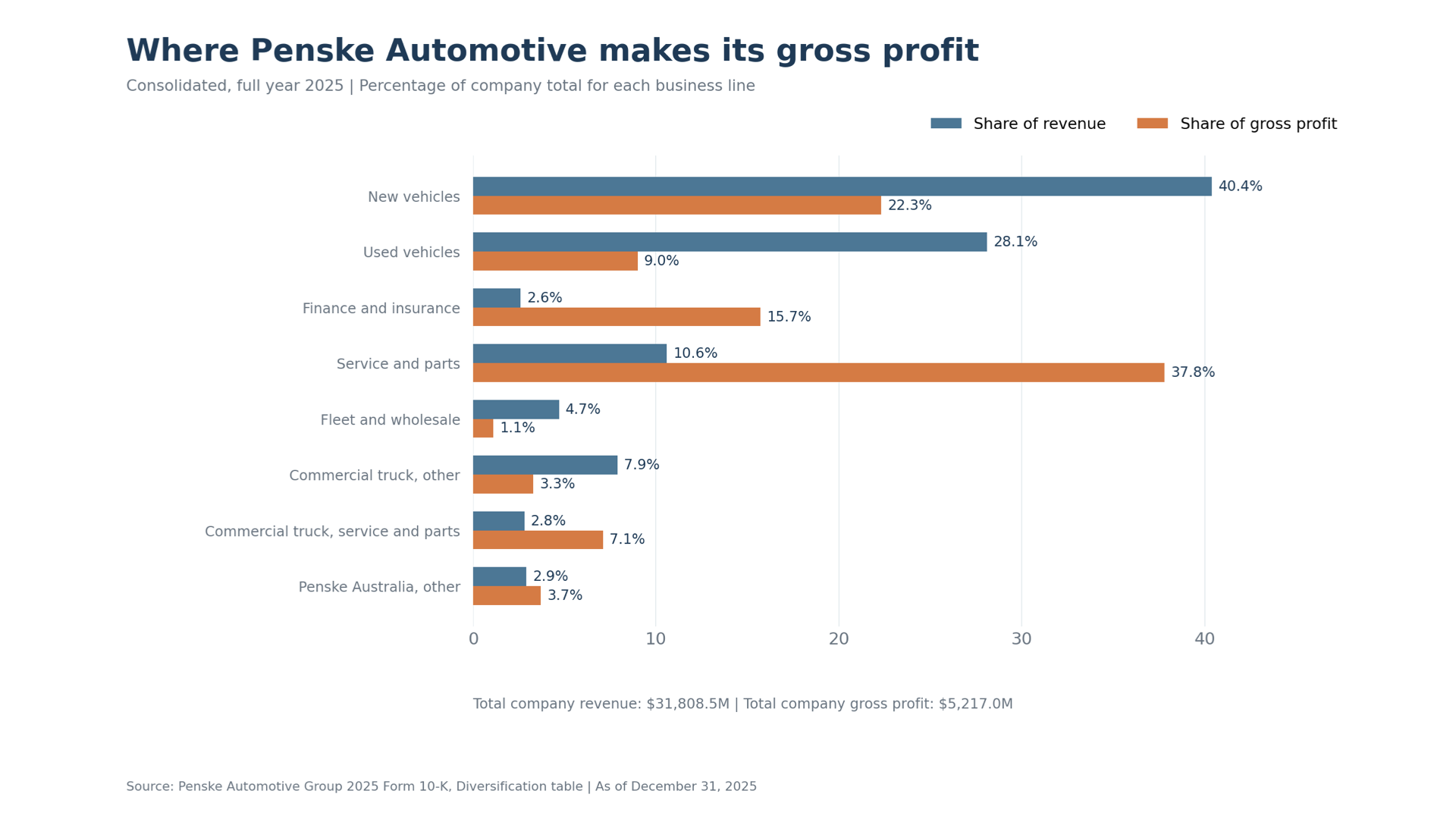
Revenue mix versus gross profit mix, 2025 New and used cars make up most of the sales. Service, parts, finance and insurance produce more than half the gross profit. Source: 2025 Form 10-K.
One company, a lot of different car markets
The international side of Penske Automotive gets less attention than it deserves.
At the end of 2025 the company had 151 franchised dealerships in the United Kingdom and 148 in the United States. Italy had 27, Germany 24, Japan 12 and Australia three, which adds up to the 365 in the year-end filing. Its Canadian locations are truck dealerships and are counted separately.
The counts moved a little in 2026. The picture didn't. There are more Penske car dealerships outside the US than inside it.
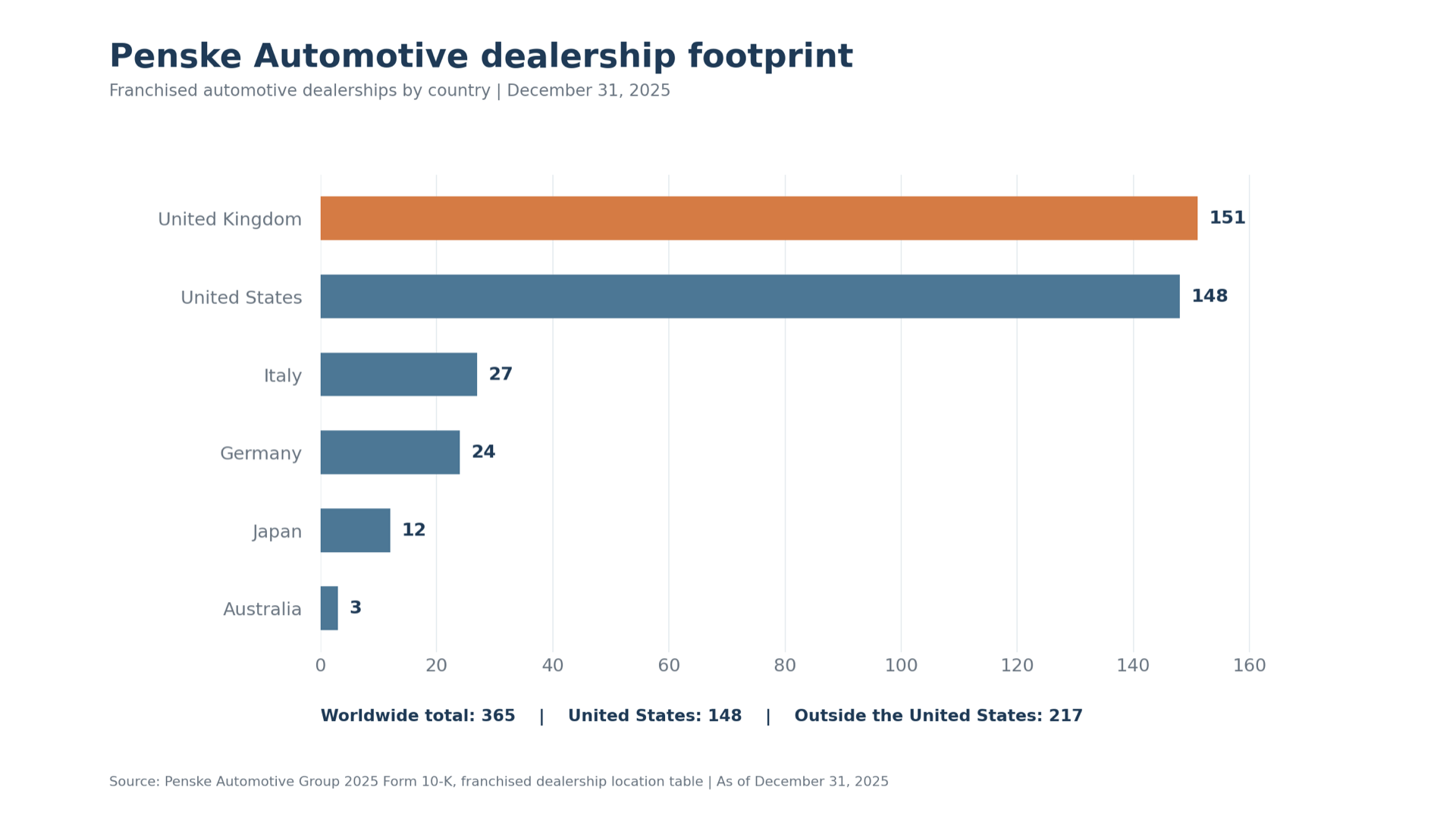
Chart 03 caption: Franchised dealerships by country, December 31, 2025
The UK had 151 franchised dealerships to the US's 148. Source: 2025 Form 10-K.
Revenue tells it differently. In 2025 about 62% came from the United States, 26% from the UK and 12% from other international markets. Store count and economic weight aren't the same thing. The US side, commercial trucks included, carries more revenue than its location count would suggest.
Each of these markets is changing in its own way. In the US, affordability has become a real problem. In Europe, manufacturers are working through different regulations and a shifting push on electrification, with Chinese brands coming on strong.
Penske isn't watching that from the sidelines. Its annual report notes the Chinese manufacturers' growing share of the British market, and in 2025 the company opened Geely and Chery franchises at its Sytner Select locations in the UK and a BYD franchise in Germany.
In some markets it also sells under agency arrangements. The manufacturer controls more of the sale, and the dealer earns a fee instead of buying the car and reselling it. That changes how much capital the dealer ties up and how the revenue shows up on the books. It changes the relationship with the factory too, and it doesn't automatically make the dealer more money.
Penske represents BMW, MINI, Mercedes-Benz, Toyota, Lexus and the Volkswagen Group brands, among many others. Every one of those companies is deciding what to build, how to sell it and how much of the customer it wants to own.
Penske has its own decisions to make about where to invest, which brands to grow with, and where the opportunity isn't what it used to be. That kind of thinking is easier on a five-year horizon than a quarterly one, which is the flexibility Roger described.
What changes when you go private, and what doesn't
Going private doesn't make a company more profitable on its own.
The dealerships still have to sell cars. The service bays still need customers. The manufacturers still shape the product and the economics. Interest rates, wages, inventory costs and buyers changing their minds don't go away.
The buyout is expensive. The buyer group has committed debt financing in place and the deal carries no financing condition, but the final structure and its cost will come out in the proxy filings. Expect more borrowing at the owner level. Public-company costs will go down, and there's no reason to assume those savings cover the financing.
The upside is in what the owners do next. Penske and Mitsui can take the long view on acquisitions, facilities, technology and manufacturer relationships, and on which businesses they want to own at all. Whatever they build, they share the gains and losses only with each other.
Mitsui first invested in 2001. After closing, Penske Corporation would hold about 64% and Mitsui about 36%. The two are already partners elsewhere: Penske Corporation and Mitsui own most of Penske Transportation Solutions, with Penske Automotive holding the rest.
Roger said the partners plan to draw on their combined capabilities and networks to find new opportunities and joint projects. Nothing specific has been announced.
The family's automotive holdings have also been coming together. Last November, Penske Automotive bought Penske Motor Group, Greg Penske's Toyota and Lexus stores in California and Texas, including Longo Toyota, the biggest Toyota dealership in the country. Less than a year later, the whole company is coming off the stock exchange.
A standard built to last
Roger is chair and chief executive, and nothing in the announcement changes that. He's still the one making the big calls.
He has also built an organization with real depth around him.
Robert Kurnick Jr. has been president of Penske Automotive since 2008 and is vice chair of Penske Corporation. Bud Denker is president of Penske Corporation. Greg Penske is vice chair of Penske Automotive, runs Penske Motor Group, now a division of the company, and is vice chair of Penske Entertainment.
I first worked closely with Roger in 1996, when Pfanner Communications was hired to help launch California Speedway. I wrote about what that taught me in Everything Matters. Roger didn't need to make every decision himself. He expected everything the organization touched to meet a standard, down to the smallest detail. And anyone who has worked with him knows he plans for everything, well ahead of time.
A culture like that is an enormous advantage. Private ownership gives Roger and Mitsui room to plan the company's future on their own timetable, away from the quarterly spotlight.
The IndyCar parallel
In July 2025, FOX bought a one-third interest in Penske Entertainment, which owns IndyCar and the Indianapolis Motor Speedway.
FOX already had the broadcast rights. Now it's an owner, with a financial stake in the sport's growth and its distribution, programming and promotion working for the series.
With Penske Automotive, Roger and Mitsui are going the other direction, pulling ownership in around a partner of 25 years. The businesses need different things. Who Roger picks as a partner tells you as much as the percentage does.
In The Best Is Now, I wrote about IndyCar's opportunity with stable ownership and a major media partner, and why I see the FOX arrangement as more than a TV contract.
I don't want to tie the two deals together too tightly. Penske Entertainment and Penske Automotive are separate businesses. Nothing in the automotive deal changes FOX's stake or creates a new source of money for IndyCar. If anything, the buyer group is putting serious capital into the automotive buyout.
Still, there are a few possibilities worth watching. FOX could take a bigger role. Another investor could come in someday. Penske could keep control and keep investing in management and the long-term health of the championship.
Indy Angle: Does Going Private Give Roger Penske More Freedom With IndyCar?
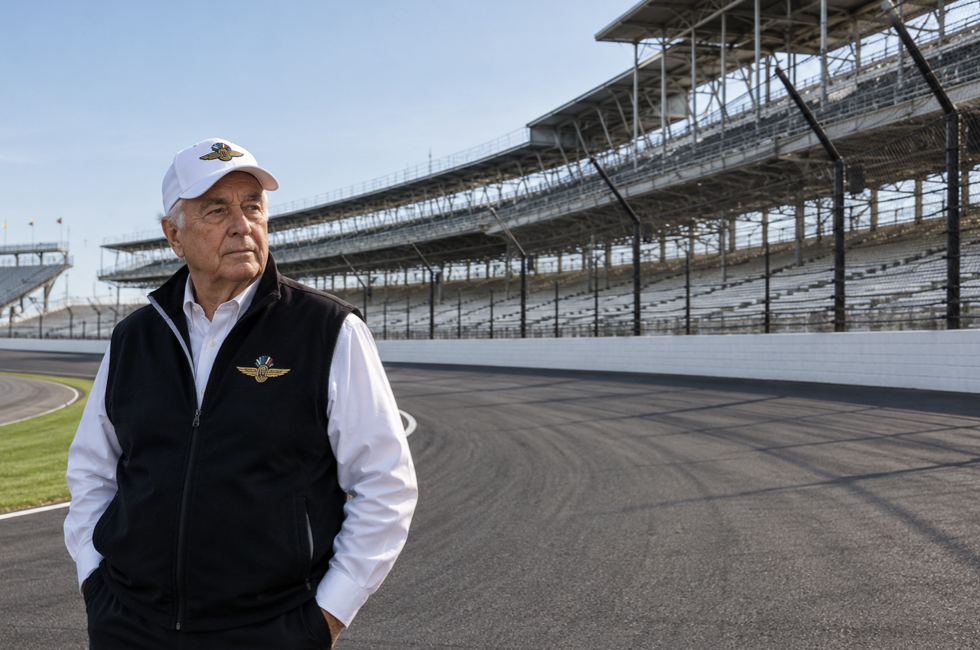
Roger Penske at the Indianapolis Motor Speedway. Penske bought the Speedway and IndyCar in late 2019. FOX acquired a one-third stake in 2025.
Penske Automotive going private raises an obvious question for anyone who follows racing. Does it give Roger more room for the next big decision about IndyCar?
I wouldn't assume so. Penske Automotive Group and Penske Entertainment are separate companies. The automotive buyout takes serious capital, and we don't know enough yet about how it's funded to say the wider organization will have more to spend anywhere else. The family thread does run through both boards: Greg Penske is vice chair of each.
What Roger has shown is a willingness to change who owns what when there's a reason. FOX bought a third of Penske Entertainment in 2025 and brought its national reach and commercial muscle straight into the ownership of IndyCar and the Speedway.
FOX could take a bigger piece someday, though nothing has been announced. Another investor could bring money or operating know-how. Penske Corporation could keep control and build up the management around the series.
IndyCar's next stage needs more than a good television deal. The audience is growing and a new car arrives in 2028. The series has to turn that, along with its commercial partnerships, into a business that pays for itself over the long haul.
I wouldn't take the automotive deal as a sign IndyCar is for sale. It's fair to watch how Roger picks partners and arranges ownership across the Penske companies. There may be a pattern there. We shouldn't pretend to know where it leads.
What happens next
The deal is expected to close in the first quarter of 2027. It needs regulatory approval and two shareholder votes, a majority of all outstanding shares and a majority of the votes cast by shareholders outside the buyer group. After closing, PAG comes off the New York Stock Exchange. It still answers to its owners, lenders, manufacturers and customers, just without the quarterly public scorecard.
The next look inside comes October 28, when the company reports third-quarter results. There won't be an earnings call this time.
Roger is still making the big decisions about the organization he built. I read this as an owner looking hard at the company as it stands today and choosing who he wants beside him while the market changes.
Whether that turns out to be the right call depends on what Penske and Mitsui do once the deal closes.
Pfanner Advantage works with clients to turn change into advantage at the intersection of mobility, motorsport, media, technology, and marketing. Learn more or start a conversation: contact us today.
Paul Pfanner’s recent Shift Happens Insights:
I Love Mission S. Now I Want to See Mission P.
The Advantage Journal arrives every week. What matters in sport, mobility, media, and technology — curated and contextualized by Bill Sparks, Bill Long, and Paul Pfanner. No hedging. No filler. Subscribe — It’s Free

