

The race to next
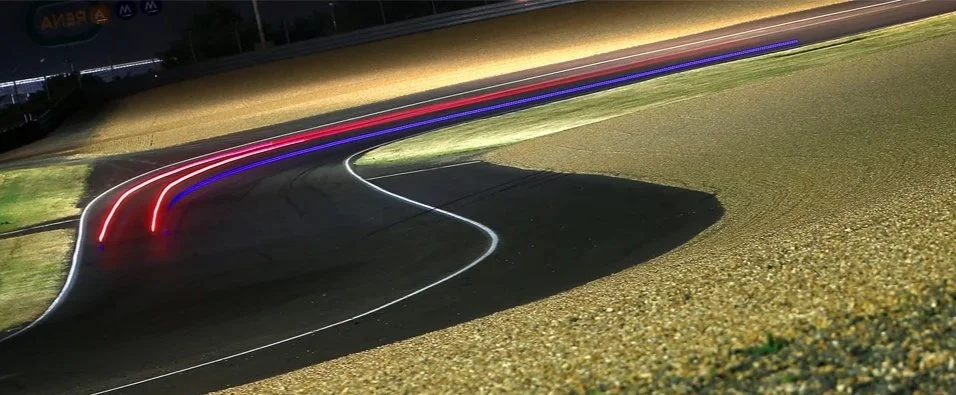
Reading the surface and shifting conditions to find traction, momentum, and advantage is a lesson that is increasingly relevant in this moment of accelerating change.
In December 1979, I started a company because I wanted to drive my own race to what was next. There was no master plan — just instinct and curiosity. I believed that if you aligned yourself with a high-performance culture — one with real emotional and intellectual gravitas — you could feel the future forming before it announced itself.
Better yet, you could shape it.
That intention led to collaborations with brands and organizations that define motorsports and mobility. It led to the creation of RACER magazine in 1992, RACER.com in 1997, and decades spent inside the intensely competitive realms of racing, media, and technology.
In 2006, when acceleration was unmistakable, we leaned into it again — reshaping IMSA, helping define the Centennial era of the Indianapolis Motor Speedway, and moving early into video-forward storytelling, including work that supported Tesla’s global debut of the Model S.
Now, in 2026, we’re back on the grid — not nostalgic, but sharpened. Pfanner Communications 3.0 is once again competing in the relentless race to next. This race, however, is different.
Finding the edge
Racing taught me something fundamental: the surface is never static. What works today can feel wrong tomorrow, and if you don’t sense that shift early, someone else will. The edge isn’t a performance trick. It’s awareness — curiosity refined into disciplined thinking and anchored in context.
That lesson feels unusually relevant now.
We’re not in a cycle. We’re in a redefinition. Influence has decentralized. The media gatekeepers who once controlled distribution no longer command it. A single creator with clarity can outrun an institution built over decades. Brands speak directly to audiences at scale. Storytelling isn’t marketing — it’s infrastructure.
And underneath it all is a simple truth: your audience owns you. In sports, in entertainment, in life. Their attention is voluntary. Their loyalty is conditional. Their trust is earned repeatedly through behavior. Brands aren’t defined by mission statements, but by what they do when pressure rises.
We are all now in the inspiration business — curiosity, passion, relevance, trust, belief. Without those, nothing endures.
From devotion to co-creation
There was a time when building something worthy of devotion was enough. That still matters.
But today the deeper win comes when something is built with the audience, not simply for them. Shared meaning. Emotional connection. Intellectual respect. The organizations that understand this aren’t chasing impressions; they’re building resonance.
There is also a dividing line emerging.
The moment a leader believes there is more to protect than to pursue, forward motion slows. In racing, driving not to lose is how you lose. In business, it often looks like caution disguised as wisdom.
Progress favors those willing to lean forward and take risks.
The restart
This moment feels like a late-race restart.
Everything learned up to now matters — the wins, the mistakes, the misreads. Experience sharpens instinct. Pattern recognition accelerates awareness. But experience does not guarantee outcome.
I don’t know what will ultimately win in this new alignment of power, technology, and culture. None of us do.
What I do know is that life, business, and racing are learning systems.
Learning compounds when perspective multiplies.
No serious race team relies on one voice. The driver feels something. The engineer sees something else. The strategist reads the moment differently. Advantage comes from tension resolved intelligently.
That’s why I truly value my teammates in this closing stint.
Bill Sparks brings competitive clarity. He sees leverage forming — and slipping — without sentiment.
Bill Long brings structural depth. He understands how organizations hold under pressure and how governance either sharpens judgment or blurs it.
I work the connective tissue — narrative, positioning, pattern recognition — sensing where alignment is tightening and where it’s separating.
Together, that triangulation sharpens focus to create advantage.. This is why our company is now known as Pfanner advantage.
Disciplined clarity
What Pfanner advantage represents now is disciplined clarity at consequential moments — the discipline to sit inside complexity and connect structure with story so behavior aligns with belief.
In a redefinition cycle, clarity compounds.
Advantage rarely belongs to the loudest voice. It belongs to the clearest mind — the one willing to recognize reality early and move decisively.
Victory travels at the speed of thought — converted into action — that creates advantage.
If this feels familiar, you already know why.
Onward to the next lap.
Paul Pfanner has spent more than five decades navigating change at the intersection of sport, mobility, media, and brand strategy. A serial founder, builder and CEO, he has guided organizations through structural resets from print to digital to AI. In the Shift Happens blog, he explores relevance, judgment, and the discipline required when timing matters.