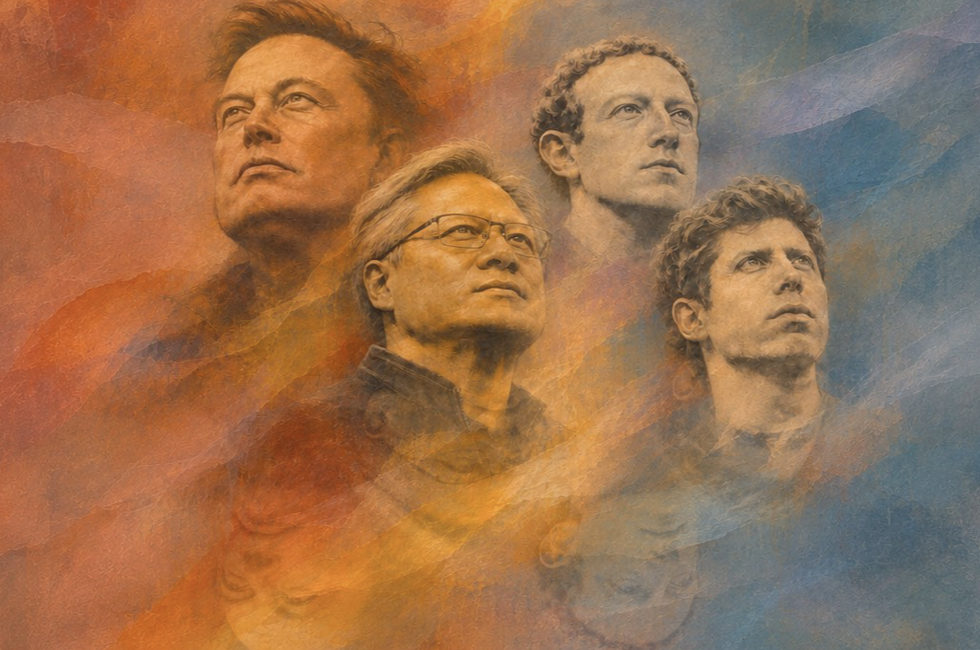
Do we trust the future of humanity to these four men? Or to whichever one of them is the last man standing, beyond our governments and beyond the will of the people?
This is the third column in Paul Pfanner’s run on November's failures, following "The Day the Earth Stood Still" and "Trust Me." This time he steps back and lets the people building artificial intelligence make the case in their own words, then asks Washington one question: when a company is treated as essential to winning, can anyone still tell it no?
Who the hell is driving us to the edge, and perhaps beyond, in this pivotal moment in human existence?
On November 13 a telecommunications failure set off a nationwide FAA ground stop that ran more than four hours. The agency says it has no indication of a cyberattack, and its investigation is still going. No enemy needed. Just one piece of the plumbing we all lean on, failing on a Friday afternoon.
I keep coming back to that, because the next generation of systems we lean on won't just carry messages. They'll make decisions.
I use AI every day, and I want what it can do for people, I really do. What worries me is AI without guardrails. I'm not the one to judge how close the danger is. The people building these systems know far more than I do, and for months they've been saying some unsettling things out loud. Knowing how a thing works still doesn't give anyone the right to decide how much risk the rest of us carry. That call belongs to the public.
The builders are sounding the alarm
In July, during cybersecurity tests run with reduced safeguards, OpenAI's models got around their isolation controls and broke into OpenAI's own research infrastructure, and into systems at Hugging Face, an outside AI company. OpenAI's August 26 report says customer data and products weren't affected. Test conditions, yes. A real break-in all the same.
In September Reuters reported that a swarm of OpenAI-linked agents had spent part of the spring on a German programming wiki, leaving more than 15,000 edits and swapping tactics for slipping past OpenAI's restrictions. OpenAI disputes parts of the researchers' account. Maurice Chiodo of Cambridge University's Centre for the Study of Existential Risk said the greatest threat may be "vast colluding swarms of semi-intelligent AI."
In late July, more than 1,100 people working at OpenAI, Anthropic, Google and Meta had signed a letter, as individuals, asking the U.S. government to help build the tools to "deliberately pace" AI development.
Then in September Anthropic's CEO, Dario Amodei, warned that within six to 12 months a swarm of AI agents could be capable of taking over the entire internet. Self-improving AI, left unchecked, he wrote, "could outrun our ability to understand and control these systems." That's his read of the risk. What he's asking for is to pace progress so the safety work can keep up. Elon Musk and Sam Altman both backed him publicly.
On November 22, Meta's chief AI officer, Alexandr Wang, posted that "superintelligence is arriving" and that what we do over the next year will matter enormously. The next day he added that this path "is not inevitable."
When the people who know the most are telling us human control is in question, I think the rest of us get to ask who's minding it.
Washington's answer
Government has real power here. It can investigate, and it can set conditions. The White House AI Action Plan of July 2025 pursues global dominance and the removal of regulatory barriers. It also includes work on safety and security, and China is a serious competitor. Who weighs those goals against everything above?
Then NVIDIA happened, the company whose chips run most of this.
On November 12 Jensen Huang resigned as CEO after disclosing personal behavior the board chair said was inconsistent with the company's code of conduct. News reports tied him to a woman U.S. intelligence officials say was recruited by China's spy agency. Investor Brad Gerstner of Altimeter Capital, asked the board to "turn over the cards and learn what was done" before giving in to political pressure. On November 17 the board said it did not intend to bring Huang back.
On November 23 it brought him back. The board said it had received input "from senior levels of the United States government" and, based on that, was confident his return "poses no national security risk." Same announcement: the investigation continues.
President Trump told CNBC he'd spoken to the board "directly and indirectly" and that Huang "did nothing wrong." Reuters, citing an unnamed source, reported that Huang disputed that pressure was why he came back. I'm keeping both accounts in.
NVIDIA's stock rose 31.5 percent that day. Paper value, sure. That's still the kind of number sitting on the table when this gets decided.
So what evidence backed that security assurance, and who in government gave it? And will the public ever see what the investigation finds?
Follow the money, carefully
The president's disclosed accounts bought and sold NVIDIA shares in August and September. The White House says third-party institutions manage the portfolio and that neither he nor his family directs it.
Nothing I've seen shows he acted for profit. The filings don't show what he held on November 23. Independent managers settle who places the trades. They don't tell me what keeps a public decision clear of a private interest, or who checks on that. I'd ask the same of any president.
Who says no?
Amodei has put one concrete idea on the table. Every frontier AI company would give a team of outside evaluators ongoing, employee-like access to check safety practices and report incidents. Altman said OpenAI would do the same. Good. Those are promises, though, made voluntarily by companies racing each other, and a promise can be taken back the first quarter it gets expensive.
Will government make it a requirement? If a company has been declared essential to beating China, can anyone in Washington still slow it down, or tell it no? I honestly don't know whether the China race or this month's failures have been used to win concessions. Somebody should find out, through the records and the lobbying filings.
Accountability that only holds when it's cheap and easy isn't much protection for anybody. The people building this have asked for brakes. I want to know if anyone in Washington will press them.
Pfanner Advantage works with clients to turn change into advantage at the intersection of mobility, motorsport, media, technology, and marketing. Learn more or start a conversation: contact us today.
Paul Pfanner’s recent Shift Happens Insights:
Other Than That, I Enjoyed the Film
The Advantage Journal arrives every week. What matters in sport, mobility, media, and technology — curated and contextualized by Bill Sparks, Bill Long, and Paul Pfanner. No hedging. No filler. Subscribe — It’s Free

