

This kind of old-school human curation is making a comeback and people are showing they’re willing to pay for it.
Part 2 of 4. Bill Sparks looks at how human-in-the-loop content is undergoing a renaissance at a time when algorithmic platforms are leveling off. Consumers are showing an increasing willingness to pay for content created and edited by trusted human sources.
If you want to see what consumers will pay for human editorial judgment, look at the newsletter market. It is the cleanest test case available. No algorithms. No recommendation engines. One person (or a small team) decides what to write, and readers decide whether to pay for it. The economics are now substantial enough to call it an industry.
Substack's numbers make the case. The platform has more than one million paid subscribers, over 40,000 paying creators (up from 24,000 in 2023), and has paid out more than $600 million to writers. Monthly paid subscriptions are growing 35% year-over-year. The platform's own annual recurring revenue sits between $50 and $60 million, on a reported valuation of $700 to $800 million.
Beehiiv, which focuses on newsletter infrastructure rather than a consumer-facing brand, tells the supply-side story. The platform serves 110,000 active publishers reaching more than 400 million unique readers, with annual recurring revenue running $14 to $16 million and 37% year-over-year growth across both subscribers and publishers.
What makes these numbers remarkable is what they represent in context. These platforms are growing while the broader digital media landscape is contracting. Social media engagement is declining. Referral traffic from search is being cannibalized by AI summaries. Traditional publishers are cutting staff. The newsletter economy is not just surviving this environment. It is thriving because of it. The same forces pushing consumers away from algorithmic feeds are pushing them toward individual writers whose judgment they trust.
The business model is deceptively simple. A writer builds expertise in a subject. They demonstrate that expertise through free content. A portion of readers decides the writer's judgment is worth $5 or $10 a month. No advertising is required. No algorithm mediates the relationship. The transaction is direct: I trust your taste, your analysis, or your reporting, and I will pay to keep receiving it.
The same thesis in a different medium
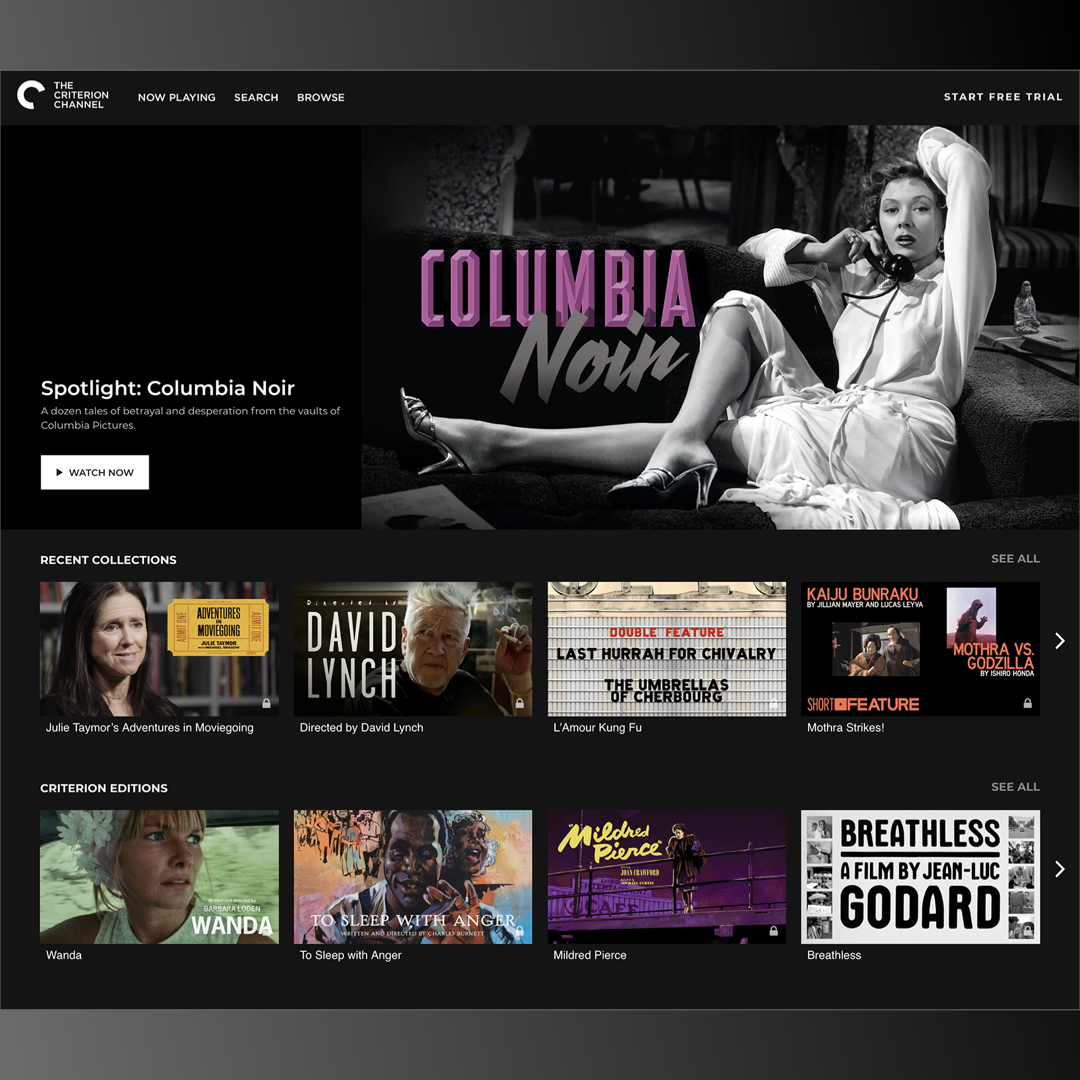
Criterion Channel’s selling proposition is that they filter out movies that will waste your time. It’s a high-loyalty, low-churn boutique operation with a library of classic, international, and arthouse films.
The model extends beyond text. Criterion Channel represents the curated alternative in film. Where Netflix and Amazon use recommendation algorithms to surface content from libraries of thousands of titles, Criterion employs film scholars and programmers who build thematic collections by hand. The selections are opinionated. They reflect a point of view. That is precisely what subscribers pay for.
MUBI takes a more aggressive approach, originally showing only one film per day, chosen by its editorial team. The platform's CEO reported that its subscriber base rebounded to a record 1.7 million after a difficult 2025. The curated model proved durable even when the company faced significant headwinds unrelated to its product.
These are not mass-market services. They are not trying to be. Criterion Channel and MUBI together serve a fraction of Netflix's subscriber base. But their economics work because the value proposition is specific: we have watched thousands of films so you don't have to, and we are telling you which ones are worth your evening. The curation is the product. Remove it and you have a smaller, less well-funded version of every other streaming library.
The same dynamic is emerging in children's media, where parents are migrating away from algorithmic video platforms toward apps that guarantee human-vetted, age-appropriate content. The parental motivation is different. It is not about taste or editorial judgment. It is about safety and trust. But the market mechanism is identical. Consumers are paying a premium to have a human being serve as a filter between content and audience.
The subscription math tells a larger story

The New York Times has more than 13 million subscribers who are attracted to human-curated editorial content.
The Digital Content Next Q1 2025 report counted 923 million total digital subscriptions globally, a modest increase from 917 million the prior period. The top line looks like a market approaching saturation. The composition tells a different story.
News subscriptions are declining. Nineteen percent of U.S. households pay for a digital news subscription, down from 22%. Bundling is growing, with 58% of video-on-demand users subscribing through bundles, up from 52%. The New York Times crossed 13 million total subscribers by leaning heavily into a bundle that combines news with cooking, games, sports, and lifestyle content, all curated by human editorial teams.
The decline in standalone news subscriptions and the growth of curated bundles are not contradictory trends. They are the same trend. Consumers are not abandoning the idea of paying for content. They are becoming more selective about what kind of content is worth paying for. A generic news feed, increasingly indistinguishable from what AI can generate for free, is losing subscribers. A curated bundle where human editors make deliberate choices about what to include is gaining them.
This is the underlying logic of the curation economy. When content production costs drop to near zero, content itself loses value. What retains value is the judgment layer on top of it. Someone who can look at the avalanche of available material and say "these seven things are the ones that matter" is providing a service that AI can technically replicate but that consumers do not trust AI to perform.
Where this leads
The curation economy is still small relative to the algorithmic platforms it competes with. Substack's $50 to $60 million in revenue is a rounding error against Meta's advertising business. Criterion Channel's subscriber base would not register on Netflix's earnings call. But the growth rates are telling a consistent story, and the underlying consumer behavior is being validated by every major survey in the market.
The harder question is whether "curated by humans" can function as a verifiable claim rather than a marketing assertion. When a brand or a platform says its content is human-made, what proves it? The answer involves a technology stack that barely existed three years ago. That is the subject of Part 3 in this series.
Pfanner Advantage works with clients to turn change into advantage at the intersection of mobility, motorsport, media, technology, and marketing. Learn more or start a conversation: contact us today.
More Cold Read Insights from Bill Sparks:
When the Customer is a Machine
Should You Allow AI Bots to Crawl Your Site
How AI Is Getting Between Brands And Customers
America Is Building Cars The World Has Stopped Buying
What 1979 Tells Detroit About 2026
Why Aren’t Americans Buying EVs?
Part 8: State of the Art Branding Case Studies
Part 7: How the Ad Industry is Reinventing Itself
Part 6: AI and the Personalization of Brand Narrative
Part 5: Building Brand Loyalty Through Community
Part 4: Independent Creators as Brand Storytellers
Part 3: Brands as Publshers: The Rise of Owned Media
The Advantage Journal arrives every week. What matters in sport, mobility, media, and technology — curated and contextualized by Bill Sparks, Bill Long, and Paul Pfanner. No hedging. No filler. Subscribe — It’s Free