
In global employer forecasts for 2030, UI and UX designers are among the fastest-growing occupations. Graphic designers are among the fastest-declining.
Paul Pfanner uses AI often, and he keeps meeting people who fear it and distrust anyone who embraces it. When Airbnb’s Brian Chesky put words to that feeling, Paul went looking for what the research shows. This is part one of a three-part investigation into who AI is serving.
I use AI frequently, and because I do, I keep encountering people who have a deep fear of it. Friends, and colleagues I’ve worked with, who are very suspicious of anyone who embraces it. Like many of us, their careers could be threatened by what AI can now do. People shake their heads or make a negative comment, or they worry about what it means for their professional identity and their ability to earn an income. It keeps coming up in my conversations, well beyond media, motorsports and mobility. These are valid concerns.
Then I watched Brian Chesky, Airbnb’s co-founder and CEO, in a video interview with Semafor’s The CEO Signal this October. “Silicon Valley’s in a bubble,” he said, “and society feels like AI is happening to them, not for them.” [1, 3]
Brian Chesky on Semafor’s The CEO Signal with Penny Pritzker and Andrew Edgecliffe-Johnson, October 22, 2026. The conversation about AI begins at about 37:07; the passage quoted above is in the opening moments, and again at 39:09. Video: Semafor
That was my aha moment. He put shape to the sentiment I keep encountering, and I wanted to find out what’s behind it.
Chesky is no AI skeptic. He has called AI the best thing that ever happened to Airbnb [2], and in this interview he said he’s personally funding a separate lab meant to “benefit regular people.” His criticism is aimed at his own industry. “We are losing people,” he said, because Silicon Valley talks about humanity and not about people. He also made clear he doesn’t think AI itself will destroy humanity anytime soon [3].
In the span of a couple of weeks, I learned to make songs and music videos with Suno and Hedra, something that had always seemed out of reach to me without musical training. It’s insane how fast that happened. I shared the experience and the music in Full Send. What I wanted to know was whether I’d still be visible in the finished work. Could my writing, and the work of directing the prompts, produce something that felt like art?
My answer is mixed. My choices mattered. But the machine’s polishing and finishing can get in the way of me recognizing the work as mine. I still enjoy listening to it when I’m walking my dog. It also left me thinking about musicians who spent years building skills that pay their bills, and what happens when a newcomer can approximate parts of that work in weeks.
So I went looking at the research.
What the public is telling us
In late June, Pew Research Center surveyed 3,488 American adults. Fifty-two percent said the increased use of AI in daily life makes them more concerned than excited, and only 9% were more excited than concerned [4]. Among adults under 30, 55% are now more concerned than excited. It’s the first time a majority of young adults has said so.
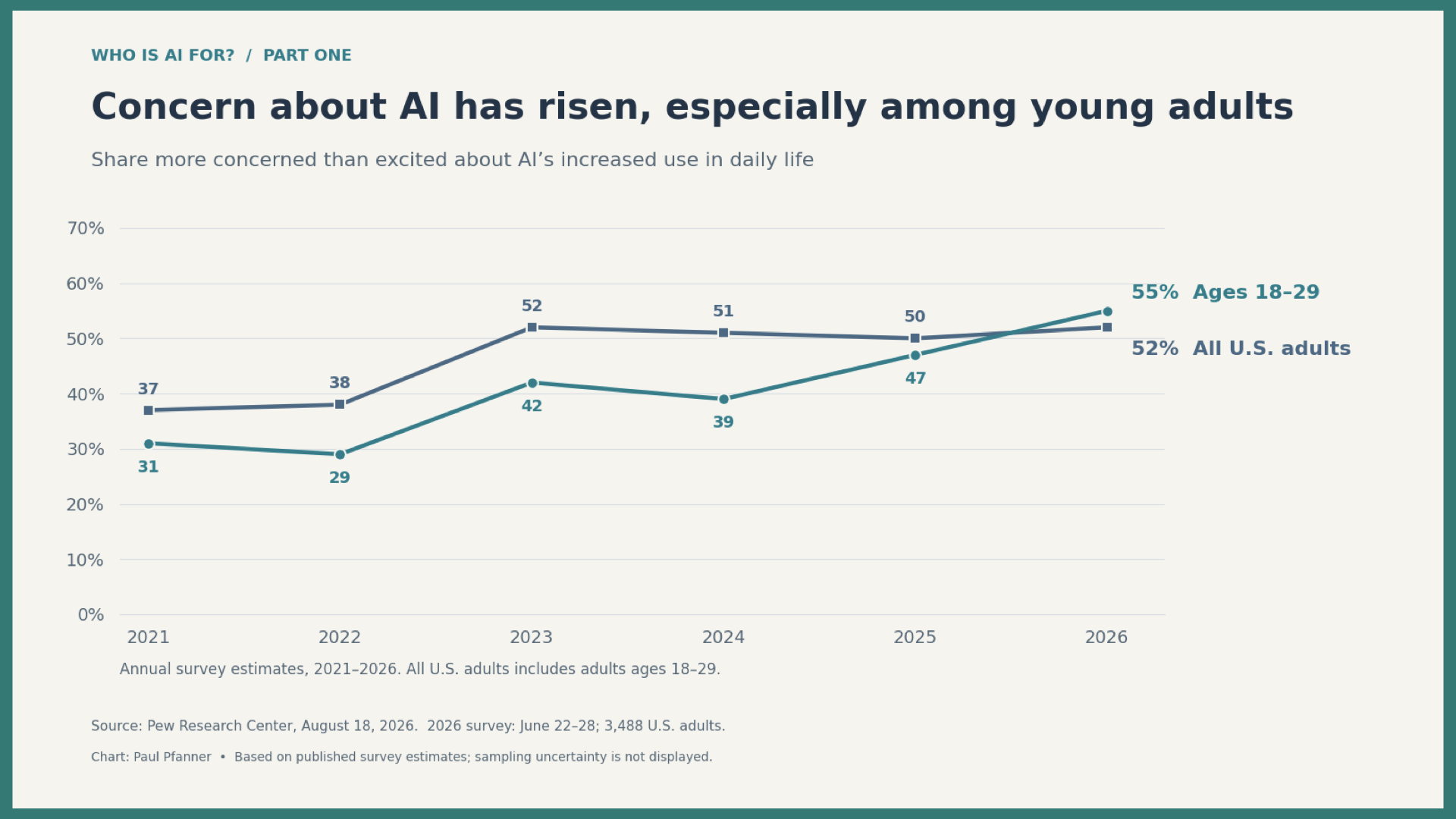
Concern among all adults has plateaued since 2023. Among adults under 30, it has risen overall, with dips in 2022 and 2024.
Seventy-one percent of Americans now expect AI to mean fewer U.S. jobs over the next 20 years, up from 64% in 2024 [4]. That tells me the people I keep meeting aren’t outliers.
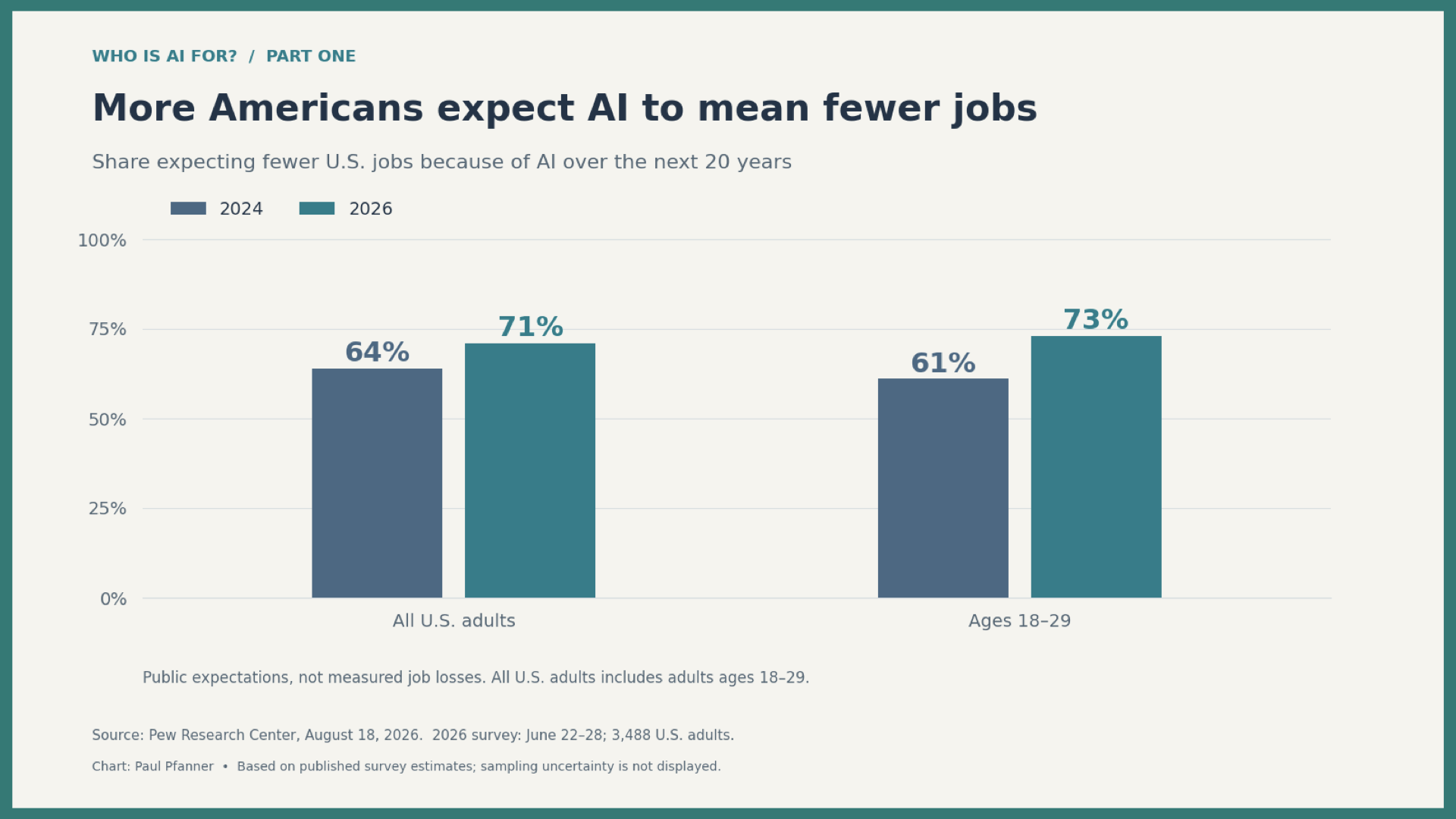
Public expectations, not measured job losses. Young adults now express similar expectations to adults overall.
Fewer assignments, harder to win
Ozge Demirci, Jonas Hannane and Xinrong Zhu studied a large online freelancing platform, in a paper published in Management Science in 2025 [5]. Within eight months of ChatGPT’s release in November 2022, postings for writing and coding work that AI could automate fell 21% compared with work requiring hands-on skills. After image generators arrived, postings for image creation fell 17% relative to the comparison group.
The remaining postings were more complex and offered higher pay, though the study measured what clients offered, not what anyone earned. Its data end in 2023 and cover one platform, so it can’t speak for the whole creative economy.
The door into a career
Stanford’s Erik Brynjolfsson, Bharat Chandar and Ruyu Chen track payroll records from ADP covering millions of U.S. workers [6]. Their first finding gets less attention than it should: no evidence of widespread, economy-wide job displacement.
Their August update found something narrower and more worrying. Using data through June 2026, employment of 22- to 25-year-olds in more AI-exposed occupations was about 19% below where it would be if it had kept pace with their peers in less-exposed jobs. Experienced workers show no comparable gap, and the shortfall shows up mostly as hiring that didn’t happen.
The finding I keep coming back to is where the gap appears. It’s in occupations where people mostly use AI to automate tasks, and not in the ones where they mostly use it to help with their own work. That’s a pattern across kinds of work, drawn from data on how people use Claude. It isn’t a record of any employer’s decision. The authors call it descriptive, not proof that AI caused anything. Some of the gap opened before generative AI spread, and the paper hasn’t been peer-reviewed. It still raises the question I most want answered: who decides whether AI replaces the newcomer or helps them?
A missing opening is hard to photograph. There’s no departing employee and no announcement. For the young person looking for it, the job that would have paid them while it taught them simply never appears.
Producing an image, editing a sequence or writing a piece of copy is a task. A career is years of doing those tasks, getting criticized and building judgment. Counting how much AI can produce won’t tell us whether those years are still on offer.
A different finding in Denmark
Economists Anders Humlum and Emilie Vestergaard linked surveys of AI chatbot use to official labor records in Denmark, across 11 highly exposed occupations, in a working paper revised in March 2026 with records through December 2024 [7]. Two years after ChatGPT’s launch, they found no measurable effect on earnings or recorded hours, and they rule out effects larger than 2%. The work itself did change, with new tasks like checking AI output.
Denmark saw a similar decline in early-career employment. But workplaces that encourage AI chatbots showed no statistically detectable difference in changes in total employment, early-career share, or hires and separations, compared with workplaces that don’t. The authors suggest other forces may be at work, such as the wider economy or anticipatory hiring freezes unrelated to actual adoption [7].
The two studies are built differently. Stanford compares U.S. occupations by how exposed they are to AI, with data through mid-2026. The Danish workplace comparison turns on whether employers encourage chatbot use, with data ending in 2024. Neither can identify the individual who would otherwise have been hired.
AI’s impact: The outlook for 2030

Employer forecasts point to different prospects across occupations, including within creative work.
Employers surveyed for the World Economic Forum’s Future of Jobs Report 2025 expect several clerical occupations, printing workers and graphic designers to lose employment by 2030 [11]. Graphic designers appear among the fastest-declining roles for the first time, just outside the top 10, after the report’s previous edition rated them a moderately growing occupation.
Creative work isn’t one outlook. UI and UX designers appear among the fastest-growing occupations. The projections can’t tell us whether beginners will find openings, or how easily people can move from one specialty to another.
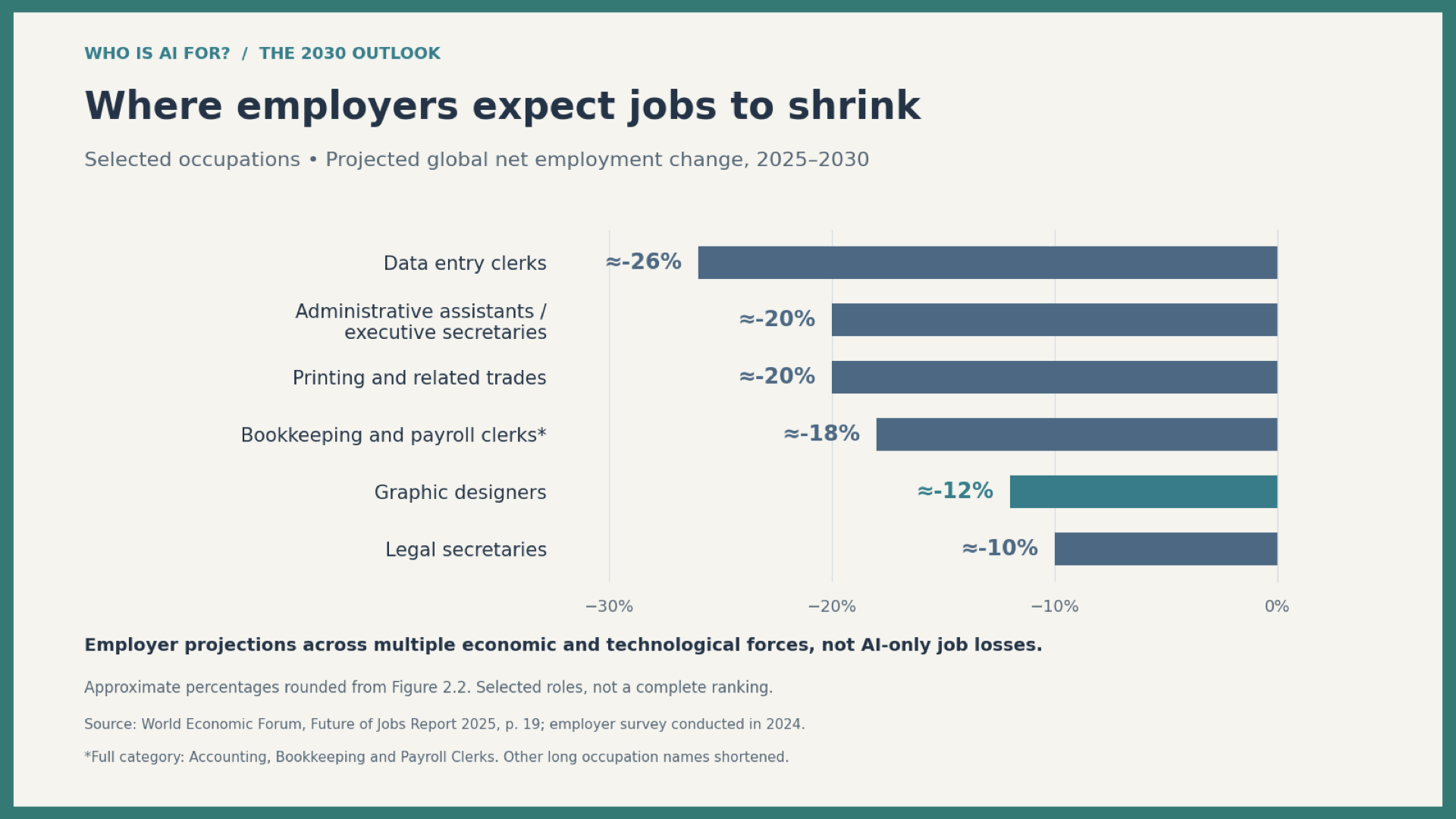
Selected occupations, not a ranking. Approximate global net employment changes for 2025 to 2030, read from WEF’s published figure. These employer projections reflect several forces, not AI alone.
Who gets the benefit
In the American Psychological Association’s 2026 Work in America survey, an online poll of 2,009 employed adults conducted by The Harris Poll, 64% said technological change benefits employers more than workers, up from 52% a year earlier [8]. The question covers technology in general, not AI alone, and it measures perception rather than paychecks.
Meaning, not just jobs
Milena Nikolova, Femke Cnossen and Boris Nikolaev studied industrial robots across 14 industries in 20 European countries [9]. For the average worker, the growth in robots between 2005 and 2020 was linked to scores about 3.4% lower for meaningfulness and 4% lower for autonomy. The authors point out that’s small for one person and adds up across industries that employ millions [10].
These were factory robots, not generative AI, and the authors say it’s unclear whether their findings will carry over [10]. Their work still makes the case for asking how a job changes, along with whether it survives.
What I’m asking next
None of this proves AI is draining purpose from society. It does raise hard questions about who benefits and what happens to the people affected. When an assignment disappears, what can the person who did it move to? If experience is worth more than ever, where do beginners get it?
In a separate article, I’ll examine remote work’s effects on early-career hiring and advancement, and whether working at a distance makes a job more vulnerable to AI substitution.
The next part of this series goes after the question I keep coming back to: who decides how AI gets deployed, and whether it replaces the newcomer or helps them.
A note on the process:
This article grew from my spoken narration and dictated passages, developed through dialogue with ChatGPT and Claude before any drafting. The tools assisted with research and revisions. I developed the AI-generated illustrations with ChatGPT through spoken direction and rounds of visual revisions. The charts draw on the cited research, with sources and qualifications shown. I directed the work and made the final editorial decisions, and I take responsibility for the published article.
References
1. Andrew Edgecliffe-Johnson, “Brian Chesky’s new blueprint for Airbnb — and Silicon Valley,” Semafor, The CEO Signal, article dated Oct. 23, 2026 (URL dated Oct. 22). https://www.semafor.com/article/10/22/2026/brian-cheskys-new-blueprint-for-airbnb-and-silicon-valley
2. “Airbnb CEO says AI is ‘the best thing that ever happened to’ his company,” Fortune, Feb. 17, 2026 (citing CNBC). https://www.fortune.com/2026/02/17/airbnb-ceo-brian-chesky-says-ai-best-thing-ever-happened-company-warns-other-founders-get-onboard-or-else
3. Brian Chesky interviewed by Penny Pritzker and Andrew Edgecliffe-Johnson, The CEO Signal, Semafor, full video episode (about 53 minutes). https://youtu.be/e7_eNEXBwhM Passages cited at about 39:09, 40:47 to 41:44 and 45:07 to 46:15. Debuted Oct. 22, 2026; recording date not published.
4. Pew Research Center, “Young adults in the U.S. are increasingly wary of AI, concerned it will take jobs,” Aug. 18, 2026. Survey conducted June 22–28, 2026. https://www.pewresearch.org/short-reads/2026/08/18/young-adults-in-the-us-are-increasingly-wary-of-ai-concerned-it-will-take-jobs/
5. Ozge Demirci, Jonas Hannane and Xinrong Zhu, “Who Is AI Replacing? The Impact of Generative AI on Online Freelancing Platforms,” Management Science, 2025. https://doi.org/10.1287/mnsc.2024.05420
6. Erik Brynjolfsson, Bharat Chandar and Ruyu Chen, “Canaries in the Coal Mine? Six Facts about the Recent Employment Effects of Artificial Intelligence,” Stanford Digital Economy Lab, revised Aug. 12, 2026. https://digitaleconomy.stanford.edu/news/canariesaug26/ Paper: https://digitaleconomy.stanford.edu/app/uploads/2026/08/Canaries_August2026.pdf
7. Anders Humlum and Emilie Vestergaard, “Still Waters, Rapid Currents: Early Labor Market Transformation under Generative AI,” RFBerlin Discussion Paper 078/26, revised March 13, 2026; also NBER Working Paper 33777. https://www.rfberlin.com/wp-content/uploads/2026/03/26078.pdf
8. American Psychological Association, Work in America 2026. https://www.apa.org/pubs/reports/work-in-america/2026
9. Milena Nikolova, Femke Cnossen and Boris Nikolaev, “Robots, meaning, and self-determination,” Research Policy, 2024. https://doi.org/10.1016/j.respol.2024.104987
10. Milena Nikolova, Femke Cnossen and Boris Nikolaev, “Robots make your work less meaningful,” Brookings, Apr. 18, 2024. https://www.brookings.edu/articles/robots-make-your-work-less-meaningful/
11. World Economic Forum, The Future of Jobs Report 2025, chapter 2, “Jobs outlook,” January 2025, Figures 2.2 and 2.3. https://www.weforum.org/publications/the-future-of-jobs-report-2025/2-jobs-outlook
Pfanner Advantage works with clients to turn change into advantage at the intersection of mobility, motorsport, media, technology, and marketing. Learn more or start a conversation: contact us today.
Paul Pfanner’s recent Shift Happens Insights:
Other Than That, I Enjoyed the Film
Will NASCAR Play the TV Game or Redefine It?
The Advantage Journal arrives every week. What matters in sport, mobility, media, and technology — curated and contextualized by Bill Sparks, Bill Long, and Paul Pfanner. No hedging. No filler. Subscribe — It’s Free

