

The Ghost in the Machine is us
The phrase “ghost in the machine” has been used for decades to describe the unseen forces inside complex systems. In today’s AI conversation, that ghost isn’t the algorithm, it’s us.
II’ve spent my life at the intersection of racing, media, and brand behavior — shaped by mentors who believed competition was a discipline, not a performance. I was raised inside the competitive cauldron of motorsport, where excuses are exposed quickly and performance is the only measure. That environment taught me to respect speed — but never mistake it for advantage.
The Diner in Daytona
In a quiet diner in Daytona after winning the GT class at the Rolex 24, the aging racer Sonny Hayes (Brad Pitt) sits with his former Formula One teammate — now F1 team owner — Ruben Cervantes (Javier Bardem) .
On the table between them sits a first-class ticket back to Formula One.
A second chance.
Ruben slides a 1990s cover of RACER magazine — a brand I created and built — across the table showing both men as young prospects. He asks Sonny what that younger version of himself would want him to do.
Sonny deflects. Jokes. Minimizes. Because that’s safer.
Ruben presses: “I’m offering you an open seat in Formula One. The only place you could say for one day — if you win — you are the absolute best in the world.”
Sonny studies the ticket and asks: “Ever seen a miracle?”
Ruben answers quietly: “Not yet.”
Later, alone, Sonny studies the ticket again. Then the magazine cover. Something shifts. Not nostalgia, but recognition of possibility.
With a wry smile Sonny silently accepts the challenge.
That scripted moment isn’t really about age, or second chances, It’s about whether someone still believes they can learn faster than the competition— even when the competition has changed.
That’s the same question artificial intelligence is now forcing on all of us.
The Speed Trap
We are living through the fastest acceleration cycle of our professional lives.
Artificial Intelligence now sits inside motorsport. It informs tire strategy, simulation modeling, stewarding review, driver development, sponsorship analytics, and the content ecosystem surrounding the sport. Across Formula 1, IndyCar, NASCAR, IMSA, WEC, WRC and Formula E, learning cycles have compressed dramatically.
That’s exciting. But here’s the uncomfortable part.
When everyone has acceleration, speed stops being the advantage.
And when speed equalizes, trust begins to matter more than velocity.
AI accelerates the race. But the race hasn’t changed.
What That Actually Means
When people talk about a “ghost in the machine,” they often imagine something mysterious inside the technology itself.
But the machine is doing exactly what it was built to do. It processes information, identifies patterns, and produces output at extraordinary speed.
The real question is what we do with that output.
We now live in a world where access to information is nearly universal. Analysis arrives instantly. Conclusions often appear before we’ve even finished forming the question.
But access to information isn’t learning.
Learning takes friction. It takes mistakes, reflection, and the humility to sit inside uncertainty long enough to develop judgment. AI can accelerate exposure and surface patterns, but it cannot internalize consequence for us.
That part remains human.
And when we stop doing that work — when we substitute instant answers for disciplined learning — the risk isn’t that machines become too intelligent.
It’s that we become less thoughtful.
In racing, that mindset doesn’t last long. Electronic timing systems don’t reward explanation. They reward performance.
Three Words
In 1979 I was racing a new Van Diemen Formula Ford under the guidance of my mentor and team manager Mike Hull. After a qualifying session debrief filled with explanation rather than performance, Mike stopped me mid-excuse.
“I thought you wanted to be a racing driver… but you’re showing real potential as an excuse maker.” Then he delivered three words that have shaped nearly everything I’ve built since: Racing is learning.
Four years earlier Mike had written something both humorous, and impactful, in my SCCA driver’s school logbook: “Nice job on the straights.”
Translation: you’re comfortable when things are easy. The real work happens in the corners — especially the fast ones where visibility is limited and exit speed determines everything that follows.
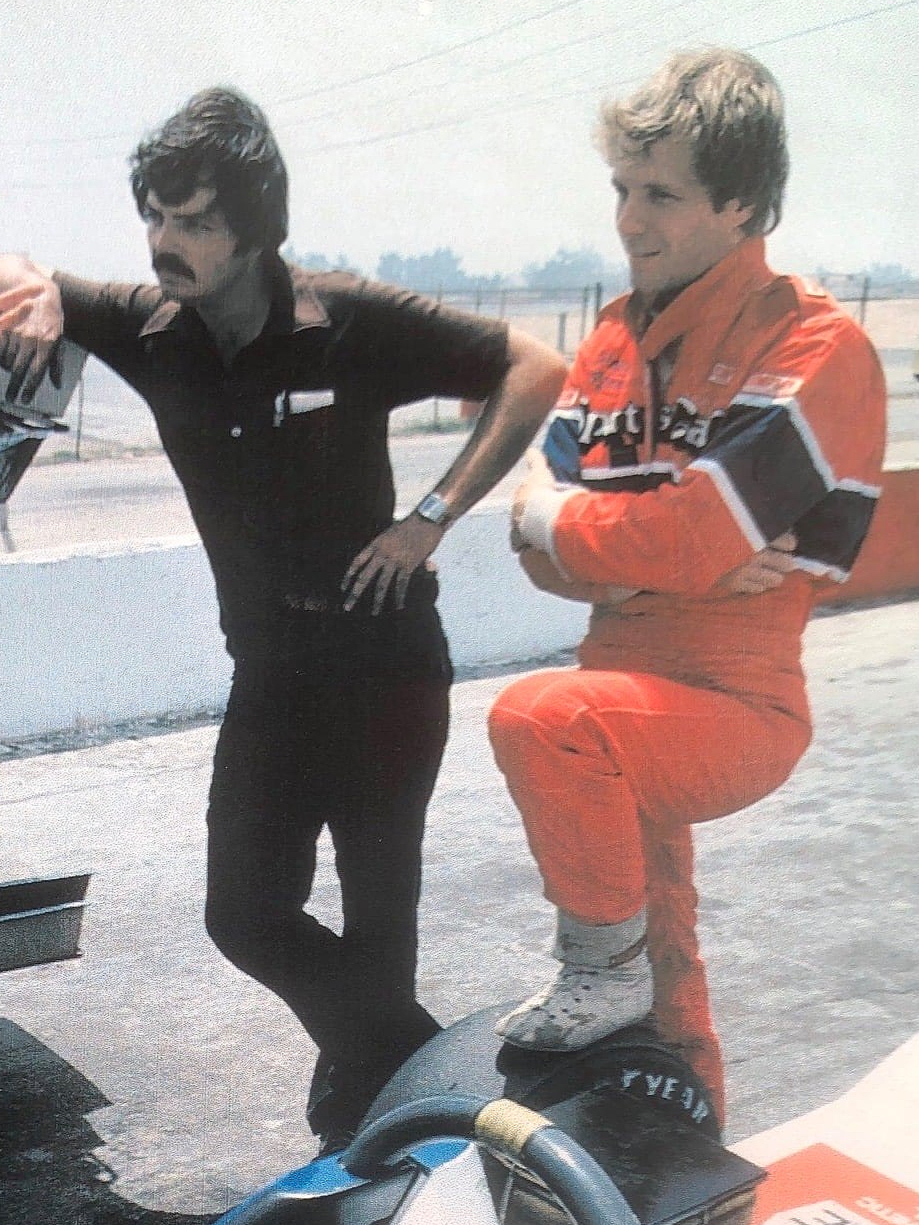
Growing fast
Racing guru Mike Hull (left) and the author, Riverside International Raceway, July, 1979.
Jeff Zwart photo
After that season I redirected my competitive instincts into something else that demanded the same commitment to learning. I left the publishing company where I worked and started what is now Pfanner Communications, Inc., and our Pfanner advantage consulting practice.
A mentor gives you the words. Life teaches you what they meant.
Mike went on to become Managing Director of Chip Ganassi Racing. Watch how he operates and you’ll see it immediately: he lives in now. No nostalgia. No ego. Just disciplined reflection and faster learning.
That behavior is advantage.
Not speed, not innovation: but Performance powered by disciplined learning.
That philosophy echoes the thinking of the late Mark Donohue, the brilliant driver-engineer who helped define the Penske era and co-authored The Unfair Advantage. Donohue understood something that still holds true today: speed matters, but intelligence determines the outcome
This is the real “unfair advantage” that has defined organizations like Team Penske and Chip Ganassi Racing for decades. In racing’s most competitive environments — Indianapolis, Daytona, Le Mans — success rarely comes from raw speed alone.
Advantage comes from teams that learn faster than everyone else while maintaining trust inside the system.
Everything matters.
The Illusion of Competence
Now layer AI on top of that.
We’re living through a global Dunning-Kruger spike. AI makes it easy to sound informed. Strategy breakdowns appear instantly. Arguments read clean and confident. Presentation has never been easier.
Some researchers warn about a performance-learning gap — where AI improves immediate output while quietly weakening the deeper learning that builds real expertise.
But clean isn’t the same as correct.
Anyone who has sat through a real race debrief knows how messy understanding actually is. Data contradicts drivers. Drivers contradict data. Context shifts everything. Judgment forms under pressure.
AI can generate output, but it cannot absorb consequence.
Right now, certainty is abundant. Depth is not.
The deeper question isn’t whether AI weakens thinking. It’s whether we allow it to replace the hard work of learning.
Backlash Is a Signal
There’s another signal forming outside the paddock.
In a recent WIRED piece on the growing backlash to AI, the turning point for many readers wasn’t technical capability — it was trust. When Duolingo announced it was becoming “AI-first” and replacing contractors with automation, public perception shifted almost overnight.
That reaction wasn’t about code quality. It was about displacement and credibility.
We’re already seeing early signs of this tension inside the AI industry itself.
In February, the Trump administration ordered federal agencies to stop using Anthropic’s AI systems after the company refused to remove contractual “red lines” prohibiting its models from being used for autonomous lethal weapons or mass domestic surveillance. The Pentagon labeled Anthropic a “national security supply-chain risk,” a designation normally reserved for foreign adversaries. Within hours, competitor OpenAI secured a Pentagon agreement to deploy its own models.
Strip away the politics and the moment reveals something deeper: a struggle over who sets the guardrails when AI becomes infrastructure — the companies building the systems or the institutions deploying them.
In racing terms, everyone wants the fastest car.
But the deeper question is this: who — or what — is actually driving?
When technology accelerates faster than trust, people start looking for a different vehicle to move forward.
People don’t resist intelligence. They resist feeling reduced to inputs inside someone else’s optimization model.
In motorsport the consequences are immediate. If a driver loses trust in the data, they override it. If a team loses trust in leadership, performance fractures. If fans lose trust in governance, they disengage.
Acceleration without trust creates instability. Acceleration with trust compounds.
That distinction matters.
The Apple Move
And then there’s Apple — and specifically Eddy Cue.
He may turn out to be the most important driver in Formula One this season, even though he’ll never sit in a cockpit.
Most people don’t know his name, but they live inside the systems he built. Cue architected Apple’s services ecosystem — iTunes, the App Store, Apple Music, Apple TV+. He understands something that many sports leagues and media companies are still learning distribution is no longer just about reach.
It’s about daily relationship.
As Eddy Cue explained to CNBC when describing Apple’s strategy:
“We say no to almost everything. When you get as large as we are, it’s easy to think you can do anything or everything — and it’s just not true.”
Focus over frenzy and clarity over distraction.
That mindset wins in a world where acceleration is everywhere and differentiation is rare.
The global success of the new F1 film wasn’t just entertainment. It was positioning — a runway for Apple TV’s Formula One rights deal beginning this weekend in Adelaide.
Liberty Media CEO Derek Chang captured the real shift in a recent Sports Business Journal interview:
“We don’t focus on reach in an archaic definition of how many people are watching you on TV, but really — how do you touch your fans? How do you engage with your fans?”
Apple understands something many media companies forgot: fans don’t just consume a sport — they belong to it.
That insight goes directly to the heart of the booming modern sports economy.
For decades I’ve believed the audience owns the sport — provided the sport remains worthy of belief and devotion.
When fans invest belief, the sport becomes identity. And once a sport becomes part of someone’s identity, loyalty stops being transactional and becomes personal.
Everything matters.
Apple isn’t simply buying rights. It’s positioning itself inside the belief system of the sport.
That’s the long game, and I like it.
The Real Race
We are witnessing a race to define “now” and “next” between those formed in the 20th century and those shaped in the 21st at the dawn of the third millennium.
My bet is on the 21st-century competitors. Not because they’re younger, but because they process now differently.
This isn’t about age. It’s about clarity and judgment inside a fully understood present. If you’re anchored in nostalgia, you reveal that you believe you have more to lose than you have to gain.
That’s defensive. And defensive competitors rarely define the future.
As my longtime friend and champion team owner Chip Ganassi likes to say: “I like winners”.
So do I. You can spot them easily: They are turbocharged now-processors. They integrate new tools without surrendering judgment. They stay grounded when narratives drift. And they learn faster than the competition.
Time is our common opponent. Speed is the weapon we use to maximize the moment before we shift from an is to a was. Intellectual and emotional intelligence determine the outcome in the race to our destiny.
Where Advantage Lives
AI accelerates learning. But if everyone accelerates, advantage migrates. The enduring edge isn’t access to intelligence. It’s disciplined learning — and earned trust.
As OpenAI’s Sam Altman said recently in a Forbes interview:
“I am consistently amazed by how much each generation builds a new layer of scaffolding.”
Scaffolding helps you build. It doesn’t decide what you build — or whether anyone believes in it.
So, here’s the real question: In an age of acceleration, are you simply moving faster?
Advantage comes from learning faster than the moment changes — and behaving well enough to be trusted when it matters.
The Shift Happens series reflects the philosophy behind Pfanner Advantage, the consulting practice of Pfanner Communications, Inc., where leaders work to sharpen judgment, accelerate learning, and create durable advantage when the stakes are real.
More at Pfancom.com